

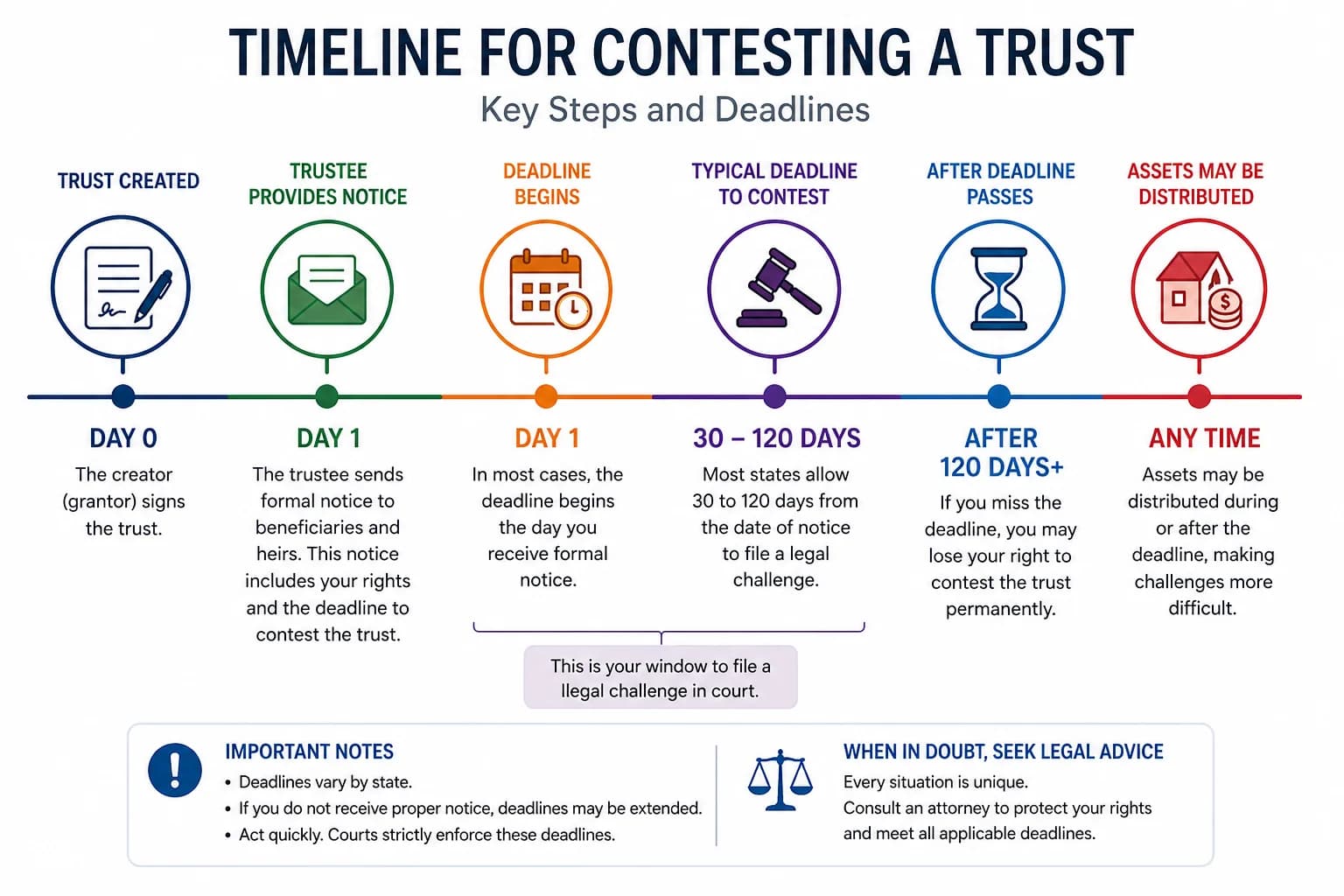
Deadlines to contest a trust are typically short and strictly enforced, often ranging from 30 to 120 days after a trustee provides formal notice. In some cases, the deadline may extend if no notice is given, but courts rarely allow late filings. Missing this deadline usually means losing the right to challenge the trust permanently, regardless of the strength of the claim.
Trust contest deadlines are governed by state law and vary depending on how and when notice is provided. Courts enforce these deadlines strictly to ensure estates are settled efficiently and to prevent prolonged legal disputes.
In most situations, the deadline begins when the trustee sends formal notice to beneficiaries and heirs.
This notice typically includes:
Once you receive this notice, the clock usually starts immediately.
Typical Deadline Range
Deadlines vary by state, but most fall within a predictable range:
These deadlines are often shorter than people expect, which is why early action is critical.
Many states follow a version of the 120-day rule.
Under this structure:
Courts enforce this deadline strictly, and extensions are rare.
If the trustee does not provide proper notice, the timeline may change.
In some cases:
However, this does not mean you can wait indefinitely. Delays can still weaken your ability to bring a claim.
Deadlines are one of the most common reasons trust challenges fail.
If you miss the filing window:
Even strong claims can be lost if action is not taken in time.
To understand what happens after a challenge is filed and how the process unfolds, refer to: Contesting a Trust
It is sometimes possible to contest a trust after assets have been distributed, but it becomes significantly more difficult.
Challenges may include:
This is why acting within the original deadline window is strongly recommended.
Many people lose their rights due to avoidable mistakes.
Delays are the most common issue.
Some individuals receive notice but do not realize it contains a deadline.
Deadlines are often shorter than expected.
Waiting too long to evaluate your position can reduce your options.
Before contesting a trust, it is important to confirm that you are reviewing the most recent version. In some cases, a newer trust or will may exist that overrides the document being used. Contesting an outdated document can lead to unnecessary legal action and delays.
The U.S. Will Registry was created to help families locate where a loved one’s will or trust is stored, whether it is held by an attorney, a private party, in the home, in the cloud, or at a financial institution. Searching the national database can help confirm whether a more current document exists before taking legal action.
Deadlines to contest a trust are one of the most critical parts of any trust dispute. Most cases are not lost because of weak claims, but because the deadline was missed.
The safest approach is to act quickly, confirm when notice was sent, and understand your state’s specific timeframe.
If you believe a trust may be invalid, timing is everything. Taking action early gives you the best chance to protect your rights and ensure the trust reflects the true intentions of the person who created it.
This article was prepared by estate planning researchers and reviewed by S. Miller and staff. With more than 25 years of experience in estate planning documentation and probate processes, our editorial oversight ensures clarity and accuracy. This content is provided for informational purposes only and does not constitute legal advice.
[View Our Editorial Policy]