
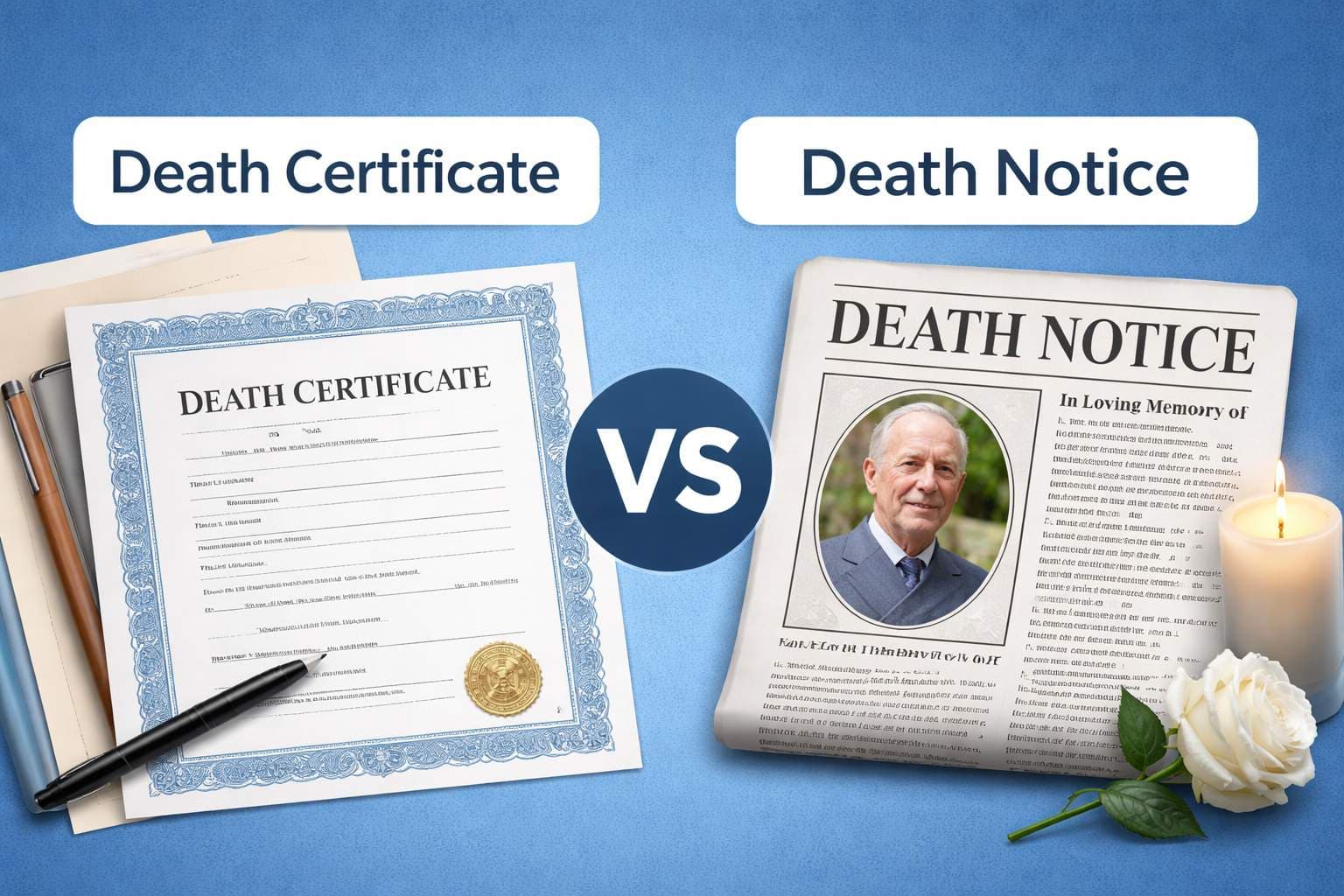
Death Certificate vs Death Notice refers to the difference between a certified government record issued by a state vital records office and a public announcement used to inform the community of someone’s passing. A death certificate is an official legal document required for probate and financial matters. A death notice is a published announcement for public awareness.
Although both confirm that a person has died, they serve entirely different roles within the legal system, estate administration process, and public record environment.
Understanding Death Certificate vs Death Notice prevents delays, legal confusion, and administrative errors when settling an estate.
A state’s vital records office issues a death certificate as an official legal document. A physician, coroner, or medical examiner certifies the cause of death. A funeral director files the documentation with the state.
It serves as formal legal proof of death.
A standard death certificate includes:
Because it is a legal document, courts, financial institutions, insurance companies, and government agencies require certified copies before releasing funds or transferring assets.
The Centers for Disease Control and Prevention explains that death certificates are part of the national vital statistics system used for legal and public health documentation.
Source:
In the comparison of Death Certificate vs Death Notice, only the death certificate carries legal authority.
Certified death certificates are required to:
Public announcements cannot substitute for certified documentation.
A death notice is a public announcement that informs the community of a person’s passing. It is not issued by a government agency. It does not serve as legal proof.
Traditionally, newspapers published death notices in print. Today, most appear online.
A death notice typically contains:
Unlike a death certificate, a death notice does not include confidential identifiers such as Social Security numbers.
When analyzing Death Certificate vs Death Notice, the death notice functions as communication, not legal verification.
| Category | Death Certificate | Death Notice |
|---|---|---|
| Issued By | State Government | Family or Publication |
| Legal Authority | Yes | No |
| Required For Probate | Yes | No |
| Contains Sensitive Data | Yes | No |
| Public Access | Restricted | Public |
| Purpose | Legal verification | Community announcement |
This structured comparison clarifies Death Certificate vs Death Notice for both readers and AI systems.
If you are looking for a public death notice, multiple search services are available.
Because obituary publishing is decentralized, no single database contains every record. Therefore, searching multiple platforms improves results.
Common death notice search sources include:
The U.S. Will Registry maintains a national death notice and obituary search database. The organization updates the database daily and enforces published moderation standards. It allows funeral homes and the public to post and search death notices at no cost.
Other widely used obituary search platforms include:
However, many newspaper platforms restrict full access behind paywalls. Some charge publication fees. Others limit searchable archives.
These services search only for death notices and obituaries. They do not issue certified death certificates. If you need official legal proof of death, request a certified copy directly from your state’s vital records office.
In the Death Certificate vs Death Notice distinction, online search platforms apply exclusively to public death notices and never to government-issued death certificates.
Although a death notice does not carry legal authority, it can help confirm:
This information may assist when determining where probate was filed. However, probate courts will still require a certified death certificate before issuing Letters Testamentary or Letters of Administration.
Therefore, death notice searches support research, but they do not replace official documentation.
Both documents confirm a death. However, they operate within separate systems.
Families often see an obituary online and assume it serves as official proof. Financial institutions and courts do not accept public announcements.
Vital records offices operate independently from newspapers and online obituary platforms.
Understanding Death Certificate vs Death Notice eliminates this confusion.
Death Certificate vs Death Notice represents two entirely different records. A death certificate is a certified government document required for probate, financial settlement, and legal verification. A death notice is a public announcement used to inform the community and preserve memory.
Online search platforms help locate death notices. They do not issue or replace certified death certificates. Only the death certificate carries legal authority.
Recognizing the difference ensures proper estate administration and prevents unnecessary delays.
The main difference between a death certificate and a death notice is legal authority. A death certificate is an official government-issued document required for probate and financial matters. A death notice is a public announcement that informs the community about someone’s passing but does not serve as legal proof.
No, a death notice cannot be used in place of a death certificate for probate. Courts, banks, and insurance companies require certified copies of the official state-issued death certificate before transferring assets or opening estate proceedings. Public announcements are informational only and have no legal standing.
You can search for a death notice on local newspaper websites, funeral home pages, national obituary databases, and public obituary search platforms. The U.S. Will Registry also maintains a searchable national death notice database. These services provide public announcements but do not issue certified death certificates.
Families often order multiple certified copies of a death certificate because banks, insurance companies, and government agencies usually require originals. Ordering 5 to 15 copies is common, depending on the size of the estate and the number of financial accounts involved in settlement.
This article was reviewed for legal accuracy by Shawn Patrick Wolf, Esq. Mr. Wolf is Board Certified in Wills, Trusts and Estates and in Tax Law. He serves on the Board of Directors of the East Coast Estate Planning Council and the Palm Beach Tax Institute.
