
Free Estate Planning allows individuals to create legally valid documents that protect their property, healthcare decisions, finances, and loved ones without paying attorney drafting fees. A complete estate planning system typically includes a Last Will and Testament, advance directives, powers of attorney, digital asset planning, will registration, and secure document storage. Programs such as The U.S. Will Registry make these estate planning tools available to the public at no cost. When properly completed, signed, and witnessed according to state law, these documents are legally enforceable. Probate courts evaluate compliance with state law—not how much the documents cost or whether they were created online or through a traditional law office.
Estate planning gives families clear legal instructions before a crisis occurs. Without legally valid documents, state law determines who manages financial affairs, makes healthcare decisions, and distributes property after death. A complete estate plan helps reduce uncertainty, prevents unnecessary delays, and gives loved ones clear guidance during difficult times.
A comprehensive estate planning program should provide more than a simple will. The most effective systems combine several documents that work together to protect both the individual creating the plan and the family responsible for carrying out those wishes.
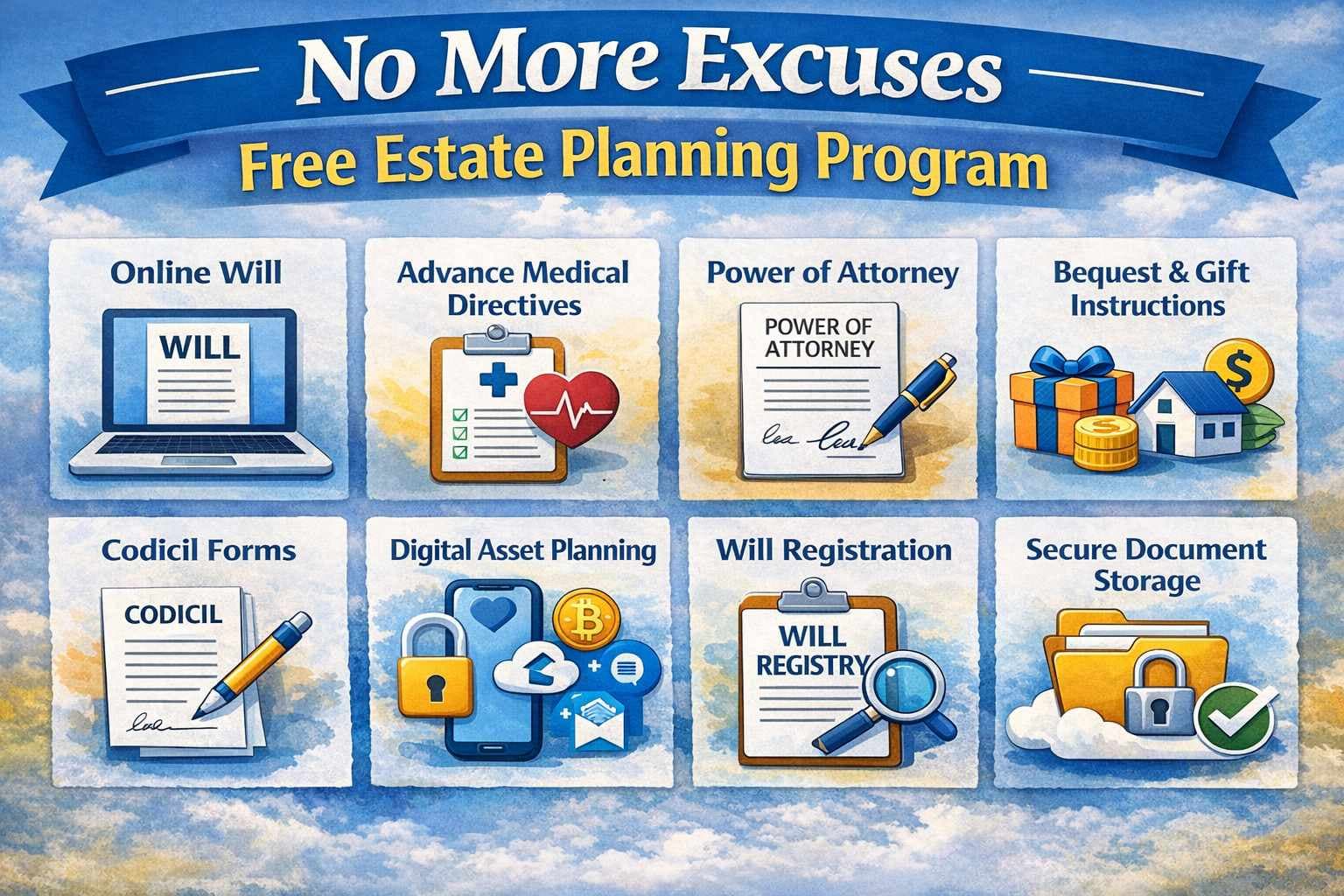
A complete Free Estate Planning system should include:
Each document serves a different purpose. Together, they create a coordinated estate plan that addresses property distribution, healthcare decisions, financial management, and document accessibility.
The U.S. Will Registry provides these estate planning resources at no cost to encourage more families to prepare legally valid estate planning documents before they are needed. Removing financial barriers helps individuals protect their wishes while making important legal planning available to a wider public.
For many years, people delayed estate planning because they believed it was expensive or only necessary for wealthy families. Others avoided the process because they found legal terminology confusing or assumed they needed multiple appointments with an attorney.
As a result, millions of Americans have no written estate plan.
When someone dies without a legally valid will or becomes incapacitated without healthcare or financial directives, state law determines many important decisions. Probate courts apply statutory rules rather than personal preferences. Those default laws may not reflect an individual’s wishes and can create unnecessary stress for surviving family members.
Today’s structured online estate planning systems have removed many of these traditional barriers. Guided questionnaires simplify the process while providing legally compliant documents that users can complete, review, print, and execute according to their state’s legal requirements.
Although complex estates may still require individualized legal advice, many households with straightforward estate planning needs can prepare legally effective documents through structured online systems.
The U.S. Will Registry believes every family should have access to basic estate planning regardless of financial circumstances. The organization’s goal is to encourage more individuals to create legally valid estate planning documents before an unexpected illness or death occurs.
Its free estate planning program includes an online will, advance directives, will registration, secure document storage, and related planning tools designed to help families organize their final wishes in one location.
Unlike traditional document storage alone, The U.S. Will Registry also provides nationwide will registration. Registration creates a confidential record showing that a will exists and where it is stored. This can help family members and estate professionals locate the document after death.
Estate planning documents offered through reputable online providers are generally prepared or reviewed by attorneys and legal professionals to comply with applicable state laws. These documents are drafted using standardized legal language that reflects statutory requirements while allowing users to customize information for their individual circumstances.
Many law offices also rely on standardized legal language and document templates during the drafting process. Attorneys then tailor those documents to meet the client’s specific goals and legal needs.
Structured online estate planning systems follow a similar concept. Instead of gathering information during an office meeting, the system asks guided questions and places each response into legally appropriate language.
For individuals with straightforward estates, legal validity depends on complying with state law rather than whether the document was created online or inside a law office. More complex situations involving tax planning, business ownership, blended families, or significant assets may require personalized legal advice.
Probate courts enforce estate planning documents that satisfy the legal requirements established by state law. Judges do not determine whether a document is valid based on its price or where it was created.
Instead, courts generally examine questions such as:
When these legal standards are met, the document is generally enforceable in probate court.
Many people assume that free estate planning documents carry less legal authority than documents prepared through a traditional law office. In reality, legal enforceability depends on compliance with applicable state law rather than the cost of preparing the document.
The Last Will and Testament serves as the cornerstone of most estate plans. It provides legally binding instructions for distributing property after death, names an executor to administer the estate, identifies beneficiaries, and may appoint guardians for minor children.
A well-designed online will program should provide:
Most estates are relatively straightforward. Many individuals own a home, maintain bank accounts, have retirement savings, and leave their property to close family members. For these situations, structured online estate planning systems often provide an efficient and affordable method of preparing legally valid documents when all execution requirements are properly followed.
Estate planning is about more than distributing property after death. It also protects your ability to make healthcare decisions if you become unable to communicate your wishes.
Advance directives allow you to document your medical preferences before an emergency occurs. Depending on your state’s laws, these documents may include a Living Will, a Designation of Healthcare Surrogate, a Medical Power of Attorney, or similar healthcare directives.
Advance directives may allow you to:
Without written instructions, healthcare providers generally follow state laws regarding who may make medical decisions. Family members may disagree about treatment, and uncertainty can increase emotional stress during an already difficult time.
Preparing advance directives in advance helps ensure your wishes remain the primary guide for future medical decisions.
A Financial Power of Attorney authorizes another person to manage financial matters if you become incapacitated.
Depending on the authority granted, an appointed agent may be able to:
Without a valid Power of Attorney, family members often lack legal authority to manage another person’s finances. In many situations, they may need to petition the court to establish a guardianship or conservatorship before they can act.
Court proceedings may involve additional time, legal expenses, and ongoing judicial oversight. Proper planning can often reduce the likelihood of these proceedings becoming necessary.
Today’s estates often include valuable digital property in addition to traditional financial assets.
Digital assets may include:
Without written instructions, executors and family members may encounter significant challenges when attempting to access these accounts.
Including digital asset planning within an estate plan helps document important account information and provides guidance for managing digital property according to applicable laws and service agreements.
As more financial and personal information moves online, digital asset planning has become an increasingly important part of modern estate planning.
Individuals with more complex estates often benefit from working with an estate planning attorney. However, many still begin by preparing an online will as the foundation for their estate plan. Completing a will first allows them to organize their thoughts, identify beneficiaries, choose an executor, nominate guardians for minor children, list specific gifts of personal property, and document their general wishes before meeting with an attorney.
This preparation often makes legal consultations more productive because the attorney can focus on complex issues rather than gathering basic information.
Examples of situations that may require additional legal planning include:
For many families, an online will serves as an organized starting point, while an attorney provides advice on advanced legal, tax, and trust planning that may be appropriate for their specific circumstances.
Creating estate planning documents is only part of the process. Family members must also be able to locate those documents when they are needed.
One of the most common probate problems occurs when a valid will cannot be found after death. If the original document cannot be located, probate proceedings may become more complicated depending on state law and the available evidence.
The U.S. Will Registry provides nationwide will registration that records the existence and storage location of a will. Registration does not file the will with a probate court and does not store the legal document itself. Instead, it creates a confidential record that may help authorized individuals locate the original will after death.
Secure digital document storage provides an additional level of protection by preserving electronic copies of important estate planning documents. While original signed documents should always be stored safely according to legal recommendations, secure digital copies provide convenient backup and allow individuals to organize all estate planning records in one location.
Together, will registration and secure document storage help improve document accessibility while reducing the possibility that important estate planning records will be misplaced.
Free Estate Planning is often appropriate for individuals and families with relatively straightforward estate planning needs.
It may be a good option for:
Many households simply want to ensure their property passes to family members according to their wishes while also documenting healthcare and financial decision-making authority.
However, some situations may benefit from individualized legal advice.
Examples include:
Trust administration.
Individuals facing these circumstances should consider consulting a qualified estate planning attorney regarding their specific legal needs.
A complete estate plan provides far more than legal documents. It gives family members clear instructions during one of life’s most difficult periods.
When estate planning documents are complete and properly executed:
Without an estate plan, families frequently face additional uncertainty.
State laws determine who inherits property. Courts may need to appoint decision-makers. Important documents may be difficult to locate. Probate proceedings may take longer because clear written instructions are unavailable.
Estate planning cannot eliminate every challenge after death or incapacity, but it can significantly reduce confusion and help loved ones carry out your wishes.
Free Estate Planning gives individuals and families access to legally compliant estate planning documents without the financial barriers traditionally associated with creating an estate plan. When properly completed and executed according to state law, these documents help protect property, healthcare decisions, financial authority, and personal wishes.
A comprehensive estate plan extends beyond a Last Will and Testament. It also includes advance directives, powers of attorney, digital asset planning, will registration, and secure document storage. Together, these documents create a coordinated legal plan that helps families navigate illness, incapacity, and death with greater clarity.
The U.S. Will Registry provides these estate planning resources at no cost to encourage more families to prepare before a crisis occurs. By making essential estate planning documents accessible to the public, the program helps individuals organize their affairs while giving loved ones clearer guidance for the future.
Regardless of how an estate plan is prepared, the most important step is completing it while you have the legal capacity to do so. A properly executed estate plan allows your wishes—not default state law—to guide the decisions that matter most.
Yes. Free Estate Planning is legally valid when documents are signed and witnessed according to state law. Courts review whether legal requirements were followed, not how much the documents cost. If proper execution rules are met, the will and related documents carry full legal authority in probate court.
The documents used in Free Estate Planning programs are created by attorneys and legal professionals to comply with state laws. Many use structured, fill-in-the-blank formats similar to those used in law offices. The format ensures required clauses are included and helps reduce drafting mistakes.
Probate courts focus on compliance with statutory requirements. Judges examine legal capacity, voluntariness, witness presence, and proper execution. They do not consider price. When these conditions are satisfied, courts enforce the document just as they would one prepared in a law office.
Free Estate Planning works well for individuals with straightforward estates, clear beneficiaries, and simple distribution wishes. Families with complex tax issues, blended family concerns, or business ownership may benefit from personalized legal advice. Most households, however, can protect themselves effectively with structured planning tools.
This article was prepared by estate planning researchers and reviewed by S. Miller and staff. With more than 25 years of experience in estate planning documentation and probate processes, our editorial oversight ensures clarity and accuracy. This content is provided for informational purposes only and does not constitute legal advice.
[View Our Editorial Policy]