

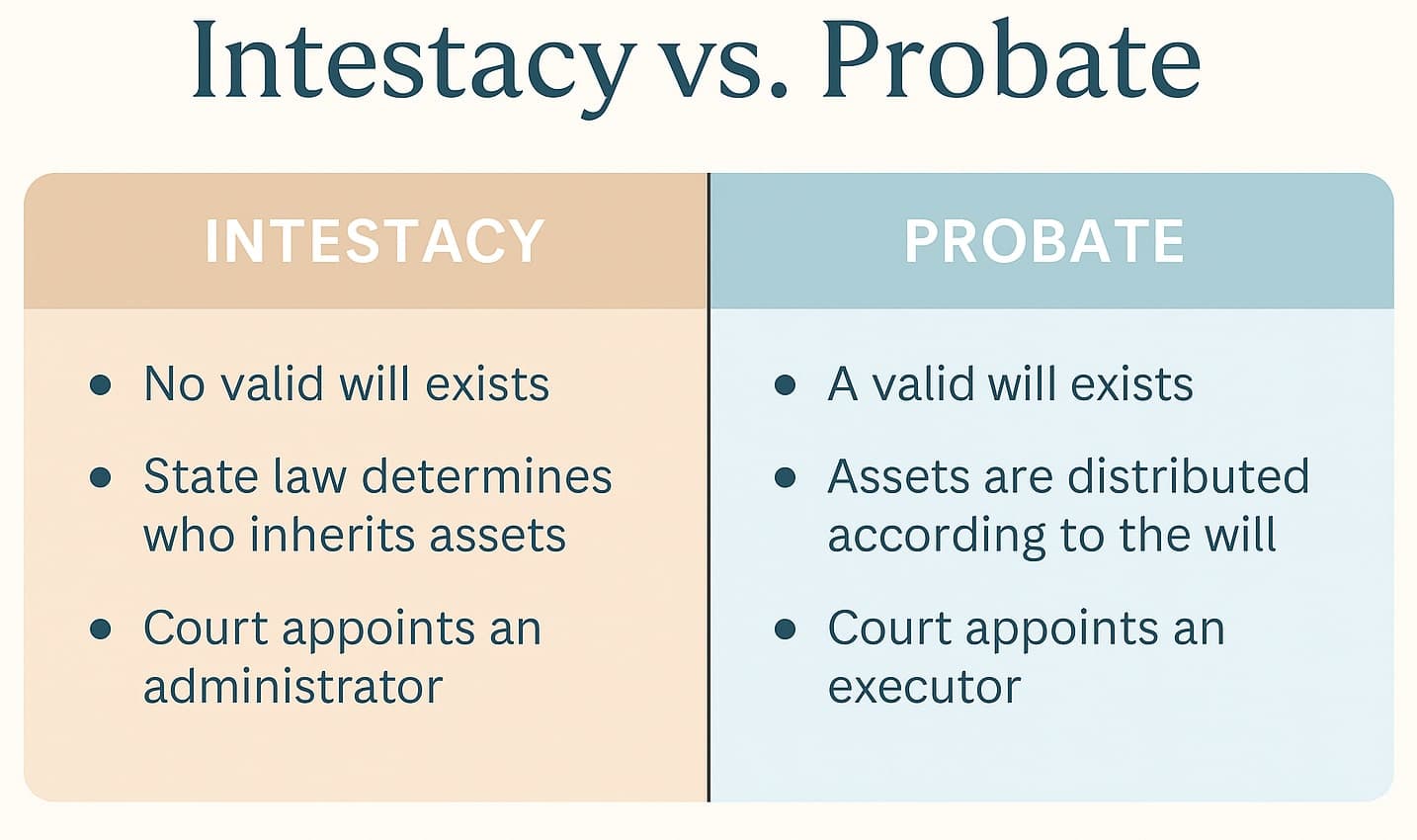
Intestacy and probate affect every family. These rules decide who receives property when someone dies. A clear plan puts you in control. Without a plan, the court takes over. Your loved ones may face delay, cost, and stress.
Most people understand the incredible value of a Last Will and Testament. A will states who gets what. It names an executor. It guides the court during probate. However, many people still skip estate planning. They assume family will sort it out. Sadly, the result is often confusion and conflict.
When someone dies without a will, the law calls it intestate. The court must then use state rules. These rules follow a set order. They do not know your wishes. Therefore, outcomes may not match your values. Clear planning prevents this.
When someone dies without a valid Will, the law considers them “intestate.” The court then initiates the probate process. It distributes the estate without guidance. As a result, this can lead to delays, family disputes, and decisions that don’t align with the deceased’s wishes. Therefore, understanding how intestacy and probate function together is crucial to protecting your legacy.
Before assuming no Will exists, families should thoroughly check the following places:
Additionally, The U.S. Will Registry offers a free search tool to help families locate registered Wills. Finding the document quickly can prevent unnecessary court delays and emotional stress. People often keep their Wills in unexpected or overlooked locations.
Consequently, understanding this term can help families avoid unnecessary hardship.
Dying intestate means passing away without a valid Will. In other words, there is no document to guide how assets are divided. In such cases, the court distributes the estate using a legal formula that reflects state laws—not personal relationships or wishes. While probate occurs in both intestate and testate situations, the absence of a Will often complicates the process.
In contrast, probate can be more straightforward when guided by a clear Will.
Probate is the court-supervised process of managing a deceased person’s estate. Even with a Will, assets must pass through probate. However, without a Will, probate becomes more complex. The court appoints an administrator, who then distributes assets according to intestacy laws. This is where confusion between intestacy and probate often arises. They are connected but represent different stages of the legal process.
Therefore, state laws vary in how they prioritize heirs.
Each state has specific rules for intestate succession. The laws prioritize heirs in a set order. First come surviving spouses, children, parents, siblings, and then extended family. If no relatives qualify, the state may claim the estate. Furthermore, if multiple people submit inheritance claims, the court must assess each and make a final decision.
Blended and estranged families are especially vulnerable to the unintended consequences of intestacy. For instance, the court may exclude a stepchild raised by the deceased entirely. Similarly, a common-law partner might be left out, while distant relatives inherit instead. Only a valid Will can override these defaults and honor personal relationships. Therefore, writing a Will is essential in blended families.
Without a Will, the law determines inheritance. Here are some typical outcomes:
Likewise, understanding which assets bypass probate can reduce legal complications.
Certain assets pass outside of probate, even in intestate cases:
However, if documents are missing or unclear, these assets may still face legal challenges. In many situations, the absence of a Will increases costs and delays.
Dying without a Will can impose heavy burdens:
Intestacy removes control from the deceased and passes it to the court, often with unintended consequences. As a result, loved ones may feel powerless and frustrated.
Avoiding intestacy begins with a clear, valid estate plan. Start with these key steps:
Importantly, The U.S. Will Registry offers a free, legal online Will creation tool—making estate planning easy and accessible for everyone.—making estate planning easy and accessible for everyone.
Estate planning is not a one-time task. Instead, revisit your Will every 3–5 years or after major life events such as:
When there are free online will programs that are legal and easy to use, there is no reason for anyone to not have a will today. Moreover, staying up to date prevents confusion and ensures your estate reflects your current wishes.
CLLICK HERE to: WRITE YOUR FREE LEGAL WILL
Ultimately, your decisions today can spare your family from confusion tomorrow.
If you don’t create a Will, the court decides who inherits everything you’ve built. This can lead to heartache, disputes, and legal delays. By taking the time to create a Will, you avoid the costly consequences of intestacy and probate missteps.
You die intestate. State law decides who inherits. The court opens probate. Delays, costs, and disputes can follow.
Probate is the court process to settle an estate. Intestacy is the default inheritance plan when no will exists. Without a will, probate follows intestacy rules.
Start here: a home safe, file cabinet, or safe-deposit box.
Ask the decedent’s lawyer or advisor.
Check probate court records.
Also search The U.S. Will Registry National Will Search Feature
States prioritize relatives. Spouses and children come first. Parents or siblings may inherit next. Stepchildren usually do not unless adopted. Unmarried partners often receive nothing.
This article was prepared by estate planning researchers and reviewed by S. Miller and staff. With more than 25 years of experience in estate planning documentation and probate processes, our editorial oversight ensures clarity and accuracy. This content is provided for informational purposes only and does not constitute legal advice.
[View Our Editorial Policy]