

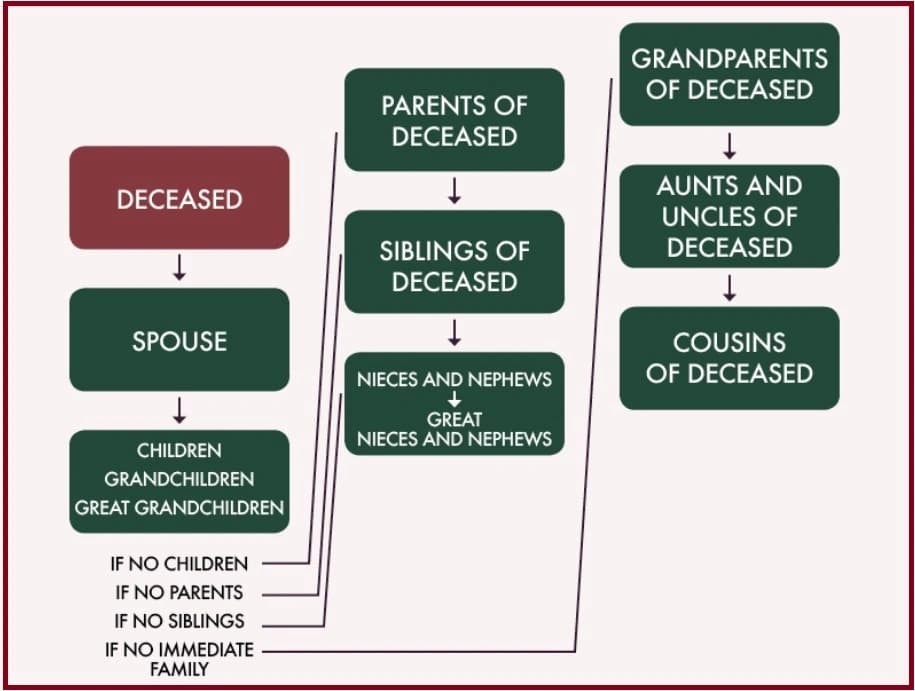
Intestate succession is the legal process that determines who inherits property when someone dies without a valid will. State intestacy laws establish a hierarchy of heirs, usually beginning with a surviving spouse and children, followed by parents, siblings, and more distant relatives. Because each state has different rules, inheritance rights and asset distribution vary by jurisdiction.
Before assuming intestate succession applies, take every possible step to locate a will. Families sometimes believe a will exists but struggle to find it. To ensure no will is overlooked, follow these steps:
First, search common storage locations, such as safes, filing cabinets, desk drawers, and safety deposit boxes.
Next, contact the deceased’s attorney, as estate lawyers often retain copies of executed wills.
Additionally, check with the State Bar Association if the attorney has retired or the law firm has closed.
Finally, review financial records, emails, business cards, or other documents for references to an estate attorney.
The U.S. Will Registry provides a national database where wills are registered by their creators or attorneys. Consequently, this free tool allows individuals to search for a missing will using the deceased’s name, date of birth, and state of residence.
Understanding the difference between probate and intestate succession is crucial. Probate is the court-supervised process of validating a will and distributing assets. However, intestate succession applies when no will exists, and state laws determine how assets are divided.
Not all assets go through intestate succession. Some pass directly to beneficiaries, including:
Life insurance proceeds with designated beneficiaries.
Joint tenancy properties, which transfer to the surviving owner.
Assets held in living trusts.
To determine ownership, individuals should review financial accounts and property deeds to identify designated beneficiaries.
When intestate succession applies, the estate enters probate. The probate process includes:
The laws of intestate succession determine who inherits in the absence of a will. While specifics vary by state, the general order of heirs includes:
The rights of a surviving spouse depend on the state’s intestate succession laws:
In community property states, the surviving spouse may inherit all marital property acquired during the marriage.
In common law states, the spouse often receives a significant portion of the estate, sometimes the first percentage (e.g., $50,000) plus half of the remaining assets.
If the deceased has children from another relationship, the spouse may receive a reduced share, with the remainder divided among the children.
Moreover, some states allow the spouse to claim a family allowance or a spousal elective share, which provides financial support regardless of intestate laws.
Related Article: Elective Share | Spousal Inheritance Rights
Children’s inheritance rights vary based on state law:
If there is no surviving spouse, the entire estate typically goes to the children, divided equally.
If a spouse exists, the children may share the estate with them, often receiving half or a designated percentage.
Adopted children inherit the same as biological children.
Stepchildren usually do not inherit unless legally adopted, but some states make exceptions.
Children born outside of marriage may need to prove paternity to claim inheritance.
If no spouse or children exist, the estate passes to:
Parents – If still living, they typically inherit the estate.
Siblings and Their Descendants – If no parents are alive, siblings inherit, and if deceased, their children (nieces and nephews) may inherit.
More Distant Relatives – Grandparents, aunts, uncles, and cousins may inherit if no closer family exists.
The State – Consequently, if no legal heirs are found, the estate escheats to the state.
CLICK HERE FOR INTESTATE LAWS FOR EVERY STATE
Intestate succession governs estate distribution when no will exists. This guide has covered:
By understanding intestate succession, individuals can navigate estate settlement efficiently and ensure a lawful distribution of assets.
The U.S. Will Registry offers a FREE online will program, allowing individuals to create a legal will from home. Since drafting a will ensures your wishes are legally documented, it prevents intestate succession from determining asset distribution.
Creating a will online is the easiest way to get started.
It takes minutes and helps protect your family.
The meaning of intestacy is the legal situation that occurs when someone dies without a valid will. In this case, state laws determine who inherits the person’s property and assets. These laws establish an order of heirs, usually starting with a surviving spouse and children, followed by other close family members.
An intestacy statute is a state law that explains how an estate is distributed when a person dies without a valid will. Every state has its own intestacy statutes, which identify eligible heirs and determine how much each person inherits. These laws also address special situations involving spouses, children, and extended family members.
To define intestate succession, think of it as the legal process that determines who inherits property when someone dies without a will. State law establishes a hierarchy of heirs and specifies how assets are divided. The probate court oversees the estate and ensures the distribution follows the intestate succession laws in that state.
An intestate will is not actually a legal document. The term usually refers to a situation where someone dies without a valid will, also called dying intestate. When this happens, the estate passes according to state intestacy laws rather than the deceased person’s wishes. The probate court supervises the process and appoints an administrator.
This article was reviewed for legal accuracy by Shawn Patrick Wolf, Esq. Mr. Wolf is Board Certified in Wills, Trusts and Estates and in Tax Law. He serves on the Board of Directors of the East Coast Estate Planning Council and the Palm Beach Tax Institute.
