

Finding an obituary for a specific person can be surprisingly difficult, even when you know the person’s full name. Many families expect a quick Google search to uncover the obituary immediately, but unfortunately, obituary records are often scattered across funeral home memorial pages, newspaper archives, genealogy databases, and private memorial platforms. Some older obituaries were never digitized, while others disappeared after funeral home website changes or newspaper archive paywalls.
If you are trying to find an obituary for a specific person, the fastest approach is to search systematically using the person’s full legal name, city, approximate date of death, and the right obituary sources.
Many people assume every death results in a publicly searchable obituary. That is not always the case. Some families choose privacy, some publish only a death notice, and others rely solely on funeral home memorial pages that may not remain searchable forever. If you are unsure why a record seems impossible to locate, our guide [Why You Can’t Find an Obituary: 10 Common Reasons] explains the most common obstacles.
The key is to search methodically rather than relying on a single search engine result.
To find an obituary for a specific person, search using the individual’s:
If the obituary does not appear in standard search results, expand your search to local newspaper archives, funeral home memorial pages, genealogy databases, and historical death record sources.
The biggest mistake people make is relying on only one search method.
Many obituary records exist, but they are often stored in places Google does not surface prominently.
Before you begin, gather as much identifying information as possible.
Even partial details can dramatically improve your search. Helpful information includes:
If you do not know the date of death, [How to Find an Obituary Without Knowing the Date of Death] can help narrow your search.
A common issue happens when families search only for a shortened first name. For example, someone remembered as “Bob Smith” may have been published as “Robert A. Smith.”
Likewise, married names create frequent search failures. Older obituaries for women are often published under married names, while family members may search using maiden names.
If military service was involved, that detail can also help identify the correct person among many similar names.
Searching randomly wastes time. A structured process usually works much faster.
Start with the person’s exact full name.
Example: John Michael Anderson
Not: John Anderson
The more specific the search, the better. Common names can generate thousands of results. If you only know the surname, [Obituaries by Last Name: How to Search Records Online] may help refine your search.
Location often makes the difference.
Search: John Michael Anderson obituary Tampa Florida
instead of: John Anderson obituary
This immediately filters irrelevant matches.
If you are unsure where the death occurred, use the last city where the person lived.
Try:
Examples:
Family names can also help narrow matches.
Example: John Michael Anderson survived by Susan Anderson
This sometimes surfaces hidden obituary references.
FIND AN OBITUARY FOR A SPECIFIC PERSON
The U.S. Will Registry National Search
There are many sources available to the public, but it is crucial to understand that you may have to visit more than one to find the obituary you are searching for.
General Google searches are not always enough.
Many obituary platforms maintain their own searchable databases.
Start with:
These platforms aggregate obituary records from funeral homes and publications. However, no single database contains every obituary. That is important. Many families stop after one failed search.
This is one of the most overlooked strategies. Funeral homes frequently publish obituary memorial pages that never rank strongly in search engines.
If you know where the funeral took place, go directly to that funeral home’s website. Search their obituary or memorial section. This often works faster than broad web searching.
One real-world problem is that funeral homes sometimes change ownership or redesign websites, causing older memorial pages to disappear. When that happens, newspaper archives become more useful.
Understanding [How Obituaries Are Published and Archived] helps explain why some records remain online while others disappear.
Before funeral home memorial websites became common, newspapers were the primary obituary publishers.
Our guide [Death Notice and Obituary] explains the difference between these records.
That means older obituaries are often easier to find in newspaper archives than in modern obituary databases.
Helpful sources include:
Some newspapers keep their own searchable obituary archive behind a paywall.
Others remove older records entirely.
If a local newspaper existed in the person’s city, it is worth checking.
Historical databases often uncover records missed elsewhere.
These sources are especially useful for older deaths, incomplete family information, genealogy research, and hard-to-find memorial records:
FindAGrave can be particularly useful when no formal obituary exists.
Many memorial pages include dates, cemetery details, and family references.
Here are some common reasons finding an obituary can be challenging:
A public obituary is optional. If you have ever wondered whether publication is required, see [Do I Have To Post an Obituary]. Some organizations share memorial information privately through:
In those cases, no searchable obituary exists.
A major issue with historical obituary searches is digitization. Many older newspaper records were never scanned. Others remain behind private archive systems. Some local newspapers simply disappeared.
Even when an obituary exists online, Google may not surface it.
Reasons include:
This is why relying only on Google often fails.
For deeper archive research, see [How to Find an Obituary From Years Ago: Complete Archive Guide].
Searching for:
James Smith obituary can be nearly impossible without location or age. The more identifying detail you add, the faster your results improve.
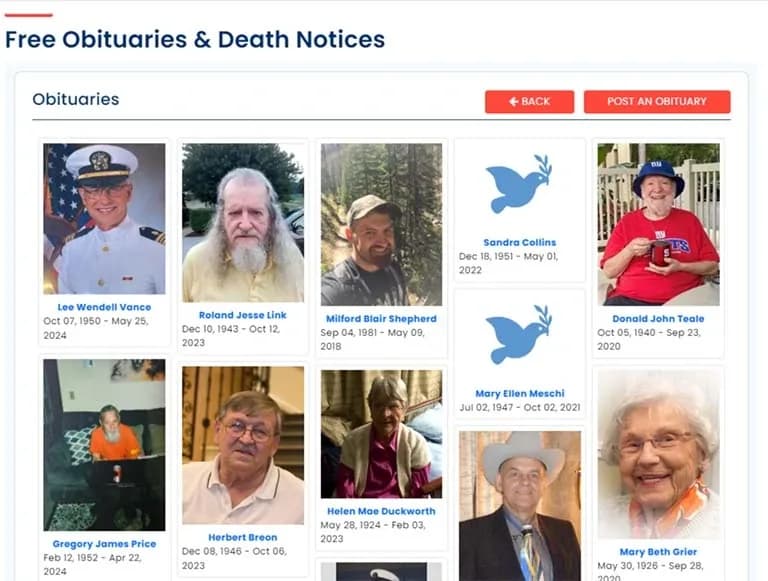
SEARCH FREE OBITUARY LISTINGS
The U.S. Will Registry National Search
Finding older obituaries often requires a different approach than searching for recent death notices. Modern obituary databases are useful, but many older obituary records were never added to those systems. If the person passed away decades ago, your best chance is often through historical archives rather than modern obituary websites.
Start with local newspaper archives in the city where the person lived or died. Before funeral homes regularly published online memorial pages, newspapers were the primary place where obituaries appeared. Many local newspapers now maintain searchable archives, although some require subscriptions.
Helpful sources include:
Genealogy platforms can also be extremely useful for older obituary research. FamilySearch, Ancestry, and FindAGrave often contain records that never appear in ordinary search engine results.
If the death occurred many years ago, try broadening your search by using date ranges rather than exact years. Recordkeeping was not always consistent, and publication dates sometimes varied by several days or even weeks.
Older obituary searches also require flexibility with names. Misspellings were common, middle initials may have been omitted, and married names frequently create confusion. Searching multiple versions of the person’s name can often uncover records that initially appear missing.
If no obituary is found, cemetery records, death certificates, church announcements, and probate filings may still help confirm the death and identify family details.
Many families assume an obituary must exist, but that is simply not true. Some families choose privacy. Others share memorial information privately through family networks, religious communities, or social media rather than publishing a public notice.
If no obituary can be found, try these alternatives:
If you know which funeral home handled arrangements, contact them directly. Even if the memorial page is no longer visible online, they may still confirm service details or archived records.
Even if a public obituary was never published online, a death notice may have appeared in a local newspaper.
Sites like FindAGrave can provide burial information, dates, and family references.
State death indexes, public record databases, and the Social Security Death Index may confirm death information.
This sounds obvious, but it is frequently overlooked. Family members may have private memorial programs, newspaper clippings, funeral cards, or service records that never became public online.
If the individual owned assets, probate filings may provide confirmation of death and family relationships even when no obituary exists.
The absence of an obituary does not mean records do not exist. It simply means you may need to use different search methods.
You can find obituaries online through obituary databases such as The U.S. Will Registry, Legacy.com, or Tributes.com. Funeral home websites and newspaper archives also publish obituary listings. Searching multiple databases increases the chances of locating the correct obituary record.
No, not everyone has a published obituary. Families are not required to create one. Some choose privacy, some publish only a death notice, and others share memorial details privately through funeral homes, churches, or family networks. If you cannot find an obituary, it does not necessarily mean one never existed.
Not all families publish obituaries. Privacy laws, declining newspaper access, and incomplete online indexing can make searches difficult. Some obituaries are only shared privately or not at all.
The most helpful information includes the person’s full legal name, approximate date of death, and the city where they lived. Searching married and maiden names can also help when looking for an obituary. Additional details such as family member names may help narrow search results.
This article was prepared by estate planning researchers and reviewed by S. Miller and staff. With more than 25 years of experience in estate planning documentation and probate processes, our editorial oversight ensures clarity and accuracy. This content is provided for informational purposes only and does not constitute legal advice.
[View Our Editorial Policy]