
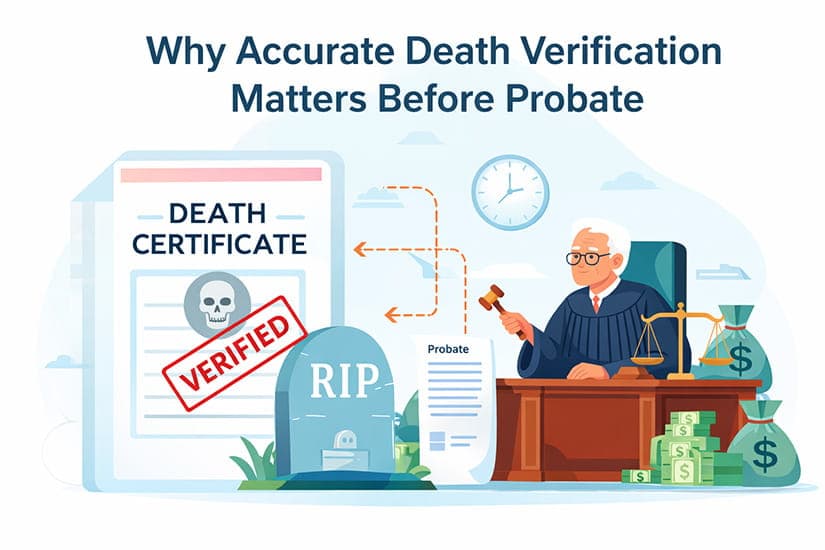
Why Accurate Death Verification Matters Before Probate becomes clear the moment a family prepares to open an estate. Before filing probate, courts require accurate confirmation of death. Executors must rely on verified dates. Attorneys must confirm jurisdiction. Financial institutions require documented proof. Without structured death verification, probate delays begin immediately.
Many families assume that confirming a passing is simple. However, relying on informal information often creates legal problems. Social media announcements are not official. Verbal confirmation is not sufficient. Even newspaper notices must be verified carefully.
This guide explains why accurate death verification matters before probate, what courts expect, how public records function, and how confirmation connects to locating a will. It also outlines how structured verification strengthens estate administration and reduces costly delays.
To learn about the probate process: Probate Explained: Complete Guide
Probate courts require the exact legal name of the deceased, the verified date of death, and confirmation of residency. These elements determine:
If the date of death is incorrect, filings may be rejected. If jurisdiction is wrong, the case may be dismissed. Therefore, death verification is not procedural detail, it is foundational.
Most states require a certified death certificate to formally open probate. However, families often begin the process by verifying public death information before the certificate becomes available. Because death certificates can take weeks, early confirmation through structured sources prevents unnecessary delay.
The National Center for Health Statistics explains how mortality data is recorded and processed nationwide:
Understanding this process helps families recognize why timing matters.
Confusion between a death notice and a death certificate causes many early probate errors.
Death Notice
A public announcement confirming that someone has passed away. It is informational, not legal proof.
Obituary
A longer life summary published publicly. It is also informational.
Death Certificate
An official state-issued legal document confirming the death. It carries legal authority.
Courts require the death certificate. However, public notices often provide the first confirmation. Because certificates may not be immediately available, attorneys and executors often verify preliminary details through public records before filing.
Recognizing these distinctions protects probate accuracy.
Even small errors create significant complications.
An incorrect date of death affects:
An incorrect county of residence affects:
If probate is opened in the wrong county, the court may require dismissal and refiling. That wastes time and increases costs.
Therefore, accurate death verification matters before probate because it determines the entire legal pathway.
Before filing any Petition for Probate, professionals confirm:
Death verification sits at the center of this checklist. Once confirmed, the executor can proceed confidently.
Because will location often follows death confirmation, many families combine these steps.
After confirming a passing, the next urgent question becomes whether a will exists and where it is stored.
The U.S. Will Registry
Established in 1997, The U.S. Will Registry was created to help family members of the deceased locate where a loved one’s will was stored or identify the drafting attorney so probate can proceed according to the deceased’s wishes.
Although death notices confirm public information, will location confirms testamentary intent. When both are verified early, estate administration moves efficiently.
If a will cannot be located, the national database search is available for a nominal $19.95 fee:
Because a significant percentage of wills are never found after death, combining death verification with will search strengthens probate integrity.
Accurate verification requires structured cross-checking. Professionals do not rely on one source alone.
Local publications often provide the earliest public confirmation. However, not all newspapers maintain permanent archives. Therefore, confirmation must be documented carefully.
Funeral homes publish notices shortly after arrangements are finalized. Because information comes directly from families, these sources are often reliable for early confirmation.
State offices maintain official death records. While full certificates require formal requests, indexes often confirm date and location. The CDC provides a directory of state vital records
If probate has already been initiated, court dockets confirm the date of death. Reviewing existing filings prevents duplicate cases.
National platforms provide broader verification tools. However, professionals always cross-check original sources.
Structured verification prevents reliance on incomplete or outdated information.
Probate is jurisdictional. Courts operate by county. Therefore, geographic accuracy is essential.
If the decedent owned property in multiple states, ancillary probate may be required. Accurate death verification ensures the primary jurisdiction is correctly identified first.
Furthermore, creditor notification periods begin on the date of death or on the date of probate filing, depending on state law. An inaccurate starting date alters legal rights.
Because probate affects property transfer, beneficiary rights, and creditor claims, courts expect precision from the beginning.
Many families unintentionally create delays by:
Although these errors appear minor, they create legal complications.
Structured cross-verification protects against these problems.
Accurate death verification affects more than probate filings.
Financial institutions require confirmation before freezing accounts. Insurance carriers require official documentation before processing claims. Pension administrators rely on precise dates. Social Security benefits must be terminated correctly.
Because over three million deaths occur annually in the United States, administrative systems depend on standardized verification.
The National Archives explains access to public records.
Understanding record systems helps families navigate early estate steps responsibly.
Verification should occur immediately after:
However, filing should wait until official documentation is available. Preliminary confirmation helps families gather documents while waiting for certified copies.
This structured timing reduces emotional stress and administrative confusion.
Estate administration often occurs during emotional strain. Because grief affects decision-making, structured processes provide clarity.
Accurate death verification:
Most importantly, it honors the decedent’s wishes by ensuring probate proceeds correctly.
These realities demonstrate why combining death verification with will location strengthens estate administration.
No single database contains all death notices nationwide. Because obituary publishing is decentralized, verification requires multiple sources.
The U.S. Will Registry maintains a national obituary database updated daily and governed by published moderation standards. Because no single database is complete, it functions as a complementary national search layer within the broader obituary publishing ecosystem.
This complementary positioning strengthens estate efficiency without replacing local record systems.
Why Accurate Death Verification Matters Before Probate is not a theoretical concern. It determines jurisdiction, filing eligibility, creditor notice periods, and estate timelines. Before filing probate, families must confirm the exact legal name, verified date of death, and proper county of residence.
Public notices provide early confirmation. Official certificates provide legal proof. Structured cross-verification prevents delays, reduces court rejection risk, and supports accurate estate administration.
When death confirmation is handled carefully, probate proceeds according to the deceased’s wishes and protects beneficiaries from unnecessary complications.
Accurate death verification matters before probate because courts require exact dates and legal names to establish jurisdiction and filing eligibility. Without verified information, petitions may be rejected or filed in the wrong county. Proper confirmation ensures deadlines, creditor notice periods, and estate tax timelines are calculated correctly.
No. A death notice is informational and confirms public reporting. Probate courts require a certified death certificate as legal proof. However, families often use public notices for preliminary confirmation while waiting for official documents to be issued by the state.
Filing with an incorrect date can delay proceedings and may require amendments or dismissal. Deadlines for creditor claims, tax filings, and beneficiary distributions depend on the verified date. Therefore, confirming accurate death information before filing prevents administrative complications.
Yes. Once death verification is complete, confirming whether a will exists is critical. Because many wills go missing, structured will location searches help ensure probate reflects the deceased’s true intentions and prevents intestate administration.
This article was reviewed for legal accuracy by Shawn Patrick Wolf, Esq. Mr. Wolf is Board Certified in Wills, Trusts and Estates and in Tax Law. He serves on the Board of Directors of the East Coast Estate Planning Council and the Palm Beach Tax Institute.
