
How to contact financial institutions when searching for a will is an important step when estate documents cannot be located after a death. Banks, financial advisors, insurance companies, and investment firms may have records that help determine whether a will exists, including documents stored in safe deposit boxes or estate planning files.
Because strict financial privacy laws apply, these institutions usually require proof of death and identification before sharing information. Understanding how these organizations handle records can help families locate estate documents more efficiently.
If you want to understand the complete process of locating a will, read : How to Find a Will: The Complete Authority Guide.
Many people discuss estate planning while organizing their finances. During those conversations, financial professionals often learn whether a will was created and which attorney drafted it.
Financial advisors commonly recommend estate planning attorneys. As a result, they may know where the will was prepared or where it was stored.
Similarly, banks sometimes store original estate documents in safe deposit boxes. Other individuals provide copies of wills to advisors, accountants, or investment firms as part of their financial planning records.
Insurance agents may also discuss estate planning when clients purchase life insurance policies. Although insurance companies rarely keep copies of wills, they may record the names of executors, attorneys, or financial planners involved in the estate plan.
Because of these connections, contacting financial institutions can sometimes help identify whether a will exists and where it may be located.
Financial institutions must protect customer privacy. Therefore, they cannot release information without verifying the request.
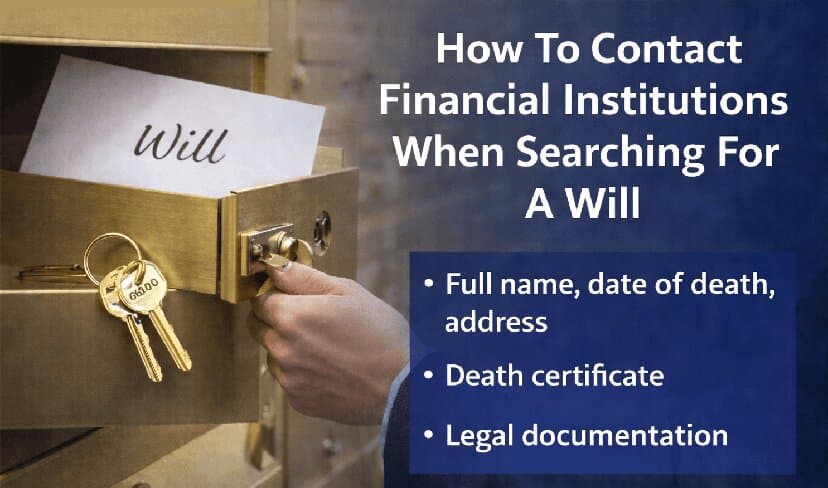
Most institutions will request identifying details about the deceased person. These details may include:
Providing accurate information helps the institution locate any records connected to the individual.
Many institutions will request a death certificate before discussing a deceased customer’s records. This document confirms the death and allows the institution to begin reviewing accounts under their deceased customer procedures.
If you are the executor of the estate, the institution may request legal documentation showing your authority to act on behalf of the estate.
Examples include:
Without these documents, institutions may limit the information they can provide.
Banks are often the first financial institutions families contact when searching for a will. Many individuals store important documents in safe deposit boxes because banks provide secure storage. If the deceased person rented a safe deposit box, it may contain the original will or other estate planning documents.
Accessing a safe deposit box after death is not always simple. When a bank learns that a customer has died, it may temporarily seal the box until proper legal authority is presented.
However, many states allow limited access to a safe deposit box for the purpose of locating a will. In those cases, a bank employee typically supervises the opening of the box to ensure that only the will is removed.
State laws vary. Some banks may require a court order before allowing access. Others may permit a spouse or executor to request supervised access.
If you believe a will may be stored in a safe deposit box, contact the bank and ask about their procedures.
Financial advisors frequently assist clients with long-term financial planning. During this process, estate planning is often discussed.
Because of this, advisors may know:
Some advisors maintain estate planning files that include copies of wills, trusts, or attorney contact information.
Investment firms may also have records showing beneficiaries or trustees connected to accounts. These records can sometimes provide clues about whether a will or trust exists.
When contacting an advisor, explain that you are attempting to locate estate documents so the estate can be properly administered.
Insurance companies may also provide helpful information during a will search. When individuals purchase life insurance policies, they often discuss estate planning with their insurance agent.
Agents sometimes record important estate planning details, including the names of executors or attorneys involved in preparing the estate plan.
Although insurance companies rarely store copies of wills, their records may help identify professionals who were involved in the estate planning process.
These details can help guide you to the attorney who drafted the will or the location where it was stored.
When contacting financial institutions, be clear and direct about your request.
Explain that you are attempting to determine whether a will exists so the estate can be administered properly.
Provide the deceased person’s identifying information and explain your relationship to the deceased. If you have documentation such as a death certificate, mention that you can provide it if required.
You may also ask specific questions such as:
Even limited information can help direct your search.
A will may be stored in one location while information about it exists somewhere else. For example, the original document may be stored in a safe deposit box while the financial advisor knows which attorney drafted it.
Because of this, it is important to contact multiple institutions rather than relying on only one source.
Checking banks, advisors, insurance companies, and investment firms can significantly increase the chances of locating the will.
Financial institutions are only one part of the search process. Families should also check the deceased person’s home, contact attorneys, review probate court records, and search national will registries.
To understand the complete legal process, read the authority guide. How to Find a Will: The Complete Authority Guide
If you believe the will may have been registered, you can also search the national database maintained by The U.S. Will Registry. This registry was created to help families locate where a loved one’s will is stored or identify the attorney holding it so probate can proceed according to the deceased person’s wishes.
SEARCH FOR A WILL
The U.S. Will Registry
Financial institutions can provide valuable clues when searching for a missing will. Banks, financial advisors, insurance companies, and investment firms may all have information connected to the deceased person’s estate planning.
Although privacy rules limit what they can disclose, providing proper documentation and asking the right questions can help uncover important information.
Combining these efforts with searches of homes, attorneys, probate courts, and national will registries greatly improves the chances of locating a will and ensuring that a loved one’s final wishes are honored.
When learning how to contact financial institutions when searching for a will, start by gathering key information about the deceased. Provide the person’s full name, date of death, and last known address. Financial institutions may also request a death certificate or legal documentation before discussing records related to the deceased.
Yes, banks can help when contacting financial institutions when searching for a will. Many people store estate documents in safe deposit boxes or discuss estate planning with their bank. If the deceased had a safe deposit box, the bank may allow supervised access to check whether a will is stored there.
Yes, financial advisors may help when contacting financial institutions when searching for a will. Advisors often discuss estate planning with their clients and may know whether a will was created. They may also know which attorney drafted the will or where the estate documents were stored.
Insurance companies may help when contacting financial institutions when searching for a will. Although they usually do not store copies of wills, insurance agents often discuss estate planning with clients. Their records may identify attorneys, executors, or advisors involved in the estate planning process.
This article was prepared by estate planning researchers and reviewed by S. Miller and staff. With more than 25 years of experience in estate planning documentation and probate processes, our editorial oversight ensures clarity and accuracy. This content is provided for informational purposes only and does not constitute legal advice.
[View Our Editorial Policy]