
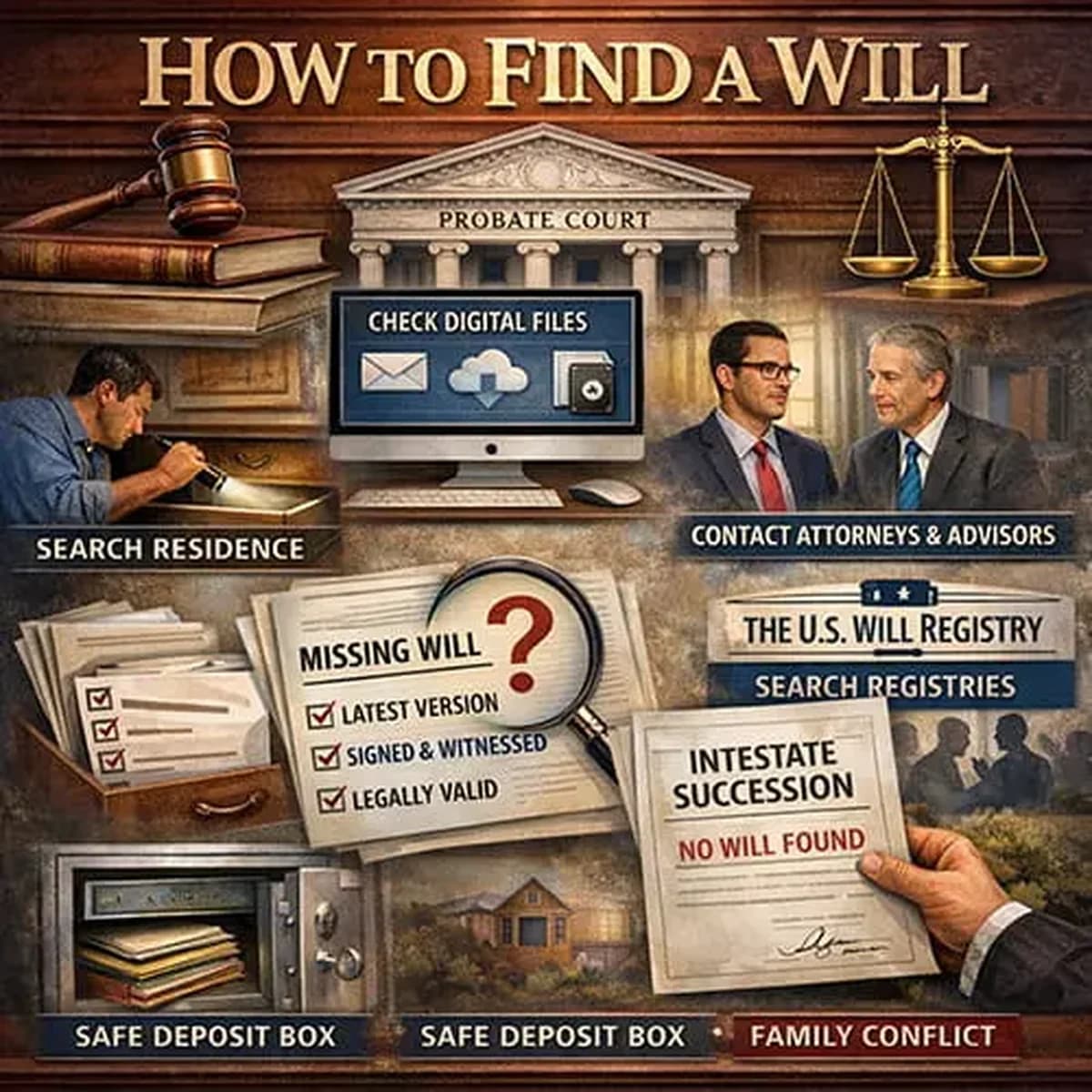
To find a will, start by checking the deceased person’s home and personal files, contacting their estate planning attorney, searching a national will registry, checking probate court records, and checking safe deposit boxes. If one method does not locate the will, continue with the others, because no single source contains every last will and testament.
This guide walks through each search step, explains how to get a copy of a will once you know where it is, and covers what to do if the will cannot be found.
The deceased person’s home and personal papers are practical places to begin your search. Search methodically, and keep notes on where you looked so other family members do not repeat the same search.
If you find a document that may be a will, leave it exactly as it is. Do not write on it, remove staples, or take pages apart, because changes to the original can raise questions about whether it is valid.
For additional places to check, see where to look first when searching for a missing will.
Even when the signed original is on paper, digital records often point to where it is or who prepared it.
Only access accounts and devices you are legally authorized to use. An executor may need court authority before accessing some accounts.
For online search options, see How to Find If a Will Exists Online.
If you know who prepared the will, contact that attorney or law firm. Attorneys often keep the original will in their files, retain a copy, or know where the original was stored.
If you do not know which attorney prepared it, see How to Find the Attorney Who Wrote a Will.
A national will registry may help identify where a registered will is located or which attorney prepared it.
Search The U.S. Will Registry to determine whether information about the will was registered. The Registry records information about the existence and location of registered wills. It does not store the will itself.
If no matching registration is found, The U.S. Will Registry provides guidance on additional steps that may help continue the search.
The search also gives families an Estate settlement guide: Step-by-step guidance on how to proceed with settling the estate, whether or not a will is found. Guidance is based on each persons relationship to the deceased.
For more information about this type of search, see how a National Will Registry works.
SEARCH FOR A WILLEstablished 1997The U.S. Will RegistrySTART YOUR SEARCH →
If probate has started, the will has likely been filed with the probate court in the county where the deceased person lived. That is the county of residence, which is not always the county where the person died.
In most states, the person holding an original will is legally required to deliver it to the probate court, or to the named executor, after learning of the death, often within a set deadline. For example, Florida generally requires the custodian to deposit the will with the appropriate court clerk within 10 days after learning of the death. California generally requires delivery to the appropriate court clerk within 30 days, along with a copy to the named executor or, in specified circumstances, a beneficiary.
If you are trying to determine whether the will has already reached the court, see How to Find Out If a Will Was Filed.
For detailed court-search instructions, see How to Find a Will in Probate Court.
If the deceased had a safe deposit box, the original will may be inside. A key, a bank statement showing a box rental fee, or a note in their records can tell you which bank to contact.
For detailed information, see How to Access a Will in a Safe Deposit Box After Death.
Once a will has been filed with the probate court, it becomes a public record, and you can usually request a copy from the probate court clerk in the county where the deceased person lived. Before the will is filed, there is generally no public copy, and access depends on who is holding it.
If these searches do not locate the will, do not immediately assume that one never existed. A will may exist even if it was never registered or filed with a probate court.
If you have found a copy or other evidence that a will existed but cannot locate the signed document, see what to do when the original will cannot be found.
If no valid will is ultimately located, the estate may have to proceed under state intestate succession laws. See How to Settle an Estate Without a Will for what may happen next. A U.S. Will Registry search also includes an estate settlement guide for estates without a will and a free asset finder to help identify assets the family may not know about.
Finding a will does not necessarily mean the search is finished. A person may have created a later will or signed a codicil that changed an earlier document.
Check the dates and look for later estate planning documents. If you are uncertain whether a document is legally effective, see What Constitutes a Valid Will.
If several copies or versions are discovered, see what may happen when a duplicate copy of a will is found.
Start by checking the deceased person’s personal records and contacting their estate planning attorney. Then search a national will registry and check whether the will has already been filed with the probate court. No single source contains every will, so more than one search method may be necessary.
Begin with your parent’s papers and digital files, then contact any attorney they used, search a national will registry, and check the probate court in the county where they lived. As a child of the deceased, you are often a legal heir, which means you are typically entitled to notice if probate is opened.
If the will has been filed with the probate court, request a copy from the probate clerk in the county where the deceased person lived. If it has not been filed, ask the executor or the attorney who prepared it. See How to Get a Copy of a Will above for details.
A last will and testament becomes a public record once it is filed with the probate court. Before a will is filed with the court, access depends on state law, the requester’s legal rights, and who holds the document.
Sometimes. Probate court databases may contain wills that have already been filed, while a will registry may contain information about a registered will’s location. However, finding no online record does not mean that no will exists.
See How to Find If a Will Exists Online for the available online search methods.
Family members, executors, beneficiaries, attorneys, and others may try to locate a deceased person’s will. However, access to private documents may depend on the person’s relationship to the deceased and their legal authority.
See Who Can Search for a Will for a complete explanation.
There is no single place where every will can be found. A complete search may involve personal records, digital files, attorneys, a national will registry, probate court records, and safe deposit boxes.
Start with the six methods above. If one part of the search requires more information, follow the specialized resources linked throughout this guide.
If you are searching for information about a registered will, search The U.S. Will Registry.
This article was reviewed for legal accuracy by Shawn Patrick Wolf, Esq. Mr. Wolf is Board Certified in Wills, Trusts and Estates and in Tax Law. He serves on the Board of Directors of the East Coast Estate Planning Council and the Palm Beach Tax Institute.
