
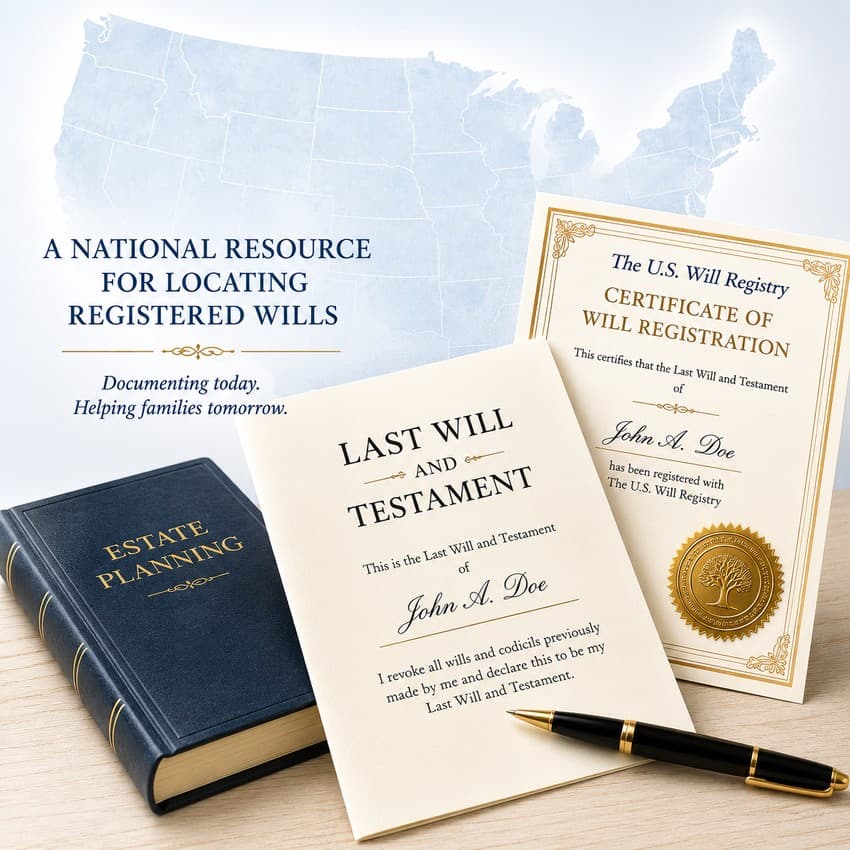
A National Will Registry is a nationwide resource that documents the existence and location of a Last Will and Testament so it can be found when it is needed. It provides families, executors, attorneys, and estate professionals with a central place to determine whether information about a will has been registered and where the document may be located.
The U.S. Will Registry, established in 1997, provides nationwide will registration and search services designed to help address a major estate planning problem: wills that cannot be located when families need them to settle an estate.
In a survey of estate planning attorneys, those interviewed estimated that nearly 65% of wills were not found when needed. This figure represents the professional opinions of the attorneys surveyed rather than a national statistical finding. However, it illustrates the seriousness of a problem estate planning professionals regularly encounter.
A person may carefully document final wishes, select beneficiaries, appoint an executor, and securely store a will. Yet years or decades later, the family may have no idea where that document is located.
A will can only help carry out a person’s wishes if someone knows it exists and can find it.
For families currently searching, see our complete guide on how to find a will.
Years or even decades may pass between the date a will is signed and the date it is needed.
During that time, circumstances can change dramatically:
After a death, family members may suddenly find themselves searching personal files, contacting attorneys, checking safe deposit boxes, speaking with relatives, and reviewing court records.
In many cases, the problem is not the absence of a will. The problem is the inability to find it.
That is the estate planning crisis a National Will Registry is designed to address.
The U.S. Will Registry was formed in 1997 with a specific mission: to help address the crisis of wills that cannot be located when families need them to settle an estate.
Estate planning traditionally focuses considerable attention on preparing the legal document. However, another question is equally important:
How will the family find that document many years later?
The Registry was designed to help create that connection.
By documenting where a person’s will is located, the Registry gives authorized family members, executors, attorneys, and estate professionals a central resource to begin their search after death.
The objective is not simply to maintain a database. The objective is to help families locate the will they need and provide information that can help them move forward with settling the estate.
When someone dies, one of the first questions a family may face is:
“Where is the will?”
A will may identify the executor, name beneficiaries, provide instructions for distributing property, and communicate other important final wishes.
Without access to the will, family members may not know who was selected to administer the estate. They may also be uncertain about how the deceased intended property to be distributed.
Finding a will after someone dies can be time-sensitive.
Every state has laws and procedures governing probate and estate administration. Deadlines and requirements vary by state.
These requirements can create additional pressure for families who are still trying to determine whether a will exists and where it is located.
As estate administration moves forward, the family may need to identify the correct will and determine who was named executor or personal representative.
When a will cannot be found, valuable time may be spent searching attorneys’ offices, personal records, safe deposit boxes, and court records.
This is another reason a National Will Registry matters. It provides a central place to begin searching when locating a will may be both important and time-sensitive.
Families who cannot locate a will can review our complete guide on how to find a will for additional places to search and steps to take.
A National Will Registry creates a record connecting an individual with information about their Last Will and Testament and where it is located.
A will can be registered regardless of where or how it was prepared. Registration documents an existing will and its location.
The individual provides identifying information and information concerning the will.
This creates a record that can help authorized individuals locate the document in the future.
For additional information, see how to register a will and why registration matters.
The Registry records information about where the will is being kept.
That may include an attorney’s office, secure home safe, safe deposit box, trusted custodian, institution, online document storage, or another secure location.
Estate plans and circumstances can change.
A will may be replaced. An attorney may change. The original document may be moved.
When this happens, the registration information should be updated so the documented information remains current.
When the will is needed, an authorized family member, executor, attorney, or other qualified individual can request a search.
If matching registration information is located, information can be provided according to the Registry’s verification and release procedures.
REGISTER YOUR WILLIT’S FREE!Registration Helps Ensure It’s FoundSTART HERE →
A search of The U.S. Will Registry does more than determine whether information about a will has been registered.
When a registered will is not identified, the Registry continues to assist the family with information designed to help them determine what to do next.
Families may still need to locate a will, understand their rights, determine who should handle the estate, or begin settling an estate without a will in hand.
When performing a will search, the searcher identifies their relationship to the deceased.
That relationship matters.
A surviving spouse, adult child, sibling, executor, or other relative may have different rights, responsibilities, and concerns when settling an estate.
The U.S. Will Registry uses that information to provide educational guidance relevant to the searcher’s relationship to the deceased.
For example, a surviving spouse may have rights under state law, including the potential right to an elective share of the estate. Elective-share laws and amounts vary by state.
Families can also review our step-by-step guide to settling an estate.
A National Will Registry documents information designed to help identify an individual and locate important estate planning documents.
Depending on the registration, information may include:
The value of this information may not become apparent until many years after registration.
Ideally, a family will locate the original signed Last Will and Testament.
The original is generally the document presented when beginning probate or estate administration, subject to the laws and procedures of the applicable state.
However, a duplicate or photocopy of a will can be far better than finding no will at all.
A copy may identify:
A copy may also provide clues that help an attorney or family member continue searching for the original.
In some circumstances, a court may permit a copy of a will to be admitted to probate when the original cannot be located. Requirements vary by state and circumstances, and additional evidence may be required.
Therefore, never disregard a copy simply because the original cannot immediately be found.
Preserve the copy and provide it to the probate or estate attorney assisting with the estate.
If you have a copy but cannot locate the original, see what to do when you can’t find the original will.
Will registration and will storage serve different purposes.
The U.S. Will Registry documents information about a will and where it is located. The original signed document can remain in the secure location selected by the individual.
For additional guidance, see where to store your will.
The distinction is simple:
Will storage protects the document.
Will registration helps ensure the document can be found.
Will Registry searches are intended for people with a legitimate reason to locate information concerning a deceased person’s will.
Depending on the circumstances and verification requirements, searchers may include:
Verification procedures help protect registered information while allowing qualified individuals to receive appropriate information when a will is needed.
For more information, see who can legally search for a will.
The reason to register a will can be summarized in one sentence:
Your family cannot follow instructions they cannot find.
Registration provides another safeguard against that problem.
Registering a will’s location:
Registering the location of a will helps make sure it can be found when it is needed.
Register your will free with The U.S. Will Registry.
Yes. Registration with The U.S. Will Registry is free.
Free registration allows individuals to document where their wills are located without making cost a barrier to registration.
Search services for families attempting to locate a deceased person’s will are handled separately.
Register your will free with The U.S. Will Registry.
A National Will Registry is a nationwide resource that documents the existence and location of a Last Will and Testament. It allows authorized individuals to search for that information when the will is needed.
The U.S. Will Registry was established in 1997 to address an estate planning crisis: too many wills cannot be located when families need them to settle an estate.
In a survey of estate planning attorneys, those interviewed estimated that nearly 65% of wills were not found when needed.
The figure represents the professional opinions of the attorneys surveyed rather than a national statistical finding.
Registration creates a documented record of the will’s location.
This gives authorized family members, executors, attorneys, and estate professionals a central place to begin searching when the document is needed.
Locating the original signed will is generally preferable for probate and estate administration.
However, a copy can be far better than having no will at all. It may identify the attorney, executor, beneficiaries, witnesses, and the deceased person’s wishes.
Preserve it.
The copy may provide valuable information and help an attorney continue searching for the original. Speak with a qualified probate or estate attorney about the requirements in the applicable state.
The U.S. Will Registry documents information concerning the will and its location.
The original signed document can remain in the secure location selected by the individual.
Qualified family members and other authorized individuals can request a search after death, subject to the Registry’s verification and release procedures.
A negative Registry search does not necessarily mean no will exists.
The U.S. Will Registry provides educational information to help families continue searching and understand steps they may need to take to settle the estate.
Start by determining whether information about the will was registered.
You can also investigate the deceased person’s records, attorneys, executor, safe deposit boxes, financial professionals, family members, and appropriate probate court records.
See our complete guide on how to find a will for a detailed search process.
This article was reviewed for legal accuracy by Shawn Patrick Wolf, Esq. Mr. Wolf is Board Certified in Wills, Trusts and Estates and in Tax Law. He serves on the Board of Directors of the East Coast Estate Planning Council and the Palm Beach Tax Institute.
