
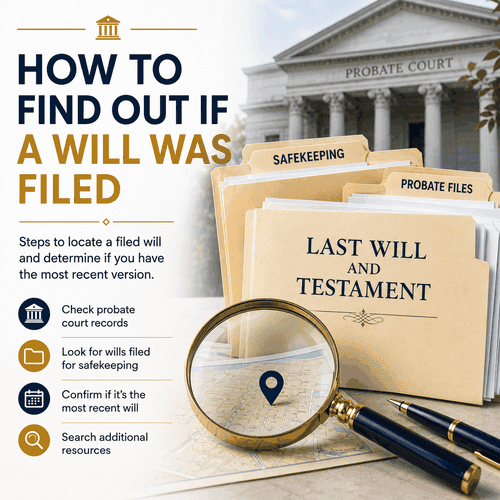
To find out if a will was filed, check the probate records in the county where the person legally lived at death. Many courts offer an online search by name. However, an online case search may not show every deposited will.
If you find nothing, contact the probate clerk or the office that handles wills. Ask two separate questions: Has a probate case been opened, and has a will been deposited?
A missing court record does not prove that no will exists. The will may remain with its custodian, await filing, or appear in another court’s records.
| Where to check | What to ask or look for |
|---|---|
| Court records online | A probate case and any entry showing a filed will. |
| Probate clerk | A deposited will, including one without an open probate case. |
| Another relevant court | Records where the deceased owned real estate or had another legal connection. |
| Named executor or attorney | Who holds the will and whether it has been filed. |
| The U.S. Will Registry | Registered information identifying the will’s location or custodian. |
Start with court records when your question is whether someone filed a will. If you need to locate the document itself, a search of The U.S. Will Registry may help.
Step by Step: How to Find Out If a Will Was Filed
Begin with the county where the deceased had their legal residence, also called their domicile. This usually means their permanent home. It may differ from the place where they died.
For example, someone might die in a hospital outside their home county. That does not automatically make the hospital’s county the correct place to search.
If the deceased owned real estate elsewhere, a separate estate proceeding may exist there. However, property ownership does not always require another proceeding. Ownership arrangements and state law matter.
Our guide on finding a will in another state explains how to expand your search.
Next, locate the official court or government office that handles probate records in that county.
The office’s name varies. Examples include:
Search for the county name with “probate records” or “Register of Wills.” Then confirm that you have reached the official government website.
Use the office’s published contact information if you are unsure which department handles deposited wills.
Have the following information ready:
Try alternate spellings if the first search produces no results. Some systems work better with a surname alone.
Also, check whether the website limits searches by filing year, case type, or court location.
Many courts provide free online searches by name. However, access to copies or document images may involve fees or additional steps.
New York’s WebSurrogate provides information about estate proceedings and other Surrogate’s Court filings.
When you find a case, review the document list or docket. Look for entries identifying a will, a probate petition, or an order admitting a will to probate.
A probate case alone does not establish that a will was filed. Courts also handle estates without wills.
Likewise, a search result may show the case without displaying its documents. Contact the clerk to confirm what the file contains.
If you find nothing online, call or visit the office.
You can say:
“I am checking records for [full name], who died on [date]. Has a probate case been opened? Separately, has a will been deposited or lodged with your office?”
Also ask whether deposited wills appear in the online system. Some offices may maintain a separate index or require staff assistance.
The clerk can explain record searches, copying fees, and filing procedures. Questions about your inheritance rights may require advice from a probate attorney.
If the office has the will, ask how to obtain a copy. Confirm whether you need an ordinary copy or a certified copy.
An ordinary copy may be enough for reading the document. A certified copy includes the clerk’s certification and may serve specific official purposes.
If you need to know whether the court accepted the will, request the relevant court order too.
See our guides on who can get a copy of a will and how to get a certified copy of a will.
Depositing a will, opening an estate case, and admitting a will to probate are different steps.
Depositing the will means delivering it to the appropriate office for its records.
Opening an estate case generally requires an application or petition for court proceedings.
Admitting the will to probate means the court accepts it through the applicable legal process.
Therefore, a deposited will may exist without an active probate case. Filing alone does not establish that the document is valid or the deceased’s final will.
New York Courts explains that filing and court approval are separate parts of the probate process.
Some states require the custodian to deposit a will after death even when no probate administration is needed.
In Florida, the custodian must deposit the will within 10 days after receiving information that the person has died. The custodian must use the clerk of the court with proper venue for the estate. This requirement appears in Florida Statutes section 732.901.
Our guide on how to find a will in Florida explains the search process in more detail.
There is no single nationwide deadline. State laws distinguish between delivering a will and seeking probate.
Some states require prompt delivery of the original will. Meanwhile, opening an estate case may take longer.
Texas generally bars admitting a will to probate more than four years after death, subject to statutory exceptions. See Texas Estates Code section 256.003.
That four-year rule is not a universal filing deadline. It also does not mean a family should wait four years.
If you searched shortly after death, ask the clerk about later searches and any available notice procedures. However, seek legal advice promptly if your rights may be affected. Repeated searches do not extend legal deadlines.
An empty search can have several explanations.
The custodian may not know about the death or may not have delivered the document.
However, delays do not remove any legal duty to deposit the will. State filing requirements still apply.
The person’s legal residence may differ from their mailing address or place of death.
First, confirm the correct county and search spelling. Then check another relevant jurisdiction if there is a reason to do so.
Some assets pass through beneficiary designations, survivorship ownership, or trusts. Small estates may also qualify for simplified procedures.
Nevertheless, avoiding full probate does not necessarily remove the duty to deposit a will.
Read our guide on whether all wills need to go to probate.
The document may remain at home, in an attorney’s file, or in a safe deposit box.
Contact the named executor, family members, or the drafting attorney if you know their identities. Ask who holds the original and whether anyone delivered it to the court.
Access to private files and safe deposit boxes follows separate rules. Finding a possible location does not automatically authorize you to enter or remove documents.
If no valid will exists, state intestacy law generally determines who inherits probate assets.
However, assets governed by valid beneficiary designations, survivorship rights, or trusts may pass separately.
For additional information, see what happens if a will is not filed.
If you believe someone holds a will but refuses to deliver it, consult a probate attorney.
Depending on state law, an interested person may ask the court to require production of the document. Florida expressly provides a procedure to compel a custodian to deposit a will under section 732.901.
Also, ask about procedures for receiving notice of estate proceedings. Eligibility, forms, and deadlines vary by state.
Do not assume that being a relative automatically guarantees notice of every filing.
Court records help establish whether a will was filed. The U.S. Will Registry helps locate a will.
Since 1997, attorneys nationwide and members of the public have registered the locations of their wills with The U.S. Will Registry. Free registration has helped the database grow to more than two million will registrations. The Registry records where wills are kept, but does not store the documents or record their contents.
A matching registration may identify the attorney, a custodian, institution, or online document storage site leading to the location of the document. However, registration does not confirm that someone filed the will in probate court or that a court accepted it.
If a match is found, information is released only to authorized individuals after verification of a death certificate and valid photo identification. A search cannot guarantee that a registration exists or that the document remains at its recorded location.
The search service also includes estate settlement guidance based on your relationship to the deceased. This general information helps families understand possible next steps with or without a located will.
Begin a missing will search, or review our guide on how to find out if a will exists.
Older probate records may not appear online. The original court may hold paper files or microfilm.
Alternatively, county, municipal, or state archives may hold records from particular periods. In New York, for example, the State Archives holds certain historical records from predecessor probate courts.
Start by asking the probate clerk where records from the relevant years are kept. Provide the person’s name, approximate death year, and place of residence.
Also ask about indexes, archived case numbers, search fees, and copy requests.
Often, yes. Many courts provide online case searches. However, the system may omit deposited wills or older records. Contact the clerk if the results are incomplete.
Generally, a will filed with the court after death becomes public record. However, access rules vary, and some records may be restricted or sealed. Lifetime safekeeping deposits generally remain confidential.
Our guide on whether wills are public record explains further.
State law controls the duty to deposit a will after death. Some states require deposit even when the estate needs no probate administration.
See whether wills need to be filed with the court.
Some states allow a person to deposit a will for safekeeping during their lifetime. The document generally remains confidential.
The person, or someone authorized under state law, may be able to withdraw it. After death, release procedures depend on state law. The Maryland Register of Wills describes one such safekeeping service.
Filing alone does not establish the will’s validity or resolve inheritance questions. The court may need to admit the will to probate. Other documents, ownership arrangements, and state law can also affect inheritance.
Often, the named executor or the person holding the original delivers it. However, state law may impose that duty on the custodian, even if someone else is named executor.
It may mean the will awaits deposit, remains undiscovered, or appears in another office’s records. It could also mean no will exists. Confirm the clerk’s records and investigate possible document locations before drawing conclusions.
This article provides general information. State laws and court procedures vary. A probate attorney can advise you about your specific circumstances.
This article was reviewed for legal accuracy by Shawn Patrick Wolf, Esq. Mr. Wolf is Board Certified in Wills, Trusts and Estates and in Tax Law. He serves on the Board of Directors of the East Coast Estate Planning Council and the Palm Beach Tax Institute.
