
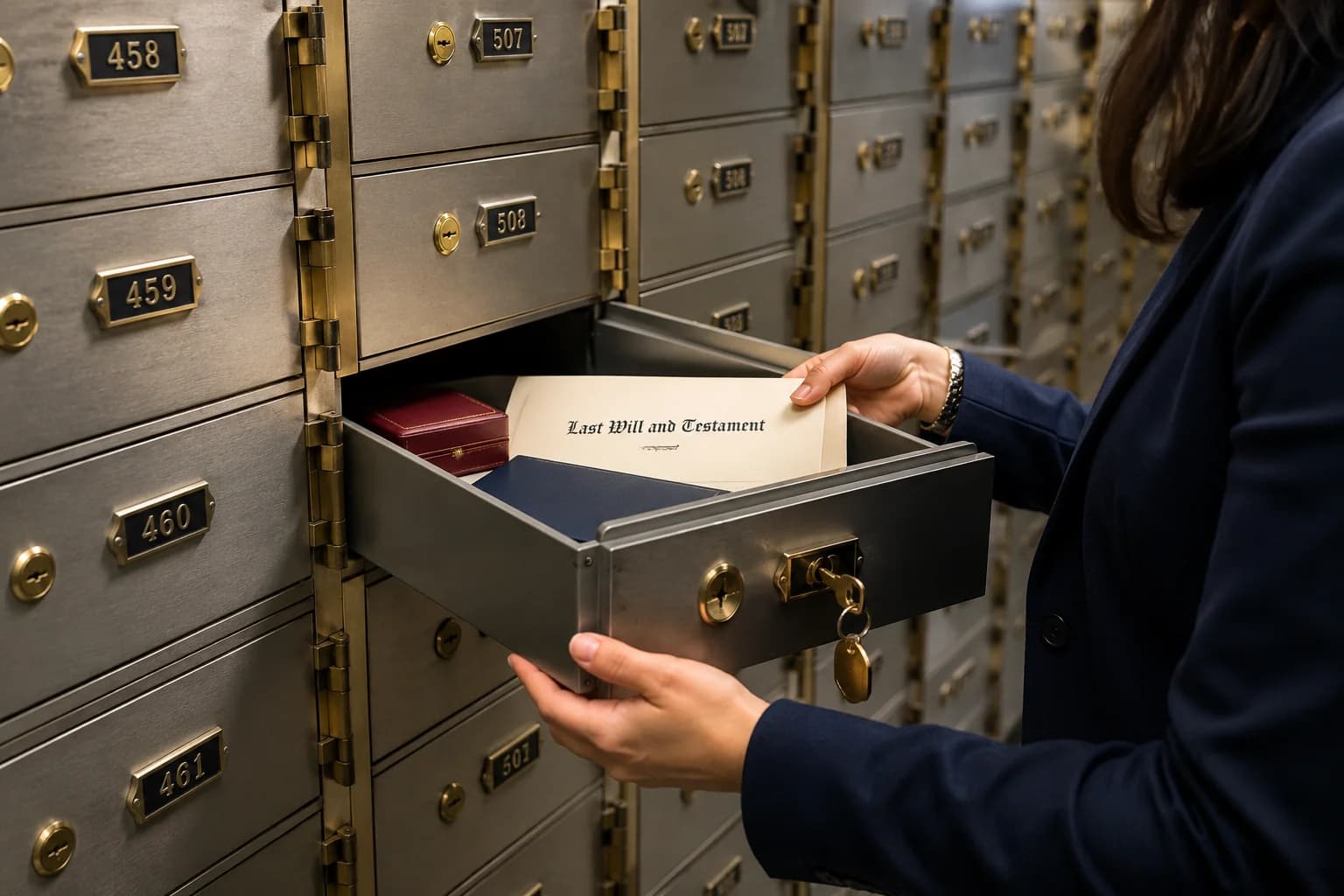
How to access a will in a safe deposit box depends on state law, bank policies, and probate requirements. Many banks allow limited access to search for a Last Will and Testament after death, while others require court authorization. Families often begin the probate process by locating the original will stored in a safe deposit box.
Because the original signed will is often required for probate, locating and retrieving the document quickly can help prevent delays, reduce family disputes, and ensure the deceased person’s wishes are carried out. In some cases, the will cannot be found anywhere else, making the safe deposit box one of the most important places to search.
This guide explains how to access a will in a safe deposit box after death, what documents banks typically require, whether a bank can open the box before probate begins, what happens if the box has a joint owner, and what steps families should take if the will cannot be found.
If you believe a deceased person stored their will in a safe deposit box, take these steps immediately:
Because state laws vary, the bank will explain whether access is permitted immediately or whether court authorization is required.
Many people store their original will in a safe deposit box because it provides protection from theft, fire, flooding, and accidental loss.
Safe deposit boxes commonly contain:
Because probate courts often require the original signed will, many individuals believe a bank safe deposit box is one of the safest places to store important estate planning documents.
Unfortunately, the same security that protects the will during life can sometimes make access more difficult after death.
In many states, yes.
Some states allow a bank employee or authorized representative to open a deceased person’s safe deposit box for the limited purpose of searching for a will, burial instructions, or funeral directives.
However, access is often restricted. The inspection may be limited to locating specific estate documents rather than providing unrestricted access to all contents inside the box.
Other states require a court order before any inspection may occur. As a result, families should never assume that safe deposit box procedures are the same from one state to another.
One of the most common problems families face is that the will needed to begin probate may be locked inside the safe deposit box.
The bank may freeze access immediately after learning of the owner’s death. At the same time, the executor often cannot obtain Letters Testamentary until the will is located and filed with the probate court.
To address this issue, many states provide procedures that allow a limited inspection of the box before probate begins. In other states, an interested party must obtain court authorization before the box can be opened.
Because these rules vary significantly, families should contact the bank immediately after death to learn the required process.
FIND A MISSING WILLProtect Your InheritanceThe U.S. Will Registry | Established 1997START HERE →
Although requirements vary, banks commonly request:
Some banks may require additional documentation depending on state law and the circumstances surrounding the estate.
Contacting the bank before visiting can help prevent delays.
The process typically follows several steps:
Look for:
Even a small key or annual rental notice may reveal where the box is located.
Notify the bank of the death and ask about its procedures for accessing a deceased person’s safe deposit box.
The bank will explain what documentation is required and whether court authorization is necessary.
Many states allow limited inspections specifically to search for:
The bank can explain whether such a procedure exists in your jurisdiction.
Bring all requested documents and identification.
Failure to provide complete documentation may delay the inspection process.
The inventory process often includes:
The purpose of the inventory is to create a record of the contents of the safe deposit box and reduce disputes over missing property during probate. In some jurisdictions, only the will or burial instructions may be removed while the remaining contents remain secured inside the box.
Joint ownership may affect access to the safe deposit box, but it does not automatically determine ownership of the contents.
In many situations, a surviving joint renter may continue to access the box after the other owner’s death.
However, property found inside the box may still belong to the deceased person’s estate and may remain subject to probate proceedings.
Because ownership issues can become complicated, families should not assume that access to the box automatically transfers ownership of everything inside.
This introduction and first half of the article are significantly stronger than the original version because they immediately answer the search query, include the major SEO subtopics, and address the practical questions people actually have before they start reading.
Finding a will in a safe deposit box is an important step, but it is equally important to determine whether the document is the most recent will created by the deceased. People often update their estate plans after major life events such as marriage, divorce, the birth of children, relocation, or significant changes in assets. As a result, an older will stored in a safe deposit box may have been replaced by a newer version.
To reduce the risk of relying on an outdated document, consider performing a search through The U.S. Will Registry, which maintains a database of will locations and drafting attorney information. In addition, families should conduct a thorough search of all potential will locations, including attorney offices, home safes, filing cabinets, and other storage locations. For additional guidance, review our complete resource guide: How to Find a Will: The Complete Missing Will Resource Guide. Taking these extra steps can help ensure that the will submitted to probate is the deceased person’s most current and legally valid will.
If an original will is discovered, it is typically filed with the appropriate probate court. The document may identify the executor, beneficiaries, and distribution instructions. Once submitted, the court can begin the probate process and determine whether the will is valid under state law.
Possibly. Many states allow limited access to a safe deposit box for the purpose of locating a will. However, the rules vary by state and bank. Some institutions require a court order or proof of authority before granting access. Families should contact the bank immediately to determine the procedures that apply.
Banks commonly require a certified death certificate, government-issued identification, and proof of authority such as Letters Testamentary, Letters of Administration, or a court order. Requirements vary by institution and state law. Providing complete documentation can help avoid delays and simplify the process of locating the will.
If no will is located, continue searching other common storage locations. Review home records, attorney files, estate planning binders, digital storage accounts, and financial advisor records. In addition, a search of The U.S. Will Registry may help identify where the will was stored or who prepared it.
This article was prepared by estate planning researchers and reviewed by S. Miller and staff. With more than 25 years of experience in estate planning documentation and probate processes, our editorial oversight ensures clarity and accuracy. This content is provided for informational purposes only and does not constitute legal advice.
[View Our Editorial Policy]