

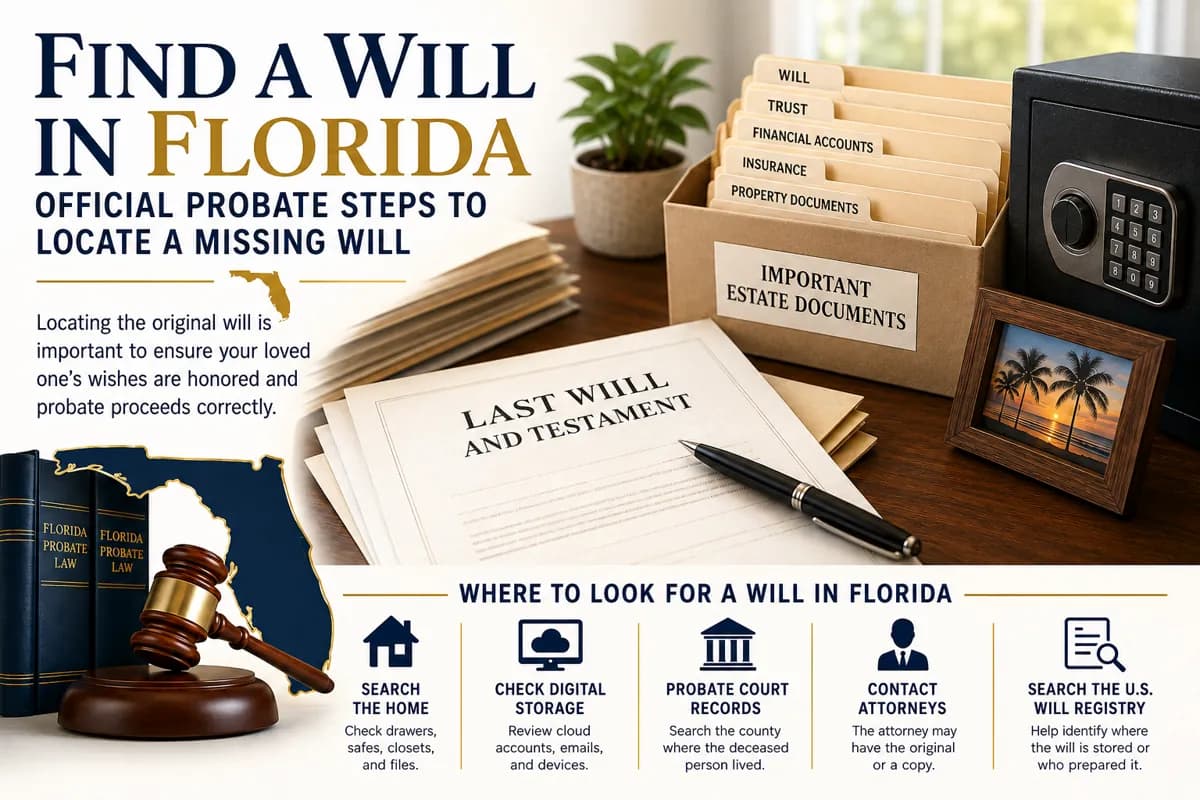
Find a will in Florida by searching probate court records, contacting estate planning attorneys, reviewing safe deposit boxes and digital storage, and searching national will registries. Florida does not maintain a statewide will database. Because Florida law requires the custodian of a will to file the original will with the clerk of court after death, probate records are often one of the first and most important places families should search.
Many Florida families struggle to locate an original will after a loved one dies. A missing will can delay probate, create inheritance disputes, and potentially change who inherits property under Florida law.
Florida does not maintain a centralized registry containing every will filed or created within the state. As a result, families often need to search multiple locations, including probate court records, the deceased person’s home, digital storage accounts, estate planning attorneys, financial advisors, and national will registries.
Many families also search The U.S. Will Registry to determine whether a will was registered and identify where the original document may be stored or which attorney prepared it. Acting quickly can help preserve inheritance rights, reduce probate delays, and ensure the deceased person’s final wishes are properly carried out.
A valid Florida will determines who inherits property, who serves as personal representative, how debts are handled, and whether specific gifts were intended. If no will is found, Florida intestate succession laws determine who inherits instead.
That can dramatically change the outcome of an estate.
For example:
Because of this, locating the original will before probate moves too far forward is extremely important.
The article “How To Find Out If Someone Has A Will” explains additional ways families may confirm whether estate planning documents exist.
Florida probate law contains important legal requirements regarding wills after death.
Under Florida Statute §732.901, the custodian of a will must deposit the original will with the clerk of court within 10 days after learning of the death.
Many people mistakenly believe wills remain permanently private. However, once a will is filed with Florida probate court, it generally becomes part of the public probate record.
That means interested parties may often access:
Because of this, probate court records are one of the most important places to search for a will in Florida.
The article “How To Find Out If A Will Was Filed In Court” explains how probate filings can help confirm whether a Florida will was already submitted to the clerk of court.
Many Florida wills are eventually discovered inside the home.
Therefore, families should carefully search before assuming no will exists.
Look inside:
Some individuals intentionally hide wills in unusual places to prevent theft or accidental discovery.
Florida residents also increasingly maintain digital copies of estate documents. Because of this, families should additionally review:
Even if the original cannot immediately be found, copies may still help identify the attorney who drafted the will or establish evidence of the estate plan.
Probate proceedings in Florida are generally filed in the county where the deceased person lived.
Therefore, families should search the probate court in that county first.
Many Florida counties provide searchable online probate systems, including:
Most searches require:
If probate already started, the will may already be available through the court file.
The article “What Is Probate” explains how Florida probate administration begins and where wills are commonly filed after death.
In Florida, wills generally remain private while the person is alive. However, once the will is filed with probate court after death, it usually becomes public record.
That means interested parties may often review:
Because of this, probate court searches are often one of the fastest ways to determine whether a will exists.
The article “Can You View A Will Online” explains when probate court records and wills may become publicly accessible after death.
A large percentage of Florida wills are prepared by attorneys.
Because of this, families should contact:
Some Florida attorneys retain original wills for safekeeping.
Even if they do not possess the original document, they may still have:
Old invoices, legal correspondence, business cards, and emails may help identify the attorney involved.
Florida does not operate a centralized statewide will registry. Because of this, many families also search The U.S. Will Registry when trying to locate a missing will.
The U.S. Will Registry was created to help surviving family members identify where a will may be stored or determine which attorney may have prepared it so probate can continue according to the deceased person’s wishes.
The registry helps families:
Importantly, the registry does not publicly display the contents of the will. Instead, it helps identify where the original document may be located if it was registered.
The U.S. Will Registry also offers the most respected, user-friendly, FREE legal online will program available to the public. The system allows individuals to create, update, register, and securely store legally valid wills online.
Finding a copy of the will is still extremely important.
Copies may help establish:
Florida courts may allow probate of a lost or destroyed will under certain circumstances. However, strong evidence is usually required.
The court may require proof that:
Because of this, families should preserve every draft, copy, email, and related estate document they locate.
The article “What Happens When the Original Will Can’t Be Found” explains how probate courts may handle a copy of a will.
If no valid will can be located, the estate usually proceeds under Florida intestate succession laws.
That means Florida law determines who inherits property.
Generally, inheritance passes to:
Unfortunately, intestate succession often creates unintended results.
For example:
Because of this, Florida probate courts encourage families to continue searching carefully before concluding that no will exists.
The article “How To Claim An Inheritance Without A Will” explains how inheritance rights change when no valid will can be located.
Many wills are eventually discovered months later because families overlooked common storage locations.
Frequently missed locations include:
Some Florida retirees also maintain estate documents in another state after relocating to Florida. Because of this, families should investigate both Florida and former home states when appropriate.
Some missing will situations become legally complicated.
You should strongly consider contacting a Florida probate attorney if:
Early legal guidance may help avoid expensive probate litigation later.
The article “Challenging A Will” explains how inheritance disputes and suspicious estate document changes can lead to probate litigation.
Finding a will in Florida often requires persistence, organization, and knowledge of Florida probate procedures.
Families should begin with the home, digital records, attorneys, and financial advisors. Then they should search probate court filings and national will registries before concluding that no will exists.
Most importantly, families should remember that many missing wills are eventually discovered after careful searching.
Acting quickly may help protect inheritance rights, reduce probate delays, and ensure the deceased person’s final wishes are properly carried out.
Yes. Once a will is filed with probate court after death, it generally becomes public record in Florida. Interested parties may often review probate filings, executor appointments, and estate administration records through the county clerk of court.
If no valid will can be located, the estate usually proceeds under Florida intestate succession laws. However, Florida courts may sometimes allow probate of a lost will if strong evidence proves the contents and validity of the missing document.
Possibly. Florida courts may allow probate of a lost or destroyed will if strong evidence proves the contents and validity of the missing document. Copies, drafts, attorney records, and witness testimony may help establish the existence of the original will.
Florida does not operate a centralized statewide will registry. However, families may search The U.S. Will Registry to determine whether a will was registered and identify where it may be stored or which attorney may have prepared it.
This article was prepared by estate planning researchers and reviewed by S. Miller and staff. With more than 25 years of experience in estate planning documentation and probate processes, our editorial oversight ensures clarity and accuracy. This content is provided for informational purposes only and does not constitute legal advice.
[View Our Editorial Policy]