

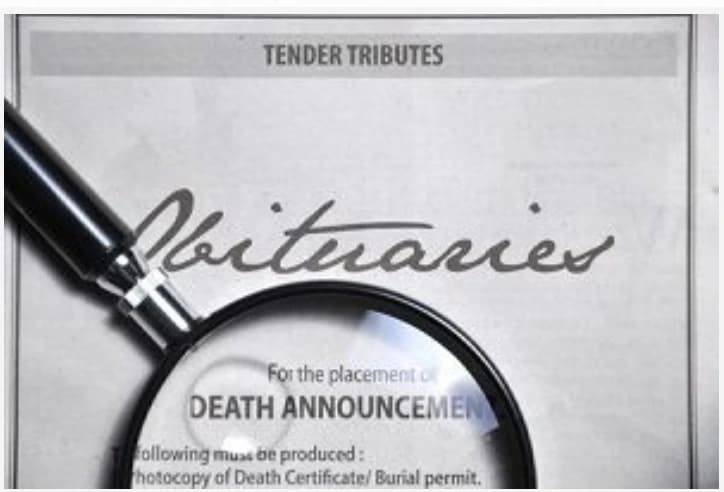
Death notice vs obituary refers to two different ways of announcing and remembering a person’s death. A death notice is a brief public announcement that typically includes the person’s name, date of death, and funeral arrangements. An obituary is a more detailed tribute that shares the person’s life story, accomplishments, family relationships, and legacy.
While death notices focus on informing the public, obituaries preserve memories and celebrate a person’s life. Understanding the differences helps families decide whether to publish a simple announcement, a personal memorial, or both.
Understanding the difference between a death notice vs obituary can help families choose the option that best meets their needs. This guide explains the key distinctions, provides examples, and discusses where to publish each type of announcement.
A death notice is a brief public announcement of someone’s passing. It usually includes:
The purpose of a death notice is to notify friends, relatives, and the community that someone has died.
Johnathan Robert Smith, 78, of Chicago, Illinois, passed away on March 12, 2026. A memorial service will be held at St. Mary’s Church on March 16 at 2:00 p.m. In lieu of flowers, donations may be made to the American Cancer Society.
Death notices are intentionally short and factual. They focus on essential information rather than personal stories or achievements.
An obituary is a more detailed tribute that honors a person’s life. In addition to announcing the death, it often shares:
Unlike a death notice, an obituary tells the story of the deceased and celebrates their legacy.
In Loving Memory of Margaret Louise ThompsonMargaret Louise Thompson, 82, of Portland, Oregon, passed away peacefully on June 14, 2026, surrounded by her family.
Born on May 2, 1943, in Salem, Oregon, Margaret dedicated her life to her family, her church, and her community. She spent more than 30 years as a public school teacher, inspiring generations of students through her kindness, patience, and love of learning.
After retirement, Margaret volunteered at the local food bank and mentored young educators through church outreach programs. She enjoyed gardening, quilting, and hosting Sunday dinners for family and friends.
She is survived by her daughters, Emily Harper and Rachel Benson; her grandchildren, Jacob, Lily, and Noah; and her brother, James Whitman.
A celebration of life will be held at Grace Memorial Church on June 22, 2026.
Margaret’s compassion, generosity, and unwavering love will continue to inspire all who knew her.
| Feature | Death Notice | Obituary |
|---|---|---|
| Length | Brief (2–5 sentences) | Detailed (multiple paragraphs) |
| Purpose | Announce a death | Honor and celebrate a life |
| Content | Basic facts and funeral details | Life story, achievements, family, legacy |
| Written By | Family or funeral home | Family, friends, or professional writer |
| Publication | Newspapers, funeral homes, online memorials | Newspapers, memorial websites, social media |
While both serve an important purpose, a death notice focuses on informing others, whereas an obituary provides a lasting tribute.
Families often publish a death notice or obituary in more than one place. The best option depends on the audience they want to reach, their budget, and how long they want the memorial to remain available online.
Local newspapers are a traditional choice and help inform the local community. However, newspapers often charge by the word or length of the notice.
Funeral home websites provide a convenient place for service information, condolences, and memorial details.
Social media allows families to quickly share news with friends and relatives, although posts may become difficult to find over time.
Online memorial and obituary websites provide a permanent location where family members and future generations can search for and revisit the obituary. For families seeking a free option, The U.S. Will Registry offers free online death notices and obituary listings that can be posted and searched by the public.
Many families choose to publish a short death notice in a newspaper and a longer obituary online to preserve the person’s story and make it easily accessible in the future.
POST OR SEARCH
DEATH NOTICE AND OBITUARYFree
Most death notices and obituaries are publicly accessible because families voluntarily publish them through newspapers, funeral homes, or online memorial websites.
However, they are not government-issued records, and not every death results in a published obituary. Some families choose private services or decide not to publish any announcement.
Because publication is voluntary, no single website contains every obituary or death notice. Researchers often need to search multiple sources, including newspapers, funeral home websites, genealogy databases, and memorial platforms.
Common places to publish a death notice include:
Obituaries are commonly published on:
Losing a loved one is never easy, and making decisions during grief can feel overwhelming. Understanding the difference between a death notice vs obituary can make the process easier.
A death notice provides a brief public announcement of a person’s passing and funeral arrangements. An obituary offers a more detailed tribute that honors the person’s life, achievements, and legacy.
Many families choose to publish both—a short death notice to inform the community and a longer obituary to celebrate the person’s life and preserve their memory.
Related Article: If you are also searching for important estate documents after a death, you may find this guide helpful: How to Locate a Lost Will
A death notice is a brief announcement that informs the public about a person’s passing and funeral arrangements. An obituary is a longer tribute that shares the person’s life story, accomplishments, family relationships, and legacy. While death notices focus on facts, obituaries celebrate the individual’s life and preserve their memory for future generations.
Many families choose to publish both. A death notice quickly informs friends and relatives about funeral or memorial services, while an obituary provides a more personal and lasting tribute. Publishing both allows families to share important details immediately and preserve memories, achievements, and stories that honor their loved one’s life.
The best place depends on your goals and audience. Local newspapers reach the community, funeral home websites provide service details, and online memorial sites offer long-term accessibility. Many families also use free online obituary platforms to preserve memories and make notices searchable by future generations, relatives, and genealogical researchers.
Death notices and obituaries are generally public because families voluntarily publish them through newspapers, funeral homes, or online memorial websites. However, they are not official government records, and not every death results in a published notice. Availability varies depending on where the announcement was published and whether the family chose to make it public.
This article was prepared by estate planning researchers and reviewed by S. Miller and staff. With more than 25 years of experience in estate planning documentation and probate processes, our editorial oversight ensures clarity and accuracy. This content is provided for informational purposes only and does not constitute legal advice.
[View Our Editorial Policy]