
An estate search to locate a will may involve two types of Register of Wills resources: a National Will Registry and a County Register of Wills or Probate Court. Both can help families locate information needed to settle an estate, but they search different records. A National Will Registry can help locate information about a registered will, while a County Register of Wills or Probate Court can determine whether a will has already been filed locally. Depending on the circumstances, a family may need to search both.
When someone dies, time can be important when locating a will and beginning the estate settlement process. States have their own probate laws, procedures, and time requirements. These may include deadlines affecting court filings, notices, claims, or the exercise of certain legal rights.
Locating the will as early as possible helps determine the deceased person’s wishes, identify the person chosen to administer the estate, and establish who may be entitled to inherit.
Delays can also create practical problems. When family members do not know whether a will exists or cannot find the original, uncertainty can lead to disagreements and tension over how the estate should be handled.
For these reasons, families should begin searching promptly.
The two resources provide different ways to search for information about a deceased person’s will.
A National Will Registry provides a nationwide resource for locating information about registered wills. It can be useful when the original will cannot be found, the drafting attorney is unknown, or the family does not know where the document was stored.
A County Register of Wills or Probate Court maintains probate and estate records for a specific jurisdiction. It can help determine whether an estate has been opened and whether a will has already been filed with the court.
Understanding the difference helps families determine where to search and whether both resources may be necessary.
The U.S. Will Registry has assisted families and estate professionals with locating registered wills since 1997.
Estate planning attorneys can register their clients’ wills, and individuals can register their own wills at no cost. Free registration removes financial barriers and supports the Registry’s purpose of helping families locate a loved one’s will when it is eventually needed for estate settlement.
Once registered, the record remains in The U.S. Will Registry until the person would have reached 125 years of age. This helps ensure the registration remains available regardless of how many years pass between creating the will and the person’s death.
This can be particularly valuable if the person moves, the drafting attorney retires or closes a practice, or family members simply do not know where the original will was kept.
The U.S. Will Registry does not store the actual will. Instead, registration information can help identify where the original will is stored and/or the attorney who drafted it.
Families trying to locate a missing will can search The U.S. Will Registry.
The next step depends on whether a will registration is found.
When a registration is located, the family can receive information that helps identify where the will is stored and/or the attorney who drafted it.
This provides a direct lead for obtaining the will and moving forward with the estate settlement process.
Not finding a registration does not mean the deceased person never created a will.
The U.S. Will Registry provides a personalized guide based on the searcher’s relationship to the deceased. The guide provides information about potential legal rights and how to proceed in determining what the person may be entitled to through the estate.
The information can differ depending on whether the person searching is a surviving spouse, child, other relative, or another person with a potential interest in the estate.
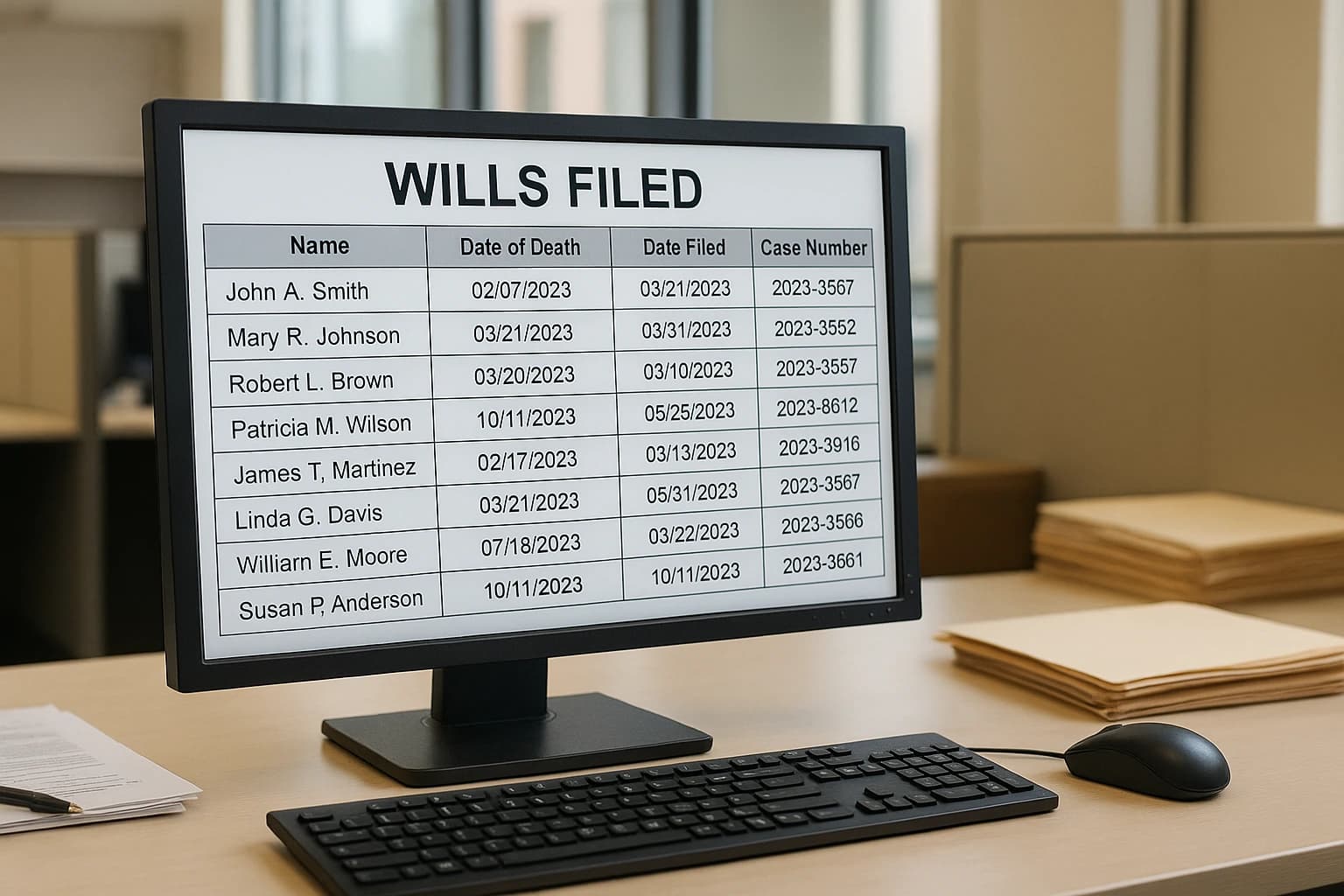
A County Register of Wills or Probate Court maintains records associated with probate and estate proceedings within its jurisdiction.
An estate search may provide information such as:
Not every jurisdiction uses the title Register of Wills. Similar responsibilities may be handled by a Probate Court, Surrogate’s Court, Clerk of Court, County Clerk, Probate Division, Orphans’ Court, or Register in Probate.
Begin with the county or probate jurisdiction where the deceased person lived at the time of death.
Many jurisdictions provide an online probate or estate case search. The deceased person’s full legal name is generally the starting point, although additional identifying information may be required.
If online records are unavailable, contact the appropriate probate office and ask how to search its estate records or request copies of filed documents.
For more detailed instructions, see How to Find Out If a Will Was Filed.
A will can be created and privately stored for years before it ever reaches a probate court. Until someone submits the will to the appropriate probate authority, it may not appear in a County Register of Wills or Probate Court search.
For example, a family may search county probate records shortly after a death and find nothing because an estate has not yet been opened. A National Will Registry search may provide information that helps locate the will so the family can begin the appropriate estate proceedings.
On the other hand, probate may already have been opened and the will filed. In that situation, the County Register of Wills or Probate Court may provide the information the family needs.
The two searches therefore address different stages and circumstances in locating a will and settling an estate.
Moving can make locating a will more complicated.
A person may have prepared a will while living in one state, moved to another state, continued using an attorney from the previous state, or later created a new will.
Begin the probate-record search in the jurisdiction where the deceased person lived at the time of death. However, previous residences may provide additional leads.
A National Will Registry search can be especially useful in this situation because it is not confined to the probate records of one county. Previous addresses, attorney correspondence, and estate planning documents can also help identify where the will was prepared or stored.
If the will has not been located through the initial searches, investigate places where the deceased person may have kept important documents.
These may include:
Also look for a copy of the will. Even if it is not the original, it may contain the drafting attorney’s name, execution date, witnesses, nominated executor, or other information that provides a useful lead.
For a more detailed search process, see How to Find a Will.
Yes. If you know which attorney or law firm prepared the deceased person’s estate plan, contact that office.
The attorney may know whether the original will was retained by the firm, returned to the client, or placed somewhere else for safekeeping.
If the attorney is unknown, legally accessible trusts, powers of attorney, advance directives, correspondence, email, and financial records may identify the attorney or law firm involved in the person’s estate planning.
No. A County Register of Wills maintains probate and estate records for its jurisdiction. A National Will Registry provides a nationwide resource for locating information about registered wills. They perform different functions when a family is trying to locate a will.
No. A will can be created and privately stored without being filed with a probate court during the person’s lifetime. Therefore, the absence of a will from county probate records does not establish that no will exists.
Yes. A person may create a will years or decades before death. Until someone submits the will to the appropriate probate authority, it may not appear in the county’s probate records.
Begin with the probate jurisdiction where the deceased person lived at the time of death. Previous states and counties may also provide useful leads. A National Will Registry can be particularly helpful because its search is not limited to the deceased person’s final county of residence.
Start by determining what information is missing.
When the family cannot locate the will itself, a National Will Registry can help search for information about a registered will.
To determine whether a will has already been filed in probate, search the appropriate County Register of Wills or Probate Court.
When neither search provides the information needed, continue investigating attorneys, previous residences, personal records, financial documents, and other sources that may provide clues to the will’s location.
Search The U.S. Will Registry for a missing will.
The U.S. Will Registry has assisted families and estate professionals with locating registered wills since 1997. This guide is based on the Registry’s experience helping families search for wills and understand the next steps when a registration is or is not found.
This article provides general educational information and is not legal advice. Probate procedures, terminology, deadlines, and legal rights vary by state and jurisdiction.
This article was reviewed for legal accuracy by Shawn Patrick Wolf, Esq. Mr. Wolf is Board Certified in Wills, Trusts and Estates and in Tax Law. He serves on the Board of Directors of the East Coast Estate Planning Council and the Palm Beach Tax Institute.
