
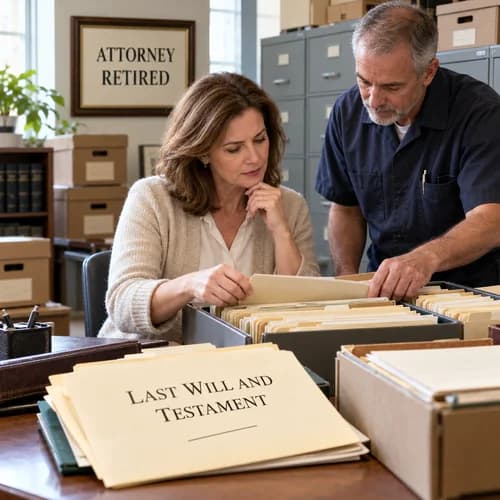
When the attorney who drafted a will retires or dies, the original may be held by another attorney, the former firm, an attorney appointed to wind down the practice, or a court. The attorney may also have returned it to the client. Start with a search of The U.S. Will Registry, then contact the former firm and ask the state bar who took responsibility for the files.
Some attorneys keep signed original wills in their office vaults for clients. Others return the original to the client. When the attorney later retires, sells the practice, or passes away, families may be left holding a copy (or nothing at all) and a phone number that no longer works.
Bar rules and ethics opinions in many states treat original wills as client property that must be safeguarded, not thrown away. The task is figuring out who has the will now. For a broader look at every place to search, see How to Find a Will.
That is why it is worth tracking down the original before assuming it is gone.
Follow these steps to find out who took custody of the attorney’s files and locate the will or a copy.
Before making calls, collect every clue you can find:
Check desk drawers, filing cabinets, safe deposit box inventories, and old bank or billing records for anything with the law firm’s name on it.
If you do not know which attorney prepared the will, see How to Find the Attorney Who Wrote a Will.
Start with a search of The U.S. Will Registry. Since 1997, attorneys and individuals have registered over 2 million wills, recording where the original is stored, the attorney who prepared it, and who is authorized to receive it. A matching registration may identify a storage location or an attorney connected with the will. If the information is older, it can still be a useful lead to whoever took over the files.
The one-time search fee is $19.95 and covers up to 3 searches, allowing for name variations or misspellings. To protect privacy, the will’s location is released only to individuals authorized in the registration, after a death certificate and photo ID are verified. If no registration is found, participating attorneys are notified that someone is searching for a matching will. Every search also comes with guidance based on your relationship to the deceased on how to proceed whether or not a will is found, which helps families avoid legal fees until an attorney is truly needed.
Every state bar has a public lawyer lookup on its website. Search the attorney’s name to see whether they are listed as retired, inactive, or deceased. Then call the bar and ask:
Bar staff cannot give legal advice, but they can often tell you who took custody of the files.
If the attorney worked in a firm, call the firm directly. If the practice was sold, the buyer was typically required to notify clients in writing, so look for that letter among the deceased person’s papers.
When you call, have a certified death certificate ready and ask what identification and proof of authority the custodian requires. Family relationship alone may not be enough. Many custodians release the original only to the named executor, an attorney handling the estate, or directly to the probate court.
If the attorney practiced alone and died, the attorney’s executor or family may still have the files. Ethics opinions in some states allow the executor of a deceased lawyer’s estate to review stored wills in order to identify the people involved and return them. A local obituary or probate filing for the attorney can help you identify who is handling their affairs.
Call the probate court clerk (sometimes called the Register of Wills or Surrogate’s Court) in:
Ask whether a will was deposited for safekeeping under the decedent’s name. Some courts keep wills deposited by retiring lawyers for many years, and some release them only after receiving a certified death certificate.
Some county and local bar associations keep their own records of where a retired or deceased member’s files went, and a few run local will registries. A short phone call can save weeks of searching.
A copy is still valuable. It may help establish the will’s contents and identify the drafting attorney or witnesses, which can lead you to the original. If the original truly cannot be found, many states allow a copy to be offered for probate through a separate proceeding, but the rules vary. This is the point where speaking with a probate attorney is worth the cost. For more, see what to do when the original will cannot be found.
Generally, no. Ethics rules and opinions in many states treat original wills as client property that must be safeguarded, returned, transferred to another lawyer, or deposited with a court as state law allows.
It depends on the custodian and the state. Many release it only to the named executor, an attorney handling the estate, or directly to the probate court, and they may ask for proof of authority.
Some courts charge a small fee and require a certified death certificate or court order before releasing or opening a deposited will. Call the clerk to confirm.
Wills from long-closed practices are often passed from firm to firm or deposited with a court. Start with a registry search, then work through the state bar and the probate courts in both counties.
Not to start. You can search the registry, call the state bar, and contact the probate court yourself. An attorney becomes important if the will is found and needs to be probated, or if only a copy exists.
This article provides general information and is not legal advice. Laws vary by state. For guidance on a specific estate, consult a licensed probate attorney in the state where the person live
This article was reviewed for legal accuracy by Shawn Patrick Wolf, Esq. Mr. Wolf is Board Certified in Wills, Trusts and Estates and in Tax Law. He serves on the Board of Directors of the East Coast Estate Planning Council and the Palm Beach Tax Institute.
