
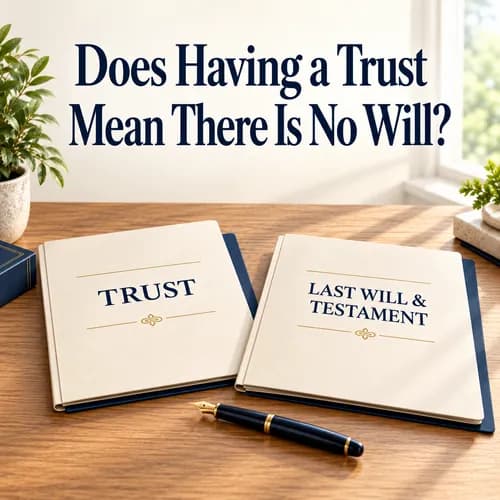
No. Having a trust does not mean there is no will. Many people have both a trust and a will, often a living trust plus a separate pour-over will. The trust governs trust property, while the will may address assets outside it. Finding a trust is therefore a reason to check for related estate documents, rather than assume no will exists.
After someone dies, family members often find only part of the estate plan. They may discover a trust binder, a property deed, or an attorney’s letter. However, those records do not necessarily reveal every document the person signed.
Someone may say, “There is a trust, so we can stop looking.” That assumption can stop a search too soon.
Before deciding that no will exists, check the records and ask the right questions. A trust and a will can serve different purposes within the same estate plan.
Finding a trust gives you a starting point for further investigation. It may identify the drafting attorney, the successor trustee, and the date of the estate plan.
Use those details to ask whether the person also signed a will.
For example, a folder labeled “Living Trust” may contain several documents. Another folder may hold the original will. Alternatively, an attorney may retain the original while the family keeps copies.
The important question is whether you have located the complete, current estate plan.
Consider asking:
These questions help separate confirmed facts from family assumptions.
A living trust can govern property during the creator’s lifetime and after death. A trustee administers that property under the trust’s terms.
A will gives instructions for the person’s probate estate after death. It can also nominate an executor and a guardian for minor children. The American Bar Association explains these roles and distinguishes probate property from assets that pass through other arrangements. americanbar.org
The practical difference matters when you review documents. Seeing someone’s name in a trust does not tell you what every other asset does. For a deeper look at how these documents compare, read this side-by-side comparison guide.
| Question | Living trust | Will |
|---|---|---|
| What property does it generally address? | Property held in the trust | Property passing through the probate estate |
| Who administers it? | A trustee or successor trustee | An executor or personal representative |
| Can it operate during life? | Yes | Its estate-distribution instructions take effect after death |
| Can both documents exist together? | Yes | Yes |
Consequently, families should examine both documents when both exist. Neither document alone necessarily explains the entire estate.
A pour-over will directs covered probate assets into a trust after death.
Think of it as a backup for property that never entered the trust during the person’s lifetime. The Florida Bar explains that a revocable trust may not completely avoid probate. It can transfer remaining probate assets into the trust. floridabar.org
For instance, someone may create a trust and later open an individually owned account. If that account has no effective beneficiary arrangement, it may require separate attention after death.
The pour-over will may provide the missing instruction. However, transferring property under that will may still require probate.
A pour-over will does not automatically make every asset avoid probate. Its purpose is to coordinate covered estate property with the trust.
When you speak with the attorney or family, specifically ask about a pour-over will. Family members may not recognize that name as a type of will.
A will can cover responsibilities beyond managing the assets the plan already holds.
People acquire new property, change accounts, and overlook paperwork. As a result, the property they own may differ from the original plan.
The relevant question is whether each asset actually belongs to the trust or passes through another arrangement.
Parents can use a will to nominate a guardian for minor children. A court makes the appointment under applicable law.
The Santa Clara County Superior Court identifies guardian nominations and backup property transfers as reasons to have a will alongside a living trust. County of Santa Clara
An estate may need someone to handle matters outside the trustee’s responsibilities. The will can nominate that person.
Therefore, a will can remain meaningful even in a carefully funded estate plan.
A trust does not automatically eliminate probate for the entire estate.
Proper ownership and funding matter. Signing a trust agreement alone does not establish that every asset belongs to the trust.
The Florida Bar emphasizes that property must be properly transferred for a revocable trust to provide its intended probate benefits. Assets left outside it may require probate administration. floridabar.org
Nevertheless, finding a will does not prove that a full probate proceeding will be necessary. The answer depends on the assets and applicable state procedures.
Avoid making either assumption based solely on a document’s title. An estate attorney can review the actual ownership records.
A person can have a living trust without a separate will. However, that possibility does not prove that a missing will never existed.
If no valid will governs probate property, state intestacy laws generally determine who inherits that property. Those recipients may differ from the trust beneficiaries.
Meanwhile, valid trust provisions can continue to govern trust property. The court’s guidance on pour-over wills explains how property left out of the plan can create this difference. County of Santa Clara
For families, the practical step is to confirm the documents before reaching conclusions about inheritance.
“I have not found a will” and “there was no will” describe different situations. Keep that distinction clear when speaking with relatives or professionals.
Yes. A will can create a testamentary trust, which takes effect after death.
This differs from a living trust created during life. The American Bar Association uses the term testamentary trust for this arrangement. americanbar.org
Therefore, the word “trust” can refer to different arrangements.
Someone who says, “The children inherit through a trust,” might describe provisions contained within a will. Ask whether those provisions have their own separate agreement or are written into the testamentary document.
That question can help you identify which documents to locate.
Start with the people and records connected to the estate plan. Then expand the search if the first steps do not locate it.
Look for documents labeled “Last Will and Testament,” “Pour-Over Will,” or “Codicil.”
Also check correspondence, document lists, and instructions about original storage. A checklist can provide a useful lead, even when the document itself is missing.
Preserve what you find. Record where each document came from and whether it appears to be an original or copy.
Use the attorney’s name on the trust or related correspondence.
Ask whether the office prepared a will and knows where the original was stored. The firm may request proof of death and confirmation of your authority before releasing information.
If the attorney retired, ask whether another firm maintains the records.
The successor trustee may know where estate documents were kept. A spouse, adult child, or named executor may also have useful information.
However, ask what they have actually seen. A recollection that “everything was in a trust” does not settle the question.
Ask the probate clerk whether a will has been deposited or an estate case opened. Whether a filed will can be viewed depends on the court, as explained in are wills public record.
Filing requirements vary by state. For example, Florida requires a will’s custodian to deposit it with the appropriate clerk within 10 days of learning of the death. leg.state.fl.us
A court search can provide another lead. However, an empty search does not establish that no will was signed.
A registration may provide information about where a will was kept or which attorney prepared it.
You can use The U.S. Will Registry’s Missing Will Search as part of that effort.
The registry records will-location information rather than storing the physical will. A search cannot guarantee a match. Likewise, no match does not prove that no will exists.
For additional search steps, read How to Find a Will.
Ask for clarification before accepting that statement.
They may mean that the trust handles most property. They may also mean that the attorney advised against a separate will. Alternatively, they may simply misunderstand the documents.
A useful response is:
“Do we know whether a separate will or pour-over will was signed, and where the original is?”
This keeps the conversation focused on evidence. It also avoids assuming that anyone has intentionally withheld information.
Next, write down the documents located and the questions still unanswered. Share that list with the estate attorney.
If you already have a trust, confirm how every document fits into the plan.
Ask your attorney to identify the current documents and explain where the originals should remain. Also tell an appropriate trusted person how to locate them.
Finally, consider registering your will’s location. Update that information if the storage location or drafting attorney changes.
Clear instructions can spare your family an unnecessary search. They can also prevent someone from assuming that your trust means you left no will.
No. A trust does not prove that a will exists. However, many living-trust plans include one, so families should check.
Yes. Review the estate records, contact the drafting attorney, and ask whether a separate will was signed.
No. It is a separate document that directs covered estate assets into the trust after death.
No. You still need to identify the assets and the arrangements governing them. Some property may pass through beneficiary designations or ownership rights. americanbar.org
No. A document may exist without appearing in the records you searched. Continue checking other appropriate sources.
Confirm whether you have the complete estate plan. Locate related documents and seek clarification before making inheritance decisions.
Finding a trust should not end your search for a will. Check for a separate will, confirm the current documents, and use available records to locate them.
This article provides general U.S. estate-planning information. State laws and individual documents determine how a particular estate is handled.
This article was reviewed for legal accuracy by Shawn Patrick Wolf, Esq. Mr. Wolf is Board Certified in Wills, Trusts and Estates and in Tax Law. He serves on the Board of Directors of the East Coast Estate Planning Council and the Palm Beach Tax Institute.
