
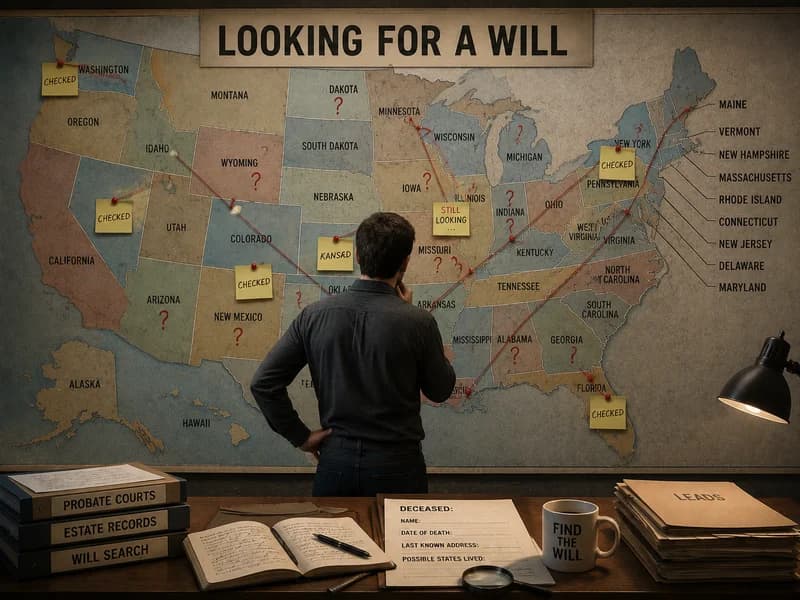
If your loved one lived, owned property, or passed away in another state, finding their will often requires searching beyond your local probate court. Before contacting courts across state lines, begin by identifying where your loved one permanently lived and search the most common places where wills are kept, including attorneys, family members, and The U.S. Will Registry. Then follow the probate procedures for the state where your loved one resided.
When someone dies in another state, families often don’t know where to begin.
You may not know:
Unlike searching within your own community, locating a will in another state may require working with courts, attorneys, banks, financial advisors, and family members hundreds or even thousands of miles away.
Fortunately, there are several steps you can take before contacting probate courts in another state.
Losing a loved one is difficult enough without trying to navigate another state’s legal system. If the deceased lived in another state—or owned a home, vacation property, or other assets outside your home state—you may wonder where to begin searching for their will.
Many people mistakenly believe that every will is automatically filed with a probate court. In reality, that is usually not what happens.
Most original wills remain with the person who created the will, the attorney who prepared it, the named executor, or another trusted custodian until after death. Even then, the will generally is not filed with a probate court until probate becomes necessary.
This becomes even more confusing when you live hundreds or thousands of miles away.
You may not know:
Fortunately, every state follows many of the same general principles, even though court names and procedures vary.
This guide explains the best way to begin searching for a will when your loved one lived in another state and then provides state-specific probate information for all fifty states.
Finding a will in another state presents challenges that families often do not anticipate.
For example:
Rather than immediately contacting multiple probate courts, it’s usually more efficient to narrow your search first.
Before spending days calling probate courts in another state, begin with the places where wills are most commonly found.
Those include:
Beginning with these resources often eliminates unnecessary travel and significantly reduces the amount of time required to locate an original will.
When the deceased lived or owned property in another state, you may not know which attorney prepared the will, where the original document is stored, or whether probate has already been opened.
Instead of immediately contacting probate courts across multiple counties or making an unnecessary trip, begin with The U.S. Will Registry.
Unlike probate court records, which generally contain wills only after they have been filed with the court, The U.S. Will Registry helps determine whether the deceased registered the location of their will during their lifetime.
For the small search fee, every search also includes a personalized Estate Settlement Guide based on your relationship to the deceased. Whether or not a will registration is found, you’ll receive information explaining your legal rights and practical guidance on how to proceed with the estate settlement process based on whether you are a surviving spouse, child, parent, sibling, executor, other relative, or friend.
This guidance can be invaluable during an already difficult time, especially when the deceased’s home, assets, and estate are located in another state. Many families find that it helps them understand their rights, responsibilities, and next steps before incurring legal fees simply to determine how to begin settling the estate.
In Alabama, a will becomes part of the public record once it’s submitted for probate. To find one, start with the Probate Court in the county where the person lived — that’s where an executor formally opens the estate and the court reviews and files the will.
Alabama probate is handled entirely at the county level. Each of Alabama’s 67 counties has its own elected Judge of Probate, and there is no single statewide probate court or portal. Online access varies significantly by county: larger counties like Jefferson, Mobile, Madison, Baldwin, and Shelby offer searchable online record databases, while smaller, rural counties may require a phone call, mailed request, or in-person visit. Alabama Code § 12-13-1 gives probate courts broad power to grant letters testamentary and administration and to probate wills, and under § 36-12-40, most probate records are public once filed.
Alabama Unified Judicial System — official statewide court website →
In Alaska, a will must be filed with the Superior Court to begin probate, and it’s the personal representative’s responsibility to locate the will and start the process. Once filed, it becomes part of the public probate record.
Alaska is unusual in that probate is handled by the Superior Court rather than a dedicated probate or surrogate’s court, and cases are organized by judicial district rather than county. Alaska has adopted the Uniform Probate Code and distinguishes between “informal” probate (the common, faster path when the will is uncontested and self-proving) and “formal” probate (used for will contests, disputes among heirs, or when the court’s direct supervision is needed). The Alaska Court System maintains a detailed public self-help center with step-by-step instructions and downloadable forms for both paths.
Alaska Court System — Probate Self-Help Center →
In Arizona, probate is opened in the Superior Court of the county where the person lived, and the will is filed as part of that process — either informally, if it’s uncontested, or formally, if the estate is more complex. Once probate begins, the will becomes a matter of public record.
Arizona routes probate matters through the Superior Court in the county where the decedent lived, and most cases proceed as “informal” probate unless the estate is large or heirs disagree, in which case a “formal” probate applies. Arizona no longer allows wills to be filed for safekeeping with the court before death, so a will only becomes part of the record once probate is opened. The Arizona Judicial Branch maintains a centralized statewide probate resource page with forms, an overview video, and FAQs that apply across counties, even though filing itself happens at the county courthouse.
Arizona Judicial Branch — Probate Resources →
In Arkansas, a will is filed with the Circuit Court’s Probate Division in the county where the person lived, and the named executor (or another qualified person) petitions the court to open probate and have the will formally admitted.
Arkansas has no stand-alone probate court — probate is handled by the Probate Division of the Circuit Court, and the Circuit Clerk in that county maintains the case file. Arkansas Code Title 28 governs wills, estates, and fiduciary relationships. Once the court appoints a personal representative, the Circuit Clerk issues letters testamentary (with a will) or letters of administration (without one) — the document banks and title companies will ask to see as proof of authority.
Arkansas Judiciary — official statewide court website →
In California, whoever has possession of a will is legally required to “lodge” it with the Superior Court once the person has died, even if a full probate case isn’t opened right away. Once lodged, it becomes accessible as part of the court record.
California probate cases are filed with the Superior Court in the county where the decedent lived, and the process is generically referred to as “probate court,” though it’s a division within each county’s Superior Court rather than a separate court. California’s Judicial Council maintains a comprehensive statewide self-help portal covering wills, estates, and probate, including current thresholds for when a full probate case is required versus a simplified small-estate transfer.
California Courts — Wills, Estates, and Probate Self-Help Guide →
In Colorado, probate begins when the will is filed with the District Court (or the Denver Probate Court, for Denver County) in the county where the person lived, and the named personal representative petitions the court to open the estate.
Colorado probate is handled by the District Court in the county where the decedent lived, with one notable exception: the City and County of Denver has its own dedicated Denver Probate Court (the 24th Judicial District) rather than routing through a general District Court. Colorado’s Probate Code (Title 15) governs the process statewide, and small estates under $80,000 with no real property may qualify for a simplified affidavit process instead of full probate.
Colorado Judicial Branch — Probate →
In Connecticut, a will is filed with the local Probate Court serving the town where the person lived — one of 54 individual courts statewide — and the estate is opened there rather than through a general trial court.
Connecticut is one of the few states with an entirely separate, statewide Probate Court system, each of its 54 courts with its own elected judge, operating independently from the regular Superior Court system. This makes Connecticut’s probate judges the only members of the state judicial branch chosen by election rather than appointment. The statewide Probate Court website offers a case lookup tool and a court locator to identify which district court serves a given town.
Connecticut Probate Courts — official statewide website →
In Delaware, a will must be brought to the Register of Wills in the county where the person lived, where it’s formally proved and entered into the probate record.
Delaware probate is handled by the Register of Wills, a distinct elected county office in each of Delaware’s three counties (New Castle, Kent, and Sussex) — not by Delaware’s well-known Court of Chancery, which handles business and equity matters instead. The Register’s office also processes inheritance tax filings, and Delaware allows the original will’s custodian to be held liable for damages if they fail to deliver it after a death is reported.
Delaware Courts — official statewide website →
In Florida, state law requires that whoever has custody of a will deposit it with the Clerk of Court within 10 days of learning the person died, even before probate is formally opened — which makes Florida’s process more time-sensitive than most states.
Florida probate proceeds through the Circuit Court’s probate division in the county where the decedent lived or owned property, filed through the county Clerk of Court. This 10-day deposit deadline comes from Florida Statute 732.901. Most Florida counties support electronic filing through the statewide Florida Courts E-Filing Portal.
Florida Courts — official statewide website →
In Georgia, a will is filed with the county Probate Court where the person lived, and the executor named in the will (or another interested party) petitions that court to have the will admitted to probate.
Every one of Georgia’s 159 counties has its own Probate Court and elected Probate Judge — Georgia has more counties, and therefore more probate courts, than almost any other state. In larger counties (population 96,000+), the Probate Court operates with expanded “Article 6” jurisdiction and the judge must be a licensed attorney; in smaller counties, the judge is not required to be an attorney. The Council of Probate Court Judges of Georgia maintains statewide standard forms used across all counties.
Council of Probate Court Judges of Georgia — official standard forms and resources →
In Hawaii, a will is filed with the Circuit Court in the judicial circuit where the person lived, and the executor petitions the court to open probate and have the will admitted.
Hawaii has a unified statewide court system with only four judicial circuits (Oahu, Maui, Hawaii Island, and Kauai), and probate is handled by the Circuit Court in each. Hawaii law gives up to five years after death to file for probate, though filing sooner is strongly advised to protect assets and pay debts. Once a will is admitted to probate, it becomes part of the public record, accessible through the Circuit Court’s Records Management Department.
Hawaiʻi State Judiciary — official statewide website →
In Idaho, a will is filed with the Magistrate Division of the District Court in the county where the person lived, and the process can move quickly if the will is uncontested and self-proving.
Idaho abolished separate probate courts back in 1971, folding probate matters into the Magistrate Division of the District Court instead. As a Uniform Probate Code state, Idaho offers both informal probate (faster, common for uncontested estates) and formal probate (for disputes), plus a small estate affidavit option for estates under $100,000 with no real property. Idaho probate records are public unless sealed by court order.
Idaho Courts — Probate Resources →
In Illinois, whoever has possession of a will is legally required to file it with the Circuit Clerk in the county where the person lived within 30 days of death — one of the more specific filing deadlines in the country.
Illinois probate runs through the Probate Division of the Circuit Court, with the Circuit Clerk maintaining case records. This 30-day filing requirement comes from 755 ILCS 5/6-1 and applies even before a formal probate case is opened. Illinois also allows estates under $150,000 with no real estate and no debts to skip probate entirely.
Illinois Courts — official statewide website →
In Indiana, a will is filed with the Circuit or Superior Court in the county where the person lived, and the named executor petitions the court to be appointed and have the will admitted.
Most Indiana counties route probate through the general Circuit or Superior Court, but St. Joseph County is the sole exception — it has its own dedicated Probate Court, one of only a handful of standalone probate courts nationwide. Indiana’s statewide Odyssey Case Management System allows online searching of probate records across most counties.
Indiana Courts — official statewide website →
In Iowa, a will must be filed with the District Court in the county where the person lived, and Iowa law expects this to happen “in a timely manner” once the custodian learns of the death, without setting one specific universal deadline.
Probate in Iowa runs through the District Court (one per county, organized into 8 judicial districts statewide), with the Clerk of District Court maintaining records. One helpful detail: some Iowa clerk of court offices will actually store a will for safekeeping before the person dies, so it’s worth checking directly with the county clerk if a will can’t otherwise be located.
Iowa Judicial Branch — official statewide website →
In Kansas, a will must be filed with the District Court in the county where the person lived within six months of death, or it risks being deemed invalid — one of the stricter filing deadlines nationally.
Kansas probate runs through the District Court’s probate section in each county, governed by the Kansas Probate Code (Chapter 59 of the Kansas Statutes). Kansas offers a Small Estate Affidavit for estates under $75,000 that lets heirs skip full probate. The Kansas Judiciary’s District Court Public Access Portal provides statewide online record searching.
Kansas Judicial Branch — official statewide website →
In Kentucky, a will is filed with the District Court in the county where the person lived, and the District Court handles the initial, uncontested probate of the will.
Kentucky splits probate jurisdiction: the District Court in each of the state’s 120 counties handles routine, uncontested probate matters, while contested wills move up to the Circuit Court. If a probate court rejects or admits a will and someone disagrees with that decision, they have two years to challenge it in Circuit Court. Kentucky’s statewide CourtNet 2.0 system allows online case searching by name or case number.
Kentucky Court of Justice — official statewide website →
In Louisiana, the process isn’t called “probate” at all — it’s called a “succession,” and it’s filed with the District Court in the parish where the person lived.
Louisiana is the only U.S. state built on a civil law tradition (drawing from French and Spanish law) rather than English common law, which is why its terminology and procedures differ from every other state on this list: parishes instead of counties, successions instead of probate. Louisiana is also the only state that allows a completely private, unwitnessed, sealed will. There is no strict filing deadline — a will can be filed up to five years after a succession has already been opened, which matters if an earlier will is later found to have been superseded.
Louisiana Supreme Court — official statewide judicial website →
In Maine, a will is filed with the Probate Court in the county where the person lived, and the Register of Probate can often handle straightforward, uncontested filings directly.
Maine has 16 individual county Probate Courts, each with its own elected Judge of Probate and Register of Probate — similar in structure to Georgia or Alabama. What sets Maine apart is a single, unified statewide records portal: filings from all 16 counties are searchable at maineprobate.net, making it one of the easier “many small county courts” states to search across.
Maine Probate Courts — statewide records portal →
In Maryland, a will is filed with the Register of Wills in the county (or Baltimore City) where the person lived, which serves as the clerk for the Orphans’ Court, Maryland’s probate court.
Every Maryland county and Baltimore City elects its own Register of Wills, who handles routine estate administration and collects inheritance taxes, while the Orphans’ Court hears disputes and more complex matters. Maryland offers a notable feature relevant to anyone thinking ahead: a living person can file their own will with the Register of Wills for safekeeping for a one-time $5 fee. Estate records statewide are searchable online through the Register of Wills’ Estate Search tool.
Maryland Register of Wills — statewide Estate Search →
In Massachusetts, a will is filed with the Probate and Family Court in the county where the person lived, and the executor petitions that same court to be appointed and have the will admitted.
Massachusetts combines probate and family law into one court — the Probate and Family Court — serving all 14 counties, a naming convention that’s easy to confuse with a family-law-only court elsewhere. Massachusetts offers three types of probate (formal, informal, and late/limited formal) plus a simplified voluntary administration option for small estates. The statewide MassCourts eServices portal allows searching dockets across all 14 counties, with documents available online back to 2009.
Mass.gov — Probate of Wills and Estates →
In Michigan, a will is filed with the Probate Court in the county where the person lived, and the named personal representative petitions the court to open the estate.
Every Michigan county has its own Probate Court, governed statewide by the Estates and Protected Individuals Code (EPIC). Beyond wills and estates, Michigan’s Probate Courts also handle a long list of related matters — guardianships, conservatorships, mental health commitments, and even examining a deceased person’s safe deposit box. Forms are standardized statewide through the State Court Administrative Office.
Michigan Courts — official statewide website →
In Minnesota, a will is filed with the District Court’s Probate Division in the county where the person lived, and there’s no fee to deposit a will with the court for safekeeping.
Minnesota probate runs through the District Court in each of the state’s 87 counties. Formal probate requires a hearing before a judge for more complex situations, while informal probate can move faster for straightforward, uncontested estates. The statewide Minnesota Court Records Online (MCRO) portal lets you search case records across all counties, though it’s explicitly not the certified, official record — certified copies still require contacting the local court.
Minnesota Judicial Branch — official statewide website →
In Mississippi, a will is filed with the Chancery Court in the county where the person lived — not a “probate court,” which doesn’t exist as a separate court in this state.
Mississippi is one of the clearest exceptions to the “probate court” naming convention: its Chancery Courts have exclusive jurisdiction over wills, estates, and the appointment of executors and administrators statewide. Mississippi has not adopted the Uniform Probate Code, instead maintaining its own statutory framework under Mississippi Code Title 91. If you’re searching in Mississippi, search for “chancery court” and the county name — not “probate court.”
Mississippi Judiciary — official statewide website →
In Missouri, a will must be admitted to probate within one year of death for it to remain valid, and it’s filed with the Probate Division of the Circuit Court in the county where the person lived.
Missouri’s 114 counties (plus the independent City of St. Louis) each have a Circuit Court with a dedicated Probate Division. The statewide Case.net portal, run by the Office of State Courts Administrator, is the fastest way to search across counties, though older historical probate files may only be available through the Missouri State Archives.
Missouri Courts — official statewide website →
In Montana, a will is filed with the District Court in the county where the person lived, but probate can’t formally begin until 120 hours (5 days) after the person’s death.
Montana has adopted the Uniform Probate Code, which keeps its process comparatively simple and inexpensive compared to non-UPC states — informal probate for uncontested estates doesn’t require a judge to approve every step. Probate is handled by 56 District Courts organized across 22 judicial districts, and Montana law generally expects probate to be filed and closed within two years of death, absent good cause for delay.
Montana Judicial Branch — official statewide website →
In Nebraska, a will is filed with the County Court in the county where the person lived — notably the County Court, not the District Court, which is the reverse of most states.
Nebraska’s 93 County Courts have exclusive original jurisdiction over probate matters statewide, a structural quirk worth knowing since “county court” sounds like a lower-level court in most other states. Nebraska doesn’t set a strict filing deadline beyond requiring it be done “in a timely manner,” though probate can’t be opened until 120 hours after death. The statewide JUSTICE case search system covers all 93 counties.
Nebraska Judicial Branch — Estates Self-Help →
In Nevada, the original will must be filed (“lodged”) with the District Court Clerk within 30 days of the person’s death, even before a formal probate petition is filed.
Nevada’s 11 judicial districts serve the state’s 17 counties, with the District Court holding exclusive jurisdiction over probate in the county where the person lived (or, for non-residents, any county where they owned property). Nevada scales its process by estate size — full administration, summary administration, or a small estates affidavit — depending on value.
Nevada Courts — official statewide website →
In New Hampshire, a will is filed with the Circuit Court’s Probate Division in the county where the person lived, and the Probate Division has exclusive jurisdiction over admitting it.
New Hampshire used to have separate, standalone Probate Courts, but in 2011 they were folded into the Circuit Court as its Probate Division — one division per county, ten total. The Circuit Court also runs a mediation program for contested probate matters at no charge to the parties, and statewide e-filing is available for estate, guardianship, and name-change cases.
New Hampshire Judicial Branch — Probate Division →
In New Jersey, a will is filed with the county Surrogate’s Court where the person lived, one of only two states (alongside New York) to use “Surrogate’s Court” as the official name for its probate court.
Each of New Jersey’s 21 counties elects its own Surrogate, and most uncontested probate matters are handled there without a formal court appearance. More complex or contested matters escalate to the Superior Court, Chancery Division, Probate Part. Since “surrogate” isn’t a term used almost anywhere else, it’s worth searching specifically for “Surrogate’s Court” plus the county name rather than “probate court” when searching in New Jersey.
New Jersey Courts — official statewide website →
In New Mexico, a simple, uncontested will can often be filed directly with the county’s own Probate Court — a separate, less formal option most states don’t offer.
New Mexico runs a genuinely two-tiered system: 33 county Probate Courts handle straightforward, informal probate cheaply (a $30 filing fee), while formal probate, contested wills, heirship disputes, and trust matters must go to the District Court instead. New Mexico also requires a five-day waiting period after death before any probate filing, and generally expects probate within three years of death.
New Mexico Courts — official statewide website →
In New York, a will is filed with the Surrogate’s Court in the county where the person lived — one of only two states, alongside New Jersey, to use “Surrogate’s Court” as the court’s official name.
Every one of New York’s 62 counties has its own Surrogate’s Court, and the presiding judge is formally addressed as “the Surrogate.” The court handles the probate of wills, administration of intestate estates, and guardianship matters, and — like New Jersey — the terminology is unique enough that searching “surrogate court” plus the county name works better than “probate court” in New York.
New York State Unified Court System — official statewide website →
In North Carolina, there’s no separate probate court at all — the elected Clerk of Superior Court in each county serves as the “ex officio” judge of probate.
All 100 North Carolina counties route probate through the Clerk of Superior Court’s office rather than a distinct probate court. North Carolina also allows a living person to deposit their will with the clerk for safekeeping — while alive, that deposited will is strictly private and can only be viewed by the named executor presenting a certified death certificate. The statewide NC Courts Public Access portal lets you search probate filings by name once a case is open.
North Carolina Judicial Branch — Wills and Estates →
In North Dakota, a will is filed with the District Court in the county where the person lived, and — unusually — a living person can deposit their will with the County Recorder (not the court) for safekeeping.
North Dakota has adopted the Uniform Probate Code, and its 8 judicial districts cover the state’s 53 counties. Informal probate is available for up to three years after death as long as the will isn’t disputed; after that window, formal probate through the District Court becomes necessary.
North Dakota Courts — official statewide website →
In Ohio, a will is filed with the Probate Division of the county’s Court of Common Pleas — often still called simply “Probate Court” even though it’s technically a division of a larger court.
Ohio’s 88 counties each maintain a Probate Division, and in a quirk that surprises many people, Ohio’s probate courts also issue marriage licenses and handle adoptions alongside estate matters. Ohio has flip-flopped on this structure historically: separate probate courts existed before statehood, were abolished in 1802, and reappeared in the 1851 constitution.
Supreme Court of Ohio — official statewide website →
In Oklahoma, a will is filed with the District Court in the county where the person lived, and the custodian of a will can be legally compelled by the court to produce it if they’re withholding it.
Oklahoma’s 77 counties each have a District Court with probate jurisdiction. One genuine convenience: the statewide Oklahoma State Courts Network (OSCN) lets you search probate case dockets across all counties at once from a single portal, rather than needing to know the correct county in advance.
Oklahoma State Courts Network — official statewide website →
In Oregon, a will is filed with the Circuit Court in the county where the person lived — except in six rural counties, which still use “County Court” instead.
Oregon’s 27 circuit court districts cover most of its 36 counties, but Gilliam, Grant, Harney, Malheur, Sherman, and Wheeler Counties retain a separate County Court for probate matters, a holdover structure worth knowing if you’re searching in one of those counties. Oregon will only release a filed will’s status information if an estate proceeding has actually been opened or the will was filed for safekeeping.
Oregon Judicial Department — official statewide website →
In Pennsylvania, a will is filed with the Register of Wills in the county where the person lived, an elected office that also serves as Clerk of the Orphans’ Court for more complex matters.
Each of Pennsylvania’s 67 counties elects its own Register of Wills, who probates wills and issues letters testamentary or administration, while contested or complicated matters escalate to the Orphans’ Court. The Register of Wills is also the state’s agent for collecting Pennsylvania’s inheritance tax, and many counties now offer online searching of probated estates.
Pennsylvania Courts — official statewide website →
In Rhode Island, a will is filed with the Probate Court of the specific city or town where the person lived — not the county, since Rhode Island doesn’t organize courts by county at all.
Every one of Rhode Island’s cities and towns runs its own municipal Probate Court, each with its own elected or appointed judge, typically meeting only once or twice a month. Because there’s no county-level index to search, forms are centralized statewide through the Rhode Island Secretary of State’s office, but you’ll still need to know the specific town to find the right court.
Rhode Island Secretary of State — Probate Forms →
In South Carolina, state law requires a will to be filed for probate within 30 days of death, with the county’s Probate Court handling the process.
Each of South Carolina’s 46 counties elects its own Probate Judge to a four-year term, with jurisdiction over estates, guardianships, conservatorships, and — notably — exclusive jurisdiction over trusts. Probate typically takes a minimum of nine months to complete, and the statewide South Carolina Probate database allows searching estate records once a case has been filed.
South Carolina Judicial Branch — Probate Court →
In New Mexico, a simple, uncontested will can often be filed directly with the county’s own Probate Court — a separate, less formal option most states don’t offer.
New Mexico runs a genuinely two-tiered system: 33 county Probate Courts handle straightforward, informal probate cheaply (a $30 filing fee), while formal probate, contested wills, heirship disputes, and trust matters must go to the District Court instead. In addtion, New Mexico also requires a five-day waiting period after death before any probate filing, and generally expects probate within three years of death.
New Mexico Courts — official statewide website →
In New York, a will is filed with the Surrogate’s Court in the county where the person lived — one of only two states, alongside New Jersey, to use “Surrogate’s Court” as the court’s official name.
Every one of New York’s 62 counties has its own Surrogate’s Court, and the presiding judge is formally addressed as “the Surrogate.” The court handles the probate of wills, administration of intestate estates, and guardianship matters, and — like New Jersey — the terminology is unique enough that searching “surrogate court” plus the county name works better than “probate court” in New York.
New York State Unified Court System — official statewide website →
In North Carolina, there’s no separate probate court at all — the elected Clerk of Superior Court in each county serves as the “ex officio” judge of probate.
All 100 North Carolina counties route probate through the Clerk of Superior Court’s office rather than a distinct probate court. North Carolina also allows a living person to deposit their will with the clerk for safekeeping — while alive, that deposited will is strictly private and can only be viewed by the named executor presenting a certified death certificate. The statewide NC Courts Public Access portal lets you search probate filings by name once a case is open.
North Carolina Judicial Branch — Wills and Estates →
In North Dakota, a will is filed with the District Court in the county where the person lived, and — unusually — a living person can deposit their will with the County Recorder (not the court) for safekeeping.
North Dakota has adopted the Uniform Probate Code, and its 8 judicial districts cover the state’s 53 counties. Informal probate is available for up to three years after death as long as the will isn’t disputed; after that window, formal probate through the District Court becomes necessary.
North Dakota Courts — official statewide website →
In Ohio, a will is filed with the Probate Division of the county’s Court of Common Pleas — often still called simply “Probate Court” even though it’s technically a division of a larger court.
Ohio’s 88 counties each maintain a Probate Division, and in a quirk that surprises many people, Ohio’s probate courts also issue marriage licenses and handle adoptions alongside estate matters. Ohio has flip-flopped on this structure historically: separate probate courts existed before statehood, were abolished in 1802, and reappeared in the 1851 constitution.
Supreme Court of Ohio — official statewide website →
In Oklahoma, a will is filed with the District Court in the county where the person lived, and the custodian of a will can be legally compelled by the court to produce it if they’re withholding it.
Oklahoma’s 77 counties each have a District Court with probate jurisdiction. One genuine convenience: the statewide Oklahoma State Courts Network (OSCN) lets you search probate case dockets across all counties at once from a single portal, rather than needing to know the correct county in advance.
Oklahoma State Courts Network — official statewide website →
In Oregon, a will is filed with the Circuit Court in the county where the person lived — except in six rural counties, which still use “County Court” instead.
Oregon’s 27 circuit court districts cover most of its 36 counties, but Gilliam, Grant, Harney, Malheur, Sherman, and Wheeler Counties retain a separate County Court for probate matters, a holdover structure worth knowing if you’re searching in one of those counties. Oregon will only release a filed will’s status information if an estate proceeding has actually been opened or the will was filed for safekeeping.
Oregon Judicial Department — official statewide website →
In Pennsylvania, a will is filed with the Register of Wills in the county where the person lived, an elected office that also serves as Clerk of the Orphans’ Court for more complex matters.
Each of Pennsylvania’s 67 counties elects its own Register of Wills, who probates wills and issues letters testamentary or administration, while contested or complicated matters escalate to the Orphans’ Court. The Register of Wills is also the state’s agent for collecting Pennsylvania’s inheritance tax, and many counties now offer online searching of probated estates.
Pennsylvania Courts — official statewide website →
In Rhode Island, a will is filed with the Probate Court of the specific city or town where the person lived — not the county, since Rhode Island doesn’t organize courts by county at all.
Every one of Rhode Island’s cities and towns runs its own municipal Probate Court, each with its own elected or appointed judge, typically meeting only once or twice a month. Because there’s no county-level index to search, forms are centralized statewide through the Rhode Island Secretary of State’s office, but you’ll still need to know the specific town to find the right court.
Rhode Island Secretary of State — Probate Forms →
In South Carolina, state law requires a will to be filed for probate within 30 days of death, with the county’s Probate Court handling the process.
Each of South Carolina’s 46 counties elects its own Probate Judge to a four-year term, with jurisdiction over estates, guardianships, conservatorships, and — notably — exclusive jurisdiction over trusts. Probate typically takes a minimum of nine months to complete, and the statewide South Carolina Probate database allows searching estate records once a case has been filed.
South Carolina Judicial Branch — Probate Court →
State Probate Guides: Batch 5 (South Dakota–Wyoming)
In South Dakota, a will is filed with the Circuit Court in the county where the person lived — sometimes still called “the probate court” locally, though it’s technically a division of the Circuit Court.
South Dakota’s seven judicial circuits cover all of its counties, and probate generally must begin within three years of death, with a few statutory exceptions. In addition, South Dakota doesn’t legally require an attorney for probate, and living trusts, joint ownership, and payable-on-death designations are all common ways estates avoid probate entirely.
South Dakota Unified Judicial System — official statewide website →
In Tennessee, a will is filed with the Chancery Court in the county where the person lived — unless that county has created its own separate Probate Court instead.
Tennessee’s 32 judicial districts each have a Chancery Court, and by default that’s where probate happens. However, a small number of counties — including Shelby (Memphis) and Davidson (Nashville) — have established dedicated Probate Courts that take over this role locally. If you’re searching in a major Tennessee city, check for a standalone Probate Court before defaulting to the Chancery Court.
Tennessee Courts — official statewide website →
In Texas, a will is filed with either a dedicated Statutory Probate Court or the general County Court, depending on which county the person lived in.
Additionally, Texas runs a genuinely two-tiered system: only 10 of Texas’s largest metro counties (19 courts total) have dedicated Statutory Probate Courts with elected judges; everywhere else, the County Court handles probate as part of its general jurisdiction. Texas also allows a living person to deposit their original will with the County Clerk for safekeeping — while they’re alive, it can only be released back to them or someone they’ve authorized in a sworn written order.
Texas Judicial Branch — official statewide website →
In Utah, a will is filed with the District Court in the county where the person lived, and informal probate can be opened as soon as five days after death.
Utah’s 8 judicial districts cover all 29 counties under the Utah Uniform Probate Code (Title 75), which offers informal probate (no hearing, handled through the clerk’s office), unsupervised formal probate (a hearing but no ongoing oversight), and supervised formal probate (full court oversight throughout). Formal probate generally must be filed within three years of death. Wills deposited for safekeeping before death are kept confidential.
Utah State Courts — official statewide website →
In Vermont, a will’s custodian has 30 days after learning of the person’s death to deliver it to the Probate Division of the Superior Court or to the named executor.
Vermont’s Probate Division has 14 elected judges statewide, one of the smaller judicial footprints among the states covered here, and it handles far more than estates — adoptions, name changes, and even authorizing nonresident clergy to perform marriages all fall under its jurisdiction alongside wills and trusts.
Vermont Judiciary — Probate Division →
In Virginia, a will is typically probated directly by the Clerk of the Circuit Court — not a judge — in the city or county where the person lived, making probate here an administrative rather than judicial process in most uncontested cases.
This is one of Virginia’s more distinctive features: unless someone appeals to a judge, the Clerk of Circuit Court handles the entire probate process, including qualifying the executor. Virginia also appoints a local “Commissioner of Accounts” — usually an attorney — to review and approve the estate’s inventories and accountings, an extra layer of local oversight most states don’t have.
Virginia’s Judicial System — Self-Help Probate →
In Washington, state law requires a will to be filed with the Superior Court within 40 days of death — but filing a full probate case afterward is entirely optional, not required.
Washington’s 39 counties each have a Superior Court, and while the will itself must be filed promptly, whether to actually open a probate case is left up to whoever’s handling the estate. Washington also offers a will repository service, letting a living person deposit their original will with the County Clerk for safekeeping before death for a small fee.
Washington Courts — official statewide website →
In West Virginia, a will is brought to the County Clerk within 30 days of death, and it’s the County Commission — not a court at all — that acts as the probate authority.
This is one of the more unusual structures covered here: each of West Virginia’s 55 counties has a County Commission, an executive/legislative body, that serves as the probate authority, with the County Clerk handling day-to-day filing. Disputes over a will’s validity are the exception — those go to the Circuit Court instead.
West Virginia Judiciary — official statewide website →
In Wisconsin, a will is filed with the Circuit Court in the county where the person lived, typically handled by an office called the “Register in Probate.”
Every Wisconsin county’s Circuit Court has a Register in Probate, a distinct clerk-level office (sometimes combined with the Clerk of Circuit Court) that manages estate, guardianship, and adoption filings. The statewide Wisconsin Circuit Court Access (WCCA) portal covers all counties for a records search, though a small search fee applies for mailed requests.
Wisconsin Court System — official statewide website →
In Wyoming, a will is filed with the District Court in the county where the person lived — Wyoming has no separate probate court at all.
Wyoming’s District Courts hold exclusive original jurisdiction over all probate matters statewide, governed by the Wyoming Probate Code (Title 2). District judges are appointed by the Governor from a shortlist provided by the Wyoming Judicial Nominating Commission, then stand for retention elections, similar to the process for Wyoming Supreme Court justices.
Wyoming Judicial Branch — official statewide website →
Begin by confirming the deceased’s state and county of residence at the time of death. Then contact the local probate court to ask whether a will has been filed. Additionally, search The U.S. Will Registry and check with the deceased’s attorney, financial professionals, or family members who may know where the will was stored.
Yes. Wills filed with a probate court become public record after the court accepts them. However, each state has different access rules. Some courts allow online searches, while others require in-person or mail requests. Be prepared to provide the deceased’s full name, date of death, and last known address.
If you cannot locate the will through the courts, family, or the attorney, the next step is to search The U.S. Will Registry. Even if the will was never registered, your search automatically alerts attorneys in that state through the Missing Will Database. If no will is found, the estate will likely be handled under intestate succession laws.
Often, yes. Because probate laws differ between states, hiring a local probate attorney can help you navigate deadlines, filing requirements, and differences in executor rules. A local attorney can also handle ancillary probate if the deceased owned property in more than one state, making the process far more efficient.
This article was reviewed for legal accuracy by Shawn Patrick Wolf, Esq. Mr. Wolf is Board Certified in Wills, Trusts and Estates and in Tax Law. He serves on the Board of Directors of the East Coast Estate Planning Council and the Palm Beach Tax Institute.
