

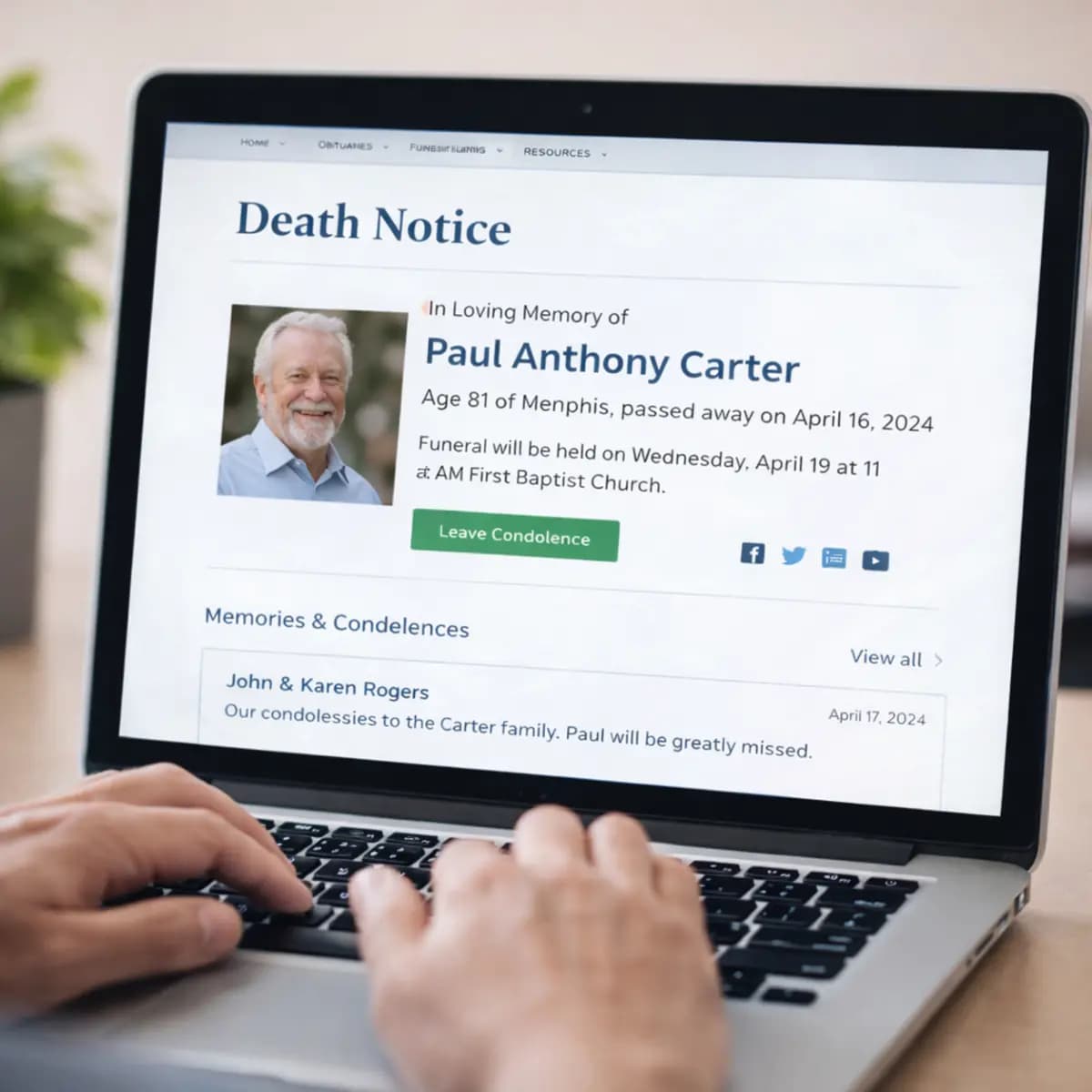
A death notice is a brief public announcement that informs family, friends, and the community that someone has died. Although it is not legally required in most states, many families publish one to share funeral or memorial service information, create a public record, and notify relatives, friends, and organizations of a loved one’s passing.
Whether you need to write, publish, or find a death notice, understanding how they work can make the process much easier during an already difficult time. This guide explains what a death notice is, how it differs from an obituary, what information to include, where to publish one, how much it may cost, and how to search for a published death notice.
Quick answer: A death notice is not legally required and is not legal proof of death—that role belongs to a certified death certificate. However, it plays an important role in informing the community, supporting estate administration, preserving historical records, and helping family and friends locate funeral or memorial service information.
A death notice is a brief public announcement that informs the community of someone’s passing. It typically includes:
Unlike a full obituary, a death notice is short and factual. It does not usually include an extended biography — instead, it focuses on the essential facts a community needs.
For a detailed comparison, see: Death Notice vs Obituary
Because a death notice is privately published by families, funeral homes, or media outlets, it is not the same as a death certificate, and it carries no legal weight on its own. Its value lies elsewhere — in the practical and human roles it plays, which the rest of this guide walks through.
Funeral homes frequently assist families by preparing and publishing death notices on local newspaper websites, funeral home websites, and online memorial platforms. Many also help ensure service information is accurate before publication.
Today, death notices may be published in local newspapers, funeral home websites, community memorial websites, or dedicated online death notice directories. Many families choose online publication because it reaches more people and remains searchable long after the funeral.
For step-by-step instructions on posting one yourself, see: How to Post a Free Death Notice
In practice, executors handle dozens of small tasks in the weeks after a death — notifying banks, canceling subscriptions, confirming dates for the court file — and a published death notice often becomes a quick reference point they return to throughout that process.
Estate administrators often recommend publishing a death notice early because it helps reduce confusion, provides a consistent public reference, and gives friends and extended family a reliable source for service information while official paperwork is being completed.
When someone dies, financial institutions, creditors, and government agencies must be notified. A certified death certificate is the official document required for legal transactions, but a death notice often provides earlier, informal confirmation of the date and location of death while that certificate is still being processed.
In addition:
A death notice is not legally mandatory in most states, but it supports transparency and gives everyone involved — family, courts, and institutions — the same starting facts to work from.
For a broader explanation of probate procedures, review: Probate Explained: Complete Guide
No — in most states, families are not required to publish a death notice, and doing so does not carry the legal weight of a death certificate. A death notice cannot be used as legal proof that someone has died; only a certified death certificate, issued by a state vital records office, serves that function.
That said, publication can still serve real legal and practical purposes:
There are a few narrower exceptions worth knowing about: probate courts in some jurisdictions require publication of creditor notices, and certain estates involve mandatory public filings. These are specific, court-driven requirements — not the same as the voluntary death notice most families publish, and the rules vary by state, so it’s worth checking with a local probate court or attorney if you’re unsure which applies to your situation.
For authoritative background on public records and legal documentation, see the Legal Information Institute at Cornell Law School.
If you’ve decided to publish a death notice, you can post one online for free or search existing death notices nationwide.
POST OR SEARCHDEATH NOTICE AND OBITUARYFreeSTART HERE →
Insurance companies, banks, and pension administrators require certified copies of a death certificate before releasing funds — a death notice can’t substitute for that. But it often plays a useful supporting role in the meantime:
That gap between the moment of death and the moment a certified death certificate is in hand can stretch to days or weeks. A death notice helps fill that gap with clarity, even though it doesn’t replace the official record.
Beyond estate logistics, a death notice does something more personal: it preserves a name, a date, and a life event in a way that outlasts memory.
A death notice:
Genealogists in particular rely on death notices to trace lineage and confirm family relationships, especially because not every historical death certificate is easy to access. In many cases, a published notice becomes the only publicly searchable record of when and where someone died.
For guidance on locating an older or historical notice, see: Find a Death Notice
Did You Know? Most death notices are published within a few days after a death and remain searchable online for years afterward, making them valuable resources for family members, genealogists, and historical researchers.
Publishing a death notice creates an openly accessible acknowledgment of death, which can:
Privacy is a legitimate concern, and not every family wants a public notice — but many choose to publish precisely because it creates that openness. Responsible platforms maintain moderation standards to keep that trust intact. The U.S. Will Registry, for example, has provided free death notice posting since 1997, with content guidelines that prohibit false or misleading announcements.
Legal and financial logistics aside, a death notice does something no court filing can: it gives a community a moment to grieve together.
Death notices:
Families often value that public acknowledgment just as much as any procedural benefit — a death notice marks a life, not just a case file.
It’s worth being direct about this: a death notice is not legal proof of death. All three documents relate to a death, but each serves an entirely different purpose:
|
Feature |
Death Notice |
Obituary |
Death Certificate |
|
Purpose |
Announces a death |
Honors and tells the person’s life story |
Official legal record of death |
|
Length |
Brief |
Detailed |
Official government document |
|
Legal Status |
No |
No |
Yes |
|
Published By |
Family, funeral home, newspaper, or website |
Family or funeral home |
State vital records office |
|
Includes Funeral Details |
Usually |
Often |
No |
|
Used for Legal Matters |
No |
No |
Yes |
For official guidance on how death certificates are issued and maintained, see the Centers for Disease Control and Prevention. Because these documents serve different roles, most families end up using more than one during estate settlement — one for the paperwork, one for the community.
Even though publication is optional, most families publish anyway. The reasons tend to repeat:
Publishing also means future searches — whether from a distant relative, a genealogist, or an old friend — can confirm the basic facts long after the immediate family has moved on.
Need to Publish or Find a Death Notice?
Post a free death notice or search existing notices nationwide using The U.S. Will Registry’s free Death Notice service.
Is a death notice legal proof that someone died?
No. Only a certified death certificate, issued by a state vital records office, serves as legal proof of death. A death notice is a public announcement with no legal standing on its own.
Do I have to publish a death notice?
In most states, no. A handful of narrow exceptions exist — such as court-required creditor notices in some probate cases — but a traditional death notice is voluntary.
What’s the difference between a death notice and an obituary?
A death notice is short and factual (name, dates, service details). An obituary is longer and tells the story of the person’s life.
Why publish a death notice if it’s not required?
Families do it for community notification, historical and genealogical record-keeping, and personal closure — benefits that exist independent of any legal requirement.
A death notice is not a legally required government document, and it is not legal proof of death — that responsibility belongs to the certified death certificate alone. But within that boundary, it plays a real role: supporting probate logistics, informing family and community, and preserving a searchable record for the future.
A death certificate carries legal authority. A death notice carries practical, social, and historical value. Knowing where that line sits helps families make informed, confident decisions about publication during an already difficult time.
This article was prepared by estate planning researchers and reviewed by S. Miller and staff. With more than 25 years of experience in estate planning documentation and probate processes, our editorial oversight ensures clarity and accuracy. This content is provided for informational purposes only and does not constitute legal advice.
[View Our Editorial Policy]