

Last updated: November 11, 2026
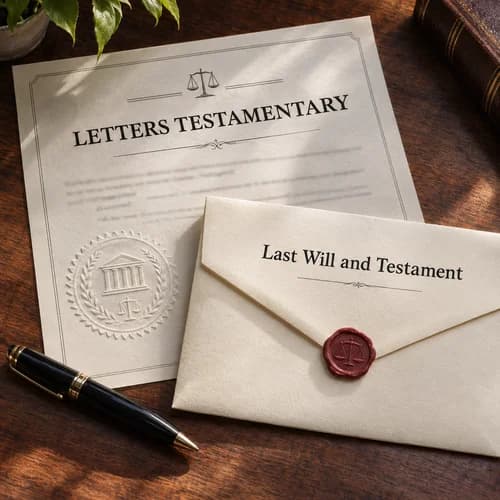
A letter of testamentary is the court document that gives the executor named in a will the legal authority to act on behalf of the estate. The correct legal term is “letters testamentary,” and a probate court issues them after it accepts the will as valid and formally appoints the executor. Banks, brokerages, and government offices often ask for certified letters before they let anyone act for the estate.
Letters testamentary are the executor’s proof of authority. A will names an executor, but the will alone does not give that person legal power. The probate court must first review the will, confirm it is valid, and appoint the executor. The letters are the court’s written confirmation of that appointment.
A letter of testamentary usually includes:
Many people search for a sample letter of testamentary. Some courts provide an official form for the executor or personal representative to complete or sign, but the court itself issues the official letters. California’s form, for example, is DE-150 (Letters). Before that, the executor files a petition asking the court to issue them.
With letters testamentary, the executor can handle the estate’s business as the law requires. Common tasks include:
Assets that pass outside the will, such as life insurance with a named beneficiary, retirement accounts with a beneficiary, and joint accounts with a right of survivorship, generally do not require letters testamentary.
When a bank asks for letters testamentary, it wants proof of who has legal authority over the deceased person’s account. What to do next depends on where you are in the process:
Which document the court issues depends on whether there is a valid will:
That is why you cannot get a letter of testamentary without a will. If there is no valid will, the family applies for letters of administration instead. If a will exists but the original is missing, the court may still accept a copy or other proof of the will, depending on state law.
The names also vary by state. Florida, for example, calls the executor a “personal representative” and issues letters of administration whether or not there is a will. Michigan uses “letters of authority,” and Illinois uses “letters of office.” They all serve the same purpose.
The process varies by state and county, but the main steps are similar everywhere. Check your local probate court’s requirements for supporting documents, notice to heirs, and any oath or bond. For a full walkthrough of the court filing, see our guide to filing a probate petition.
The process stalls if the original will cannot be found. Courts can sometimes accept a copy, but it usually means extra hearings, notice to every heir, and proof that the will was not revoked. Our articles on what to do when you can’t find the original will and on how to file a petition to admit a copy of a will explain that process.
Before going that route, check whether the will was registered. Unfortunately, there is no mandate that a will must be registered, attorneys highly recommend that every will is registered, to help families when they can’t figure out who has a will or where it is stored. A search of The U.S. Will Registry may show whether a will was registered and where the original and any duplicate are stored. Once a search is performed, every search includes valuable guidance on how to proceed whether or not a will is found. Many who prefer not to get guidance from an attorney find the guidelines extremely helpful.
There is no single national timeline. It depends on several factors:
Your county probate court’s website or clerk can tell you its typical processing time. Getting letters is only the start of probate. Our probate timeline explains what happens after the executor is appointed.
The main costs are:
Check your county probate court’s website for its current fee schedule.
In many states, an executor can file without a lawyer, and many probate courts have self-help centers and forms online. A few states, including Florida, generally require the personal representative to have an attorney, unless the personal representative is the only person interested in the estate. A lawyer is also worth considering when the estate is large, includes a business or property in another state, or when a family member may contest the will. Our guide for first-time executors covers what to expect either way.
A letter of testamentary, properly called letters testamentary, is a document issued by a probate court that gives the executor named in a will legal authority to settle the estate. It lets the executor access accounts, pay debts, sell property, and distribute assets. Banks and other institutions often ask for it before they let anyone act for the estate.
No. A probate court issues letters testamentary only when there is a valid will that names an executor. If there is no valid will, a family member can ask the court for letters of administration instead. Those give an administrator the same basic authority to settle the estate.
There is no single national timeline. It depends on the court’s schedule, local notice requirements, and whether the filing is complete. A missing original will or a contested will adds time, although some states issue temporary letters in the meantime. Your county probate court’s website or clerk can tell you its typical processing time.
The executor’s appointment generally lasts until the estate is closed, so the letters themselves do not simply expire. However, many banks and title companies only accept copies certified within a recent period, and each sets its own limit. If yours are too old, the probate court clerk can issue newly certified copies for a small fee.
Start with a search of The U.S. Will Registry, which may show whether the will was registered and where the original is stored. Every search includes guidance on how to proceed whether or not a will is found. If the original still cannot be located, the court may accept a copy through a separate process that usually takes longer.
If the executor named in the will has died, declines the job, or does not qualify, the will may name an alternate executor, who can then ask the court for letters testamentary. If no named executor can serve, many courts appoint someone else and issue letters of administration with the will annexed, giving that person authority to carry out the will.
It depends on the court. Some probate courts let executors order certified copies online or by mail, while others require a visit to the clerk’s office. Check your county probate court’s website or call the clerk, and ask the bank or institution requesting the copy how recently it must have been certified.
No. A power of attorney is signed by a living person and ends automatically at that person’s death. Letters testamentary begin after death and come from the probate court, not from the deceased person. An agent under a power of attorney has no authority over the estate unless the court also appoints them executor.
Often, yes. Many states let small estates use a simpler process, such as a small estate affidavit, instead of full probate. The dollar limit varies by state. Assets that pass directly to a named beneficiary or surviving joint owner, such as life insurance or a joint account with a right of survivorship, do not need letters testamentary at all.
This article is for general information and is not legal advice. Probate rules vary by state and county, so check with your local probate court or an attorney about your situation.
This article was reviewed for legal accuracy by Shawn Patrick Wolf, Esq. Mr. Wolf is Board Certified in Wills, Trusts and Estates and in Tax Law. He serves on the Board of Directors of the East Coast Estate Planning Council and the Palm Beach Tax Institute.
