
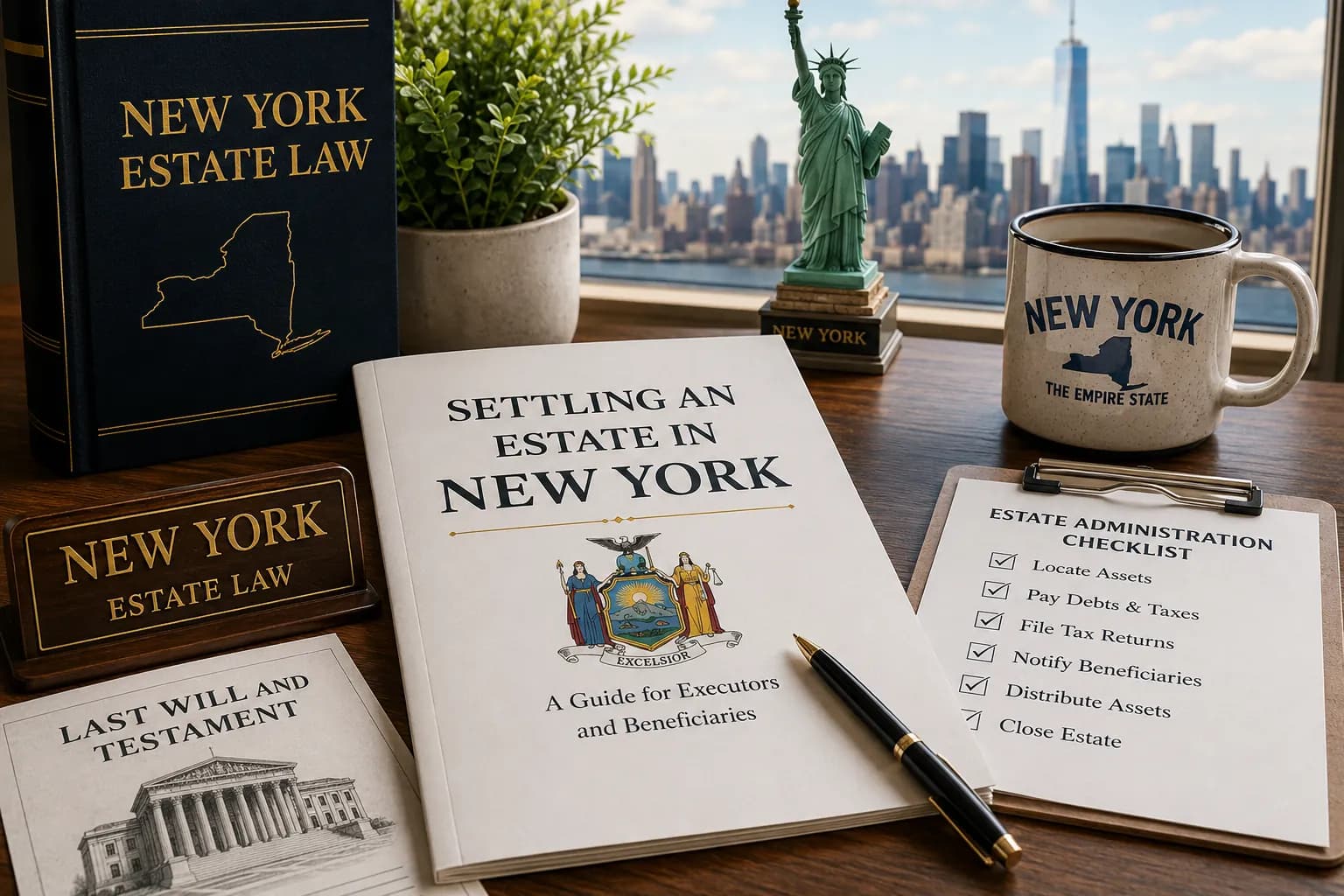
Settling an estate in NY involves following New York probate laws to collect assets, pay debts, file required court documents, and distribute property after someone dies. If the deceased left a valid will, the Surrogate’s Court typically appoints the Executor named in the will. If there is no will, the court appoints an Administrator, and New York intestacy laws determine who inherits. The process may involve probate, voluntary administration for small estates, or non-probate transfers for assets with beneficiary designations or joint ownership.
| Probate court | Surrogate’s Court |
| Executor appointed when | There is a will |
| Administrator appointed when | There is no will |
| Small estate threshold | $50,000 in personal property |
| New York inheritance tax | None |
| New York estate tax | Applies to larger estates |
| Transfer-on-Death (TOD) deeds | Permitted under New York law |
| Non-probate assets | POD accounts, beneficiary designations, trusts, and jointly owned property |
One of the first and most important steps in settling an estate in NY is determining whether the deceased left a valid will. Search personal files, safe deposit boxes, and contact the attorney who prepared the estate plan. You may also search the U.S. Will Registry to determine whether a will was registered and where it is stored.
Finding the will early helps determine whether the estate will proceed through probate with an Executor or through intestate administration with an Administrator. For more on locating a missing will, see our guide on How To Find A Will In New York.
FIND A MISSING WILLProtect Your InheritanceThe U.S. Will Registry | Established 1997START HERE
If a valid will exists, the person named as Executor files the will with the Surrogate’s Court in the county where the deceased lived. The court reviews the will and, if approved, issues Letters Testamentary. These letters give the Executor legal authority to:
Not every asset owned by the deceased becomes part of probate. Assets held jointly, owned through a trust, or carrying beneficiary designations may pass directly to the surviving owner or named beneficiary.
If there is no will, the deceased is considered to have died intestate.
The Surrogate’s Court appoints an Administrator and issues Letters of Administration. The Administrator performs duties similar to an Executor, but New York law determines who inherits. Generally:
Unmarried partners and stepchildren who were not legally adopted generally do not inherit under intestacy laws.
For additional details, review New York’s intestacy rules under EPTL § 4-1.1.
Not every estate requires full probate.
New York offers a simplified procedure called Voluntary Administration for estates consisting of $50,000 or less in personal property. Under this process, a Voluntary Administrator may:
Solely owned real estate is generally not included in the $50,000 threshold.
The Executor or Administrator must identify all estate assets and debts. Certain assets commonly pass outside probate, including:
Because these assets pass directly to beneficiaries, they are generally not distributed under the will or intestacy laws.
Probate and estate administration in New York are handled by the Surrogate’s Court. Generally, you file in the county where the deceased permanently resided. The court may:
The Executor or Administrator must pay valid debts before distributing assets to heirs or beneficiaries. Typical obligations include:
Beneficiaries are generally not personally liable for the deceased’s debts solely because they inherit property. However, estate assets may be used to satisfy valid creditor claims before distributions are made.
New York imposes a state estate tax on larger estates. For deaths occurring in 2025, New York generally exempts estates valued at $7.16 million or less from state estate tax. Estates that exceed 105% of the exclusion amount may become fully taxable under New York’s so-called “estate tax cliff.”
New York does not impose an inheritance tax. Beneficiaries generally do not pay tax simply because they inherit property.
Federal estate tax may apply to very large estates. For more on free estate planning resources, see our complete guide.
Beneficiaries may also owe income taxes on certain inherited assets, such as distributions from inherited retirement accounts or gains from selling inherited property.
How real estate transfers depends on how the property was owned.
Property held jointly with rights of survivorship generally transfers automatically to the surviving owner.
If the property was owned as tenants in common, the deceased’s share passes through probate and is distributed according to the will or intestacy laws.
Property owned solely by the deceased generally passes through probate before it can be transferred or sold.
New York adopted the Uniform Real Property Transfer on Death Act, allowing property owners to use Transfer-on-Death (TOD) deeds to transfer real estate directly to beneficiaries outside probate. A TOD deed allows the owner to name one or more beneficiaries while retaining complete ownership and control during life. The deed is revocable and does not limit the owner’s ability to sell, mortgage, or otherwise transfer the property.
The time required to settle an estate in NY depends on the size of the estate, whether probate is required, and whether disputes arise.
For a detailed breakdown, see our guide: How Long Does It Take to Settle an Estate?
Generally:
Delays commonly occur when assets are difficult to locate, tax issues arise, creditor claims are disputed, or family members challenge the will.
After debts, taxes, and administration expenses are paid, the Executor or Administrator distributes the remaining assets.
If there is a will, assets are distributed according to the deceased’s wishes. If there is no will, assets are distributed according to New York intestacy laws.
Once distributions are complete and court requirements have been satisfied, the estate can be formally closed.
Settling an estate in NY can involve probate, court filings, taxes, creditor claims, and real estate transfers. Whether you are settling an estate with a will or without a will, understanding New York probate laws is essential. One of the first and most important steps is determining whether a valid will exists — the U.S. Will Registry can help you search for a registered will quickly and confidentially.
From there, you can determine whether probate, voluntary administration, or a non-probate transfer process applies. If you are uncertain about your rights or responsibilities, consult a licensed New York estate attorney or review official resources from the New York Surrogate’s Court. With the proper guidance, families can navigate the estate settlement process with greater clarity and confidence.
Disclosure: This article is for informational purposes only ahttps://www.nycourts.gov/courts/surrogates/nd does not constitute legal advice. The figures referenced in this article, including estate tax exemption thresholds, small estate limits, and other financial amounts, are based on information available at the time of publication and are subject to change. These amounts are adjusted periodically by New York State and federal authorities. Readers are encouraged to verify current figures with the New York Department of Taxation and Finance, the New York Surrogate’s Court, or a licensed estate planning attorney before making any legal or financial decisions.
SEARCH FOR A WILLEstablished 1997The U.S. Will RegistrySTART YOUR SEARCH →
In New York, uncontested probate cases typically take 7 to 12 months, while small estates may be resolved in just a few months. Large or contested estates can take several years. Delays often arise from difficult-to-locate assets, disputed creditor claims, tax issues, or family members challenging the will in Surrogate’s Court.
New York allows a simplified Voluntary Administration process for estates with $50,000 or less in personal property. This avoids formal probate, reduces filing fees, and allows a Voluntary Administrator to collect bank accounts and personal property through streamlined court paperwork. Note that solely owned real estate is generally excluded from this $50,000 threshold.
New York does not impose an inheritance tax, so beneficiaries generally owe nothing simply for inheriting property. However, New York does levy a state estate tax on larger estates. For 2025, estates valued at $7.16 million or less are exempt. Estates exceeding 105% of that threshold may become fully taxable under New York’s “estate tax cliff.”
This article was prepared by estate planning researchers and reviewed by S. Miller and staff. With more than 25 years of experience in estate planning documentation and probate processes, our editorial oversight ensures clarity and accuracy. This content is provided for informational purposes only and does not constitute legal advice.
[View Our Editorial Policy]