
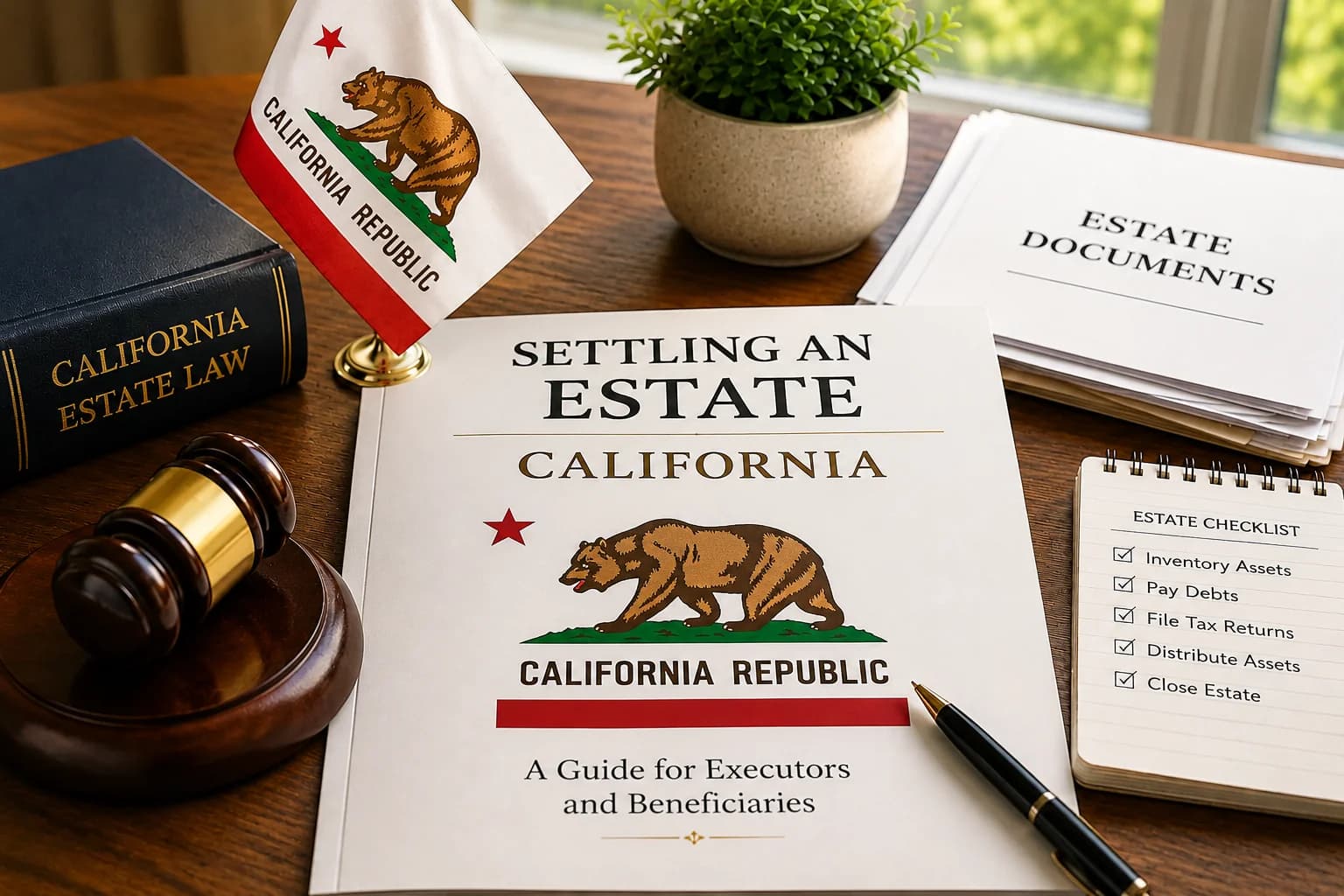
How to settle an estate in California generally involves locating the will, determining whether probate is required, identifying assets and debts, paying creditors and taxes, and distributing the remaining property to heirs or beneficiaries. The process differs depending on whether the deceased left a valid will and the size and type of assets in the estate. California also offers simplified procedures that allow some estates to avoid full probate.
For official information about probate and estate administration, see the California Courts Probate Guide and the California Probate Code.
The first step in settling any California estate is determining whether a valid will exists and confirming that it is the most recent version. A newer will can change who inherits property, who serves as executor, and how the estate is administered.
Search the deceased person’s:
Families may also search a will-location database such as The US Will Registry to determine whether a will was registered and where it may be stored. For a complete walkthrough of every place a will might be stored and how to conduct a thorough search, see our pillar guide, How to Find a Will: The Complete Missing Will Resource Guide.
If a valid will is found, the estate is generally administered according to its terms and California probate law. If no will exists, or if it cannot be located after a thorough search, the estate is considered intestate and California’s intestate succession laws determine who inherits. For a California-specific breakdown of where to look, see How To Find A Will In California: 7 Places To Search Before Probate.
FIND A MISSING WILLProtect Your InheritanceThe U.S. Will Registry | Established 1997START HERE →
Not every estate in California must go through formal probate.
California offers several alternatives to full probate, including:
If the estate is too large or does not meet the requirements for one of these alternatives, the family will usually need to open a formal probate case in court.
California probate cases are handled by the Superior Court in the county where the deceased lived. Probate judges appoint personal representatives, oversee estate administration, resolve disputes, and authorize final distributions. You can find your county’s probate division and local forms through the California Courts Find Your Court directory.
California also permits many estates to proceed under the Independent Administration of Estates Act (IAEA), which allows personal representatives to perform many routine actions without obtaining prior court approval.
If someone dies without a valid will, California law determines who inherits the estate. Because California is a community property state, inheritance rights differ substantially from those in many other states.
California is one of only a handful of community property states.
Community property generally includes assets acquired during marriage, while separate property includes assets owned before marriage or received individually through gifts or inheritances.
California also recognizes quasi-community property, which is property acquired in another state that would have been community property if the couple had acquired it in California.
Because determining whether property is community or separate can dramatically affect inheritance rights, this issue is often one of the most important aspects of settling a California estate. California probate law contains special rules governing how community and separate property pass at death.
California Probate Code sections 6400–6414 determine who inherits property when someone dies without a will.
For a broader look at how these default inheritance rules compare across states, see our guide on Understanding Intestate Succession – Settling an Estate Without a Will.
Many assets transfer outside probate and should be identified early in the estate administration process.
Common examples include:
Identifying these assets early can reduce costs, shorten administration, and simplify estate settlement. For more detail on how each of these tools works, see our related guide, Non Probate Assets in Simple Terms.
Once a personal representative is appointed, California law requires notice to creditors and payment of valid claims.
Creditors generally have a limited period to file claims against the estate. The personal representative reviews claims, pays debts according to statutory priorities, and may reject claims that are not legally owed. The relevant rules are set out in California Probate Code sections 9000–9399.
Taxes must also be addressed before assets are distributed. Although California does not impose a state inheritance tax or estate tax, federal estate tax rules may apply to larger estates. The IRS Estate Tax page has current federal exemption amounts and filing requirements.
The final stages of estate administration involve transferring real estate, distributing assets to beneficiaries or heirs, and closing the estate.
How property transfers depends on:
Once debts, taxes, and legal obligations have been satisfied, the remaining assets are distributed to beneficiaries named in the will or to heirs under California intestate succession laws. For a step-by-step look at this final stage, see our guide on Understanding Final Distribution of Estate Assets.
California offers several simplified procedures that avoid full probate administration.
As of April 1, 2025:
The official DE-300 small estate affidavit form and related Judicial Council forms are available through the California Courts forms portal. For a deeper comparison of these thresholds and how to calculate estate value, see our guide, What is a Small Estate Affidavit?.
California refers to the person managing an estate as:
Once appointed, the court issues Letters Testamentary or Letters of Administration, giving the representative legal authority to act on behalf of the estate. The California Courts guide to becoming a personal representative walks through the petition and appointment process step by step.
California permits certain estates to transfer assets through affidavits rather than full probate.
Banks, brokerages, and the DMV often have their own procedures, so successors should confirm requirements and obtain certified copies of the death certificate before proceeding. Certified death certificates can be ordered through the California Department of Public Health Vital Records office or the county recorder where the death occurred.
Real estate transfers depend on ownership structure and property value.
Joint tenancy property, living trusts, and Transfer-on-Death Deeds may avoid probate entirely. Solely owned real estate that does not qualify for a simplified procedure generally requires probate before title can be transferred. See our related guide, What Is a TOD Deed and How Does It Work?, for a closer look at how recorded deeds pass title outside of probate.
California provides several protections for surviving spouses and minor children, including:
These protections can affect who may occupy the family home during probate and how much property remains available to creditors and heirs.
California does not impose a state estate tax or inheritance tax. However, federal estate tax rules may apply to larger estates. See the IRS Estate Tax overview for current federal thresholds, or our guide to Step-Up in Basis: Saving Tax on Inherited Assets for how inherited property is taxed when it’s later sold.
California permits qualifying residential property owners to record a Revocable Transfer-on-Death (TOD) Deed under Probate Code §§5600–5696. If properly executed, the property transfers directly to the named beneficiary upon death without probate. The official Revocable Transfer on Death Deed form (DE-310 / Judicial Council form) and a notice form for beneficiaries are available through the California Courts forms portal. For more on how TOD deeds compare to trusts and joint tenancy, see our guide, Will vs Trust: Understanding the Difference.
California does not recognize common-law marriages created within the state. However, California generally recognizes common-law marriages that were validly established in another state that permits them.
This distinction can significantly affect inheritance rights when someone dies without a will. See our related guide, Elective Share | Spousal Inheritance Rights, for more on how spousal status affects what a surviving partner can claim.
Official Resources
Settling an estate in California begins with locating the most recent will and determining whether probate is necessary. From there, families must identify assets, pay debts and taxes, distribute property, and close the estate according to California law. The process can vary significantly depending on whether the deceased left a will, the size of the estate, and how assets are titled.
Because California offers several probate alternatives and follows unique community property rules, understanding your options early can save time, reduce costs, and prevent disputes. If you cannot locate a will, start your search immediately by checking the deceased person’s records, contacting their attorney, reviewing probate filings, or searching a will-location database such as The U.S. Will Registry. Taking these steps early can help your family settle the estate with greater confidence and certainty.
Disclaimer: This guide is for general informational purposes only. Probate laws, thresholds, and statutory references are subject to change, and individual circumstances may vary. Consider consulting a California probate attorney or the local Superior Court for advice specific to your situation.
The time required to settle an estate in California depends on the size of the estate, whether probate is necessary, and whether disputes arise. Simple estates that qualify for simplified procedures may close within a few months. Formal probate cases often take nine months to two years or longer, especially if litigation or tax issues occur.
No. Many California estates avoid formal probate altogether. Assets held in a living trust, jointly owned property with survivorship rights, Transfer-on-Death deeds, and certain small estates may transfer through simplified procedures. Whether probate is required depends on the estate’s value, how assets are titled, and the type of property involved.
If someone dies without a will, California’s intestate succession laws determine who inherits. In many cases, a surviving spouse or registered domestic partner receives community property. Separate property may pass to the spouse, children, parents, siblings, or other relatives according to the order established in the California Probate Code.
Yes. Several types of real estate can avoid probate in California. Property held in joint tenancy, community property with right of survivorship, a living trust, or a valid Transfer-on-Death (TOD) deed may pass directly to beneficiaries after death. Identifying these assets early can simplify estate administration and reduce costs.
This article was prepared by estate planning researchers and reviewed by S. Miller and staff. With more than 25 years of experience in estate planning documentation and probate processes, our editorial oversight ensures clarity and accuracy. This content is provided for informational purposes only and does not constitute legal advice.
[View Our Editorial Policy]