
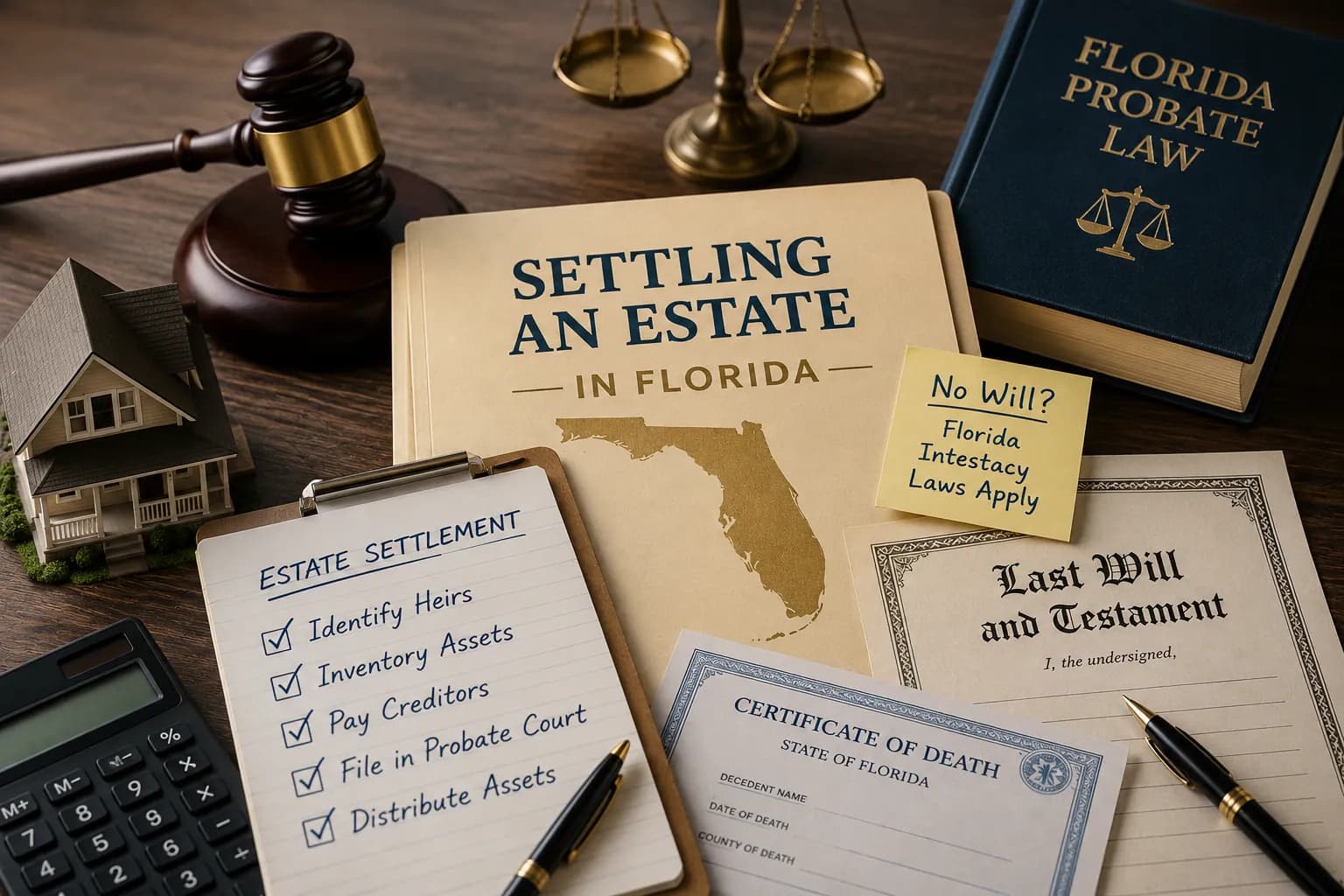
How to settle an estate without a will in Florida depends on Florida intestate succession laws and the probate process. When someone dies without a valid will, the probate court appoints a personal representative, identifies heirs, pays creditors, and distributes assets according to Florida law. However, families should first conduct a thorough search for a will because a valid will can significantly affect inheritance rights and estate administration.
Our guide, How to Find a Will: The Complete Missing Will Resource Guide, explains where families should search before concluding that no will exists.
If no valid will can be located after a comprehensive search, Florida law treats the estate as intestate. This means Florida statutes determine who inherits rather than the deceased.
Before opening an intestate probate estate, families should conduct a thorough search.
Look in:
Additionally, family members should contact attorneys, financial advisors, accountants, and trusted relatives.
If family members are unsure whether a will exists, our guide How To Find Out If Someone Has A Will explains how to investigate attorneys, court records, and other potential sources.
Families should also search The U.S. Will Registry. The registry was created to help surviving family members locate where a loved one’s will was stored or identify the attorney who prepared it so probate can proceed according to the deceased’s wishes.
FIND A MISSING WILLProtect Your InheritanceThe U.S. Will Registry | Established 1997START HERE →
Dying without a will in Florida is called dying intestate.
When this occurs, the probate court follows Florida intestate succession laws. The court does not attempt to determine what the deceased may have wanted. Instead, Florida statutes establish who inherits.
As a result, assets may pass to individuals the deceased never intended to benefit, while others receive less than expected.
This is one reason estate planning remains so important.
Once it becomes clear that no will exists, a family member generally files a petition with the probate court.
The court then appoints a personal representative to administer the estate.
The probate process typically involves:
Florida probate procedures can appear overwhelming to first-time administrators. The Florida court system provides an overview of probate administration and estate settlement procedures.
Throughout the process, the probate court oversees administration to ensure compliance with Florida law.
A valid will usually names an executor. However, when no will exists, the court appoints a personal representative.
Florida courts generally give preference to:
The personal representative has significant responsibilities.
These responsibilities often mirror those discussed in our article Executor of Estate.
The personal representative must:
Because these duties carry legal responsibilities, courts carefully evaluate who should serve.
Florida intestate succession laws determine who inherits property when someone dies without a valid will. The probate court follows Florida statutes rather than verbal promises, family expectations, or informal written instructions. For a broader explanation of inheritance laws and estate administration when no will exists, see our guide Understanding Intestate Succession – Settling an Estate Without a Will.
When the deceased leaves a surviving spouse and all descendants are children of both spouses, the surviving spouse generally inherits the entire probate estate.
This rule reflects Florida’s policy of protecting surviving spouses and simplifying inheritance when there are no children from prior relationships. In many cases, the spouse becomes the sole beneficiary of probate assets.
Different rules apply when either spouse has descendants from another relationship.
If the deceased has children from a prior relationship, Florida law generally divides the probate estate between the surviving spouse and the deceased’s descendants. These rules are designed to balance the interests of both the spouse and children from previous relationships.
Because family circumstances vary, blended-family estates often require careful legal review to ensure inheritance rights are properly protected.
If no surviving spouse exists, children generally inherit the estate in equal shares.
This includes biological children who survive the deceased. Florida law seeks to distribute assets fairly among surviving children unless another inheritance rule applies.
Under Florida law, legally adopted children generally have the same inheritance rights as biological children.
An adopted child may inherit from their adoptive parents through intestate succession just as a biological child would. Adoption typically creates the same legal parent-child relationship for inheritance purposes.
Stepchildren generally do not automatically inherit under Florida intestate succession laws unless they were legally adopted by the deceased.
Even if a close family relationship existed, stepchildren usually are not considered legal heirs unless a will specifically names them or a legal adoption occurred. This is one reason many blended families choose to create comprehensive estate plans.
Our guide Stepchild Inheritance Rights: Do Stepchildren Inherit? explains these inheritance rules in greater detail.
If a child of the deceased dies before the parent, that child’s descendants may inherit the share their parent would have received.
For example, if a deceased person’s son passed away before them but left children of his own, those grandchildren may inherit their parent’s portion of the estate.
If no spouse, children, or grandchildren survive, the deceased person’s parents may inherit the estate.
When both parents survive, they generally share the inheritance. If only one parent survives, that parent may inherit the entire probate estate.
If the deceased leaves no surviving spouse, descendants, or parents, siblings may become heirs.
Brothers and sisters may inherit equally under Florida intestate succession laws. If a sibling died before the deceased, that sibling’s descendants may also have inheritance rights depending on the circumstances.
Questions regarding inheritance often arise when multiple family members believe they have rights to an estate. Disputes over heirship, asset distribution, and estate administration are common, particularly when no will exists.
Our guide Inheritance Disputes: Causes, Examples and What to Do explains how these conflicts are typically resolved.
Heirs frequently ask how they establish their legal rights during probate. Our article How To Claim An Inheritance Without A Will
explains the process of proving heirship and claiming inherited property when no valid will can be located.
Not every asset becomes part of the probate estate.
Many assets transfer automatically.
Examples include:
Many families are surprised to learn that some assets avoid probate entirely. Our article How To Avoid Probate explains common probate avoidance strategies.
Disputes frequently arise when no will exists.
Family members may disagree regarding:
How to settle an estate without a will in Florida begins with determining whether a will truly does not exist. Families should thoroughly search personal records, contact attorneys, review court records, and search The U.S. Will Registry before proceeding under Florida intestate succession laws.
If no valid will can be found, Florida inheritance laws determine who inherits. The probate court appoints a personal representative, pays creditors, identifies heirs, and distributes assets according to Florida law.
Families seeking additional information regarding Florida probate law may also review estate resources published by the Florida Bar.
Settling an estate without a will in Florida typically takes six months to more than a year, depending on the estate’s complexity, creditor claims, court schedules, and potential family disputes. The probate court must appoint a personal representative, identify heirs, pay debts, and distribute assets according to Florida intestate succession laws before the estate can be closed.
When someone dies without a will in Florida, inheritance is determined by Florida intestate succession laws. A surviving spouse, children, parents, siblings, or other relatives may inherit depending on the family structure. The probate court follows Florida statutes rather than the deceased person’s verbal wishes or undocumented intentions.
Some assets may transfer without probate in Florida, including life insurance policies with named beneficiaries, retirement accounts, payable-on-death accounts, and jointly owned property with rights of survivorship. However, assets owned solely by the deceased generally must pass through probate before heirs can legally receive them.
If you cannot find a will in Florida, you should conduct a thorough search of personal records, safes, attorneys’ files, and estate planning documents before assuming no will exists. Families may also search The U.S. Will Registry. If no valid will can be located after a comprehensive search, the estate is generally administered through probate under Florida intestate succession laws.
This article was prepared by estate planning researchers and reviewed by S. Miller and staff. With more than 25 years of experience in estate planning documentation and probate processes, our editorial oversight ensures clarity and accuracy. This content is provided for informational purposes only and does not constitute legal advice.
[View Our Editorial Policy]