

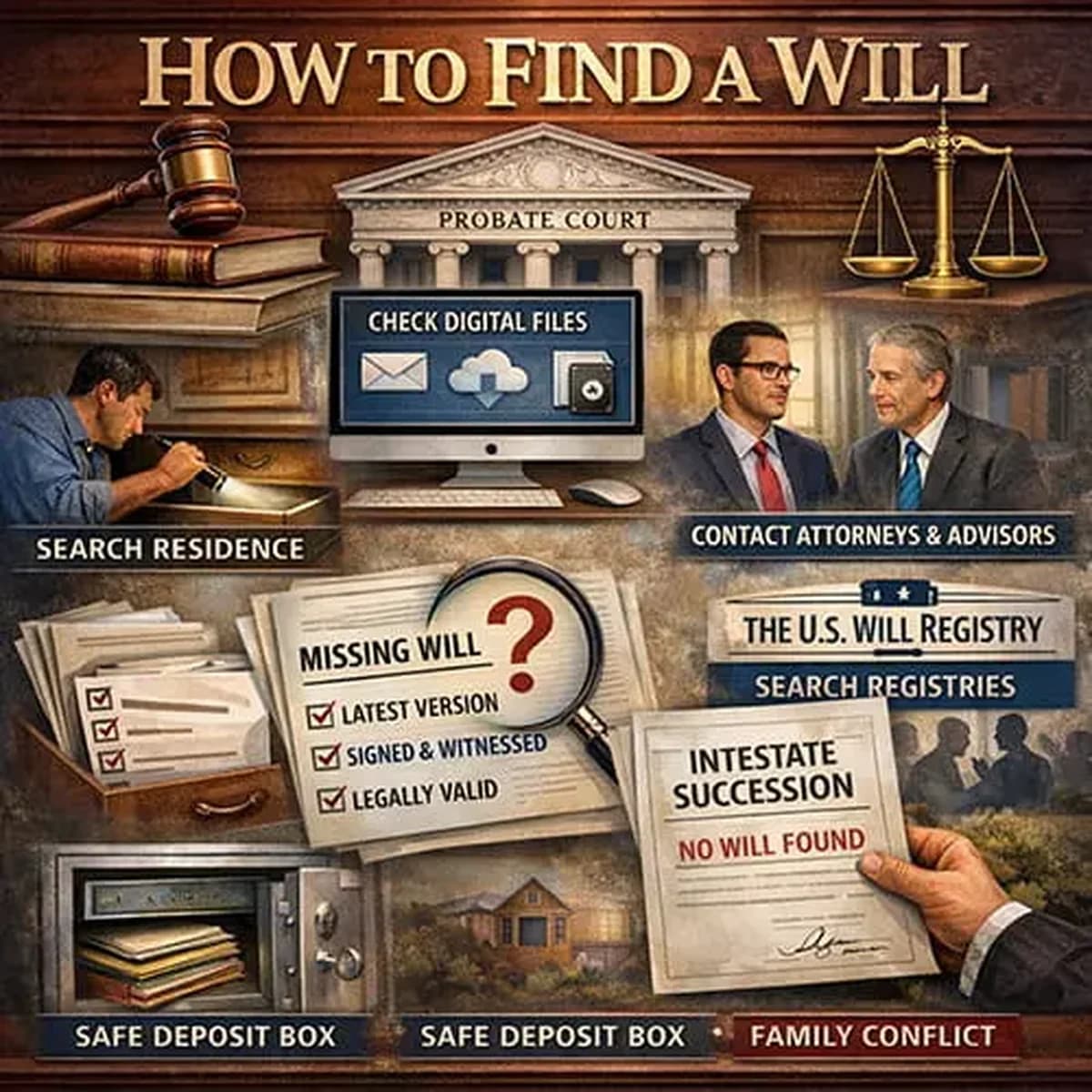
How to find a will starts with searching the deceased person’s home, personal records, digital files, safe deposit boxes, probate court records, and national will registries. Families should also contact attorneys, financial advisors, and others involved in the deceased person’s estate planning. A structured search often helps locate the most recent valid will and prevents unnecessary delays in settling the estate.
The U.S. Will Registry was created specifically to help families locate where a loved one’s will was stored or identify the attorney who drafted it so probate can proceed according to the deceased person’s wishes. Established in 1997, the registry helps families, executors, attorneys, and probate professionals search for missing wills and determine the next steps when a will cannot be located.
Finding a will is often the most important first step after a loved one dies. A valid will can determine who has authority to act, who inherits property, and how probate moves forward. When a will cannot be found, delays, disputes, and uncertainty may follow. In some situations, state inheritance laws may ultimately determine who receives estate assets.
This Complete Missing Will Resource Guide explains where to search, who to contact, how probate courts handle missing wills, and what steps to take if the original document cannot be located. It also explains how to verify that a discovered will is the most recent valid version and what happens when no will is ever found.
How to find a will is often the first important legal responsibility after a loved one dies. This step influences nearly every part of estate administration. It determines who has authority to act, how quickly probate can begin, and whether property will be distributed according to the deceased person’s wishes.
Many families mistakenly believe probate filings should occur immediately. In reality, locating the will should happen first whenever possible. Filing the wrong documents can cause delays, increase legal costs, and create tension among heirs. A properly executed will may name an executor, describe asset distribution, and provide guidance about sentimental belongings or guardianship arrangements.
For a complete explanation of how the legal process moves forward after a will is located, review our guide on understanding probate.
Grief and logistical responsibilities often make it difficult to know when to begin searching for estate documents. However, a structured timeline helps reduce complications later. In most situations, an initial search should begin within the first several days after death.
Early investigation allows families to determine whether probate filings may soon be necessary. Financial institutions sometimes restrict account access after receiving notice of death, and real estate transfers may pause until legal authority is confirmed. Conducting a careful search before filing probate petitions can prevent unnecessary amendments or repeated court filings.
Families who want a clearer understanding of possible estate delays can review our article explaining how long probate usually takes.
Responsibility for locating estate documents often falls on the person expected to serve as executor. If no executor has been identified, the closest next of kin usually begins the search. In certain situations, a probate attorney or court-appointed administrator may also take responsibility for investigating document locations.
Open communication among family members is important. When several individuals search independently without coordination, valuable information may be missed. A cooperative effort improves efficiency and helps maintain trust during an emotional time.
Before beginning a broad search, families should consider whether the deceased person likely prepared a will. Certain clues may provide direction. Organized legal files, prior discussions about estate planning, or relationships with attorneys and financial advisors may suggest that formal planning occurred.
Additional indicators may include trust documents, powers of attorney, beneficiary instructions, or written notes referencing inheritance wishes. Although these signs do not guarantee that a will exists, they often justify a structured and thorough search.
If you are unsure whether the document you located is legally effective, review our guide explainingwhat constitutes a valid will.
The deceased person’s residence is usually the most logical starting point. However, a rushed search can lead to incorrect conclusions. Families should review filing cabinets, desk drawers, safes, labeled envelopes, and storage containers that may contain legal paperwork.
Supporting documents such as attorney correspondence, insurance policies, or financial statements may provide clues about document storage. Maintaining written notes about each location examined helps prevent duplication and strengthens documentation if legal questions arise later.
Families who want a deeper checklist of common document storage locations can review our article on where to look first when searching for a missing will.
Modern estate planning often involves email communication and online document storage. Even when a scanned copy of a will does not fully satisfy probate requirements, digital files may identify the drafting attorney, execution date, or witness information.
Important sources include email inboxes, cloud storage accounts, password-protected document vaults, and computer folders. Searching key terms such as “will,” “estate,” or “executor” may reveal useful attachments or correspondence.
Many families begin their search online because it provides the fastest way to determine whether a will exists. Today, several digital tools can help identify the location of a will or confirm whether one was created.
You can begin your online search by using the following methods:
Online searching is often the fastest way to begin. However, it should be combined with physical and legal searches to ensure no document is overlooked.
Professional advisors often provide the most direct information about whether a will exists and where it may be located. Estate planning attorneys frequently retain copies of documents or maintain records showing where original wills were stored. Accountants and financial advisors may also know whether estate planning took place and which professionals were involved.
Families should review prior invoices, tax returns, contact lists, email records, and financial statements to identify advisors who worked with the deceased. If the drafting attorney has retired, relocated, or passed away, the state bar association may be able to help trace the custody of client files.
You should consider contacting a probate attorney when:
In some situations, a probate attorney can petition the court to compel production of a will, seek admission of a copy of a lost will, or resolve disputes concerning estate administration. Early legal guidance may prevent delays, reduce conflict, and help ensure the estate proceeds according to the law.
In some cases, the original will has already been filed with the probate court. Laws in many jurisdictions require the person holding the will to deliver it within a specific timeframe after death. Once filed, the document typically becomes part of the public record.
Reviewing court dockets or contacting the clerk’s office can prevent incorrect assumptions about intestacy. For additional guidance on verifying whether a will has already been filed, review our resource explaining how to find out if a will was filed in court.
Many individuals store original wills in bank safe deposit boxes. Access rules vary by jurisdiction and by financial institution. Some banks allow limited entry for the purpose of searching for estate documents, while others require court authorization.
Understanding bank procedures early helps prevent probate delays. If the signed original cannot be located, review our article addressing situations when the original will cannot be found.
When the signed original will cannot be located, probate courts may require additional proof before allowing estate administration to proceed. Judges often evaluate whether the document was intentionally revoked, lost accidentally, or destroyed without the testator’s consent.
Evidence such as witness testimony, attorney records, or copies of prior estate documents may help establish the existence and validity of the missing will. Courts may also consider the testator’s known intentions and prior statements regarding inheritance plans.
Delays in locating a will can create practical risks beyond probate timing. Real estate may remain unsecured, financial accounts may become vulnerable to unauthorized activity, and insurance or tax deadlines may approach without proper legal authority in place.
Taking prompt and organized search action helps preserve estate value and ensures that fiduciary responsibilities are fulfilled. Courts often look favorably on beneficiaries who demonstrate diligence in protecting estate property while the will search is underway.
Finding a document is only the first stage. Families must confirm that the discovered instrument represents the most recent legally valid version. This process may involve reviewing execution dates, witness signatures, and any later amendments or codicils.
If multiple versions are found, the newest valid document generally governs estate distribution. Families facing this situation may benefit from reviewing our discussion about what happens when a duplicate copy of a will is found.
Disagreements among family members about whether a will exists can significantly extend the probate timeline. Allegations that documents were hidden, destroyed, or improperly withheld may require judicial review or evidentiary hearings.
Understanding how disputes affect probate progression helps families appreciate the importance of a careful and cooperative search effort.
Occasionally, families encounter circumstances suggesting that estate documents may be intentionally or unintentionally difficult to locate. Restricted access to personal files, inconsistent statements about planning, or sudden probate filings without a thorough search may require additional investigation.
Families experiencing disputes or confusion during estate administration may find helpful guidance in our article discussing stolen inheritance.
Failure to locate the correct document can create serious consequences. Probate proceedings may be delayed while courts determine whether a valid will exists. Legal disputes among heirs may increase administrative expenses and prolong emotional strain.
Assets may ultimately be distributed according to statutory intestacy rules rather than the deceased person’s wishes. Those seeking to understand this process can review our detailed explanation of intestate succession laws.
Some will searches involve more than locating a missing document. Legal assistance may be appropriate when family members disagree about whether a will exists, someone refuses to produce a will, or evidence suggests that estate documents were altered, hidden, or destroyed.
Professional guidance may also be beneficial when the estate is particularly complex, such as when it includes multiple properties, business interests, trusts, significant assets, or beneficiaries in different states.
In some situations, concerns about undue influence may arise, particularly when a vulnerable person made unexpected changes to their estate plan shortly before death. Families who suspect manipulation or pressure may wish to review our article on Undue Influence.
Complex estate matters and will disputes often require guidance from a probate attorney to protect inheritance rights and ensure the estate is administered properly.
Families evaluating whether legal assistance is appropriate may review our guide discussing when to hire a probate attorney.
If a reasonable search fails to uncover a valid will, the estate typically passes under intestate succession statutes. This statutory distribution may differ significantly from the deceased person’s intentions.
Families preparing to administer such estates may benefit from reviewing our comprehensive guide on settling an estate without a will.
Families may use this checklist to maintain structure during the search process:
Locating a will is often the most important first legal action in protecting inheritance rights and allowing probate to begin correctly. A careful and documented investigation helps preserve estate assets, supports timely court proceedings, and reduces the risk of disputes during an already difficult time.
By combining structured searching, professional guidance, registry verification, and legal awareness, families greatly improve their chances of finding the correct document and ensuring the deceased person’s true intentions are respected.
Taking the time to conduct a thorough will search today can protect your family from uncertainty, prevent costly delays, and help bring clarity and peace of mind when it matters most.
Finding out if someone had a will usually begins with a structured search of their home, personal records, and document storage locations. Families should also review digital files, contact attorneys or financial advisors, check probate court filings, and search national will registries. Acting quickly helps protect inheritance rights and prevents unnecessary probate delays.
Families should begin searching for a will within the first several days after death and continue until all reasonable efforts are completed. Courts generally expect documented search attempts before accepting that no valid will exists. Filing probate too early can cause legal complications, increased costs, and delays in estate administration.
If a valid will cannot be located after a documented and comprehensive search, the estate may be administered under state intestacy laws. This means statutory inheritance rules determine asset distribution instead of the deceased person’s wishes. Probate courts may also require additional investigation before allowing estate settlement to proceed.
Responsibility for searching for a missing will typically falls on the person expected to serve as executor or the closest next of kin. In some situations, a probate attorney or court-appointed administrator may conduct the search. Coordinated family efforts and organized documentation help ensure the investigation is thorough and legally credible.
This article was prepared by estate planning researchers and reviewed by S. Miller and staff. With more than 25 years of experience in estate planning documentation and probate processes, our editorial oversight ensures clarity and accuracy. This content is provided for informational purposes only and does not constitute legal advice.
[View Our Editorial Policy]